A charcuterie board is the easiest entrance to hosting that exists. No cooking. No timing. No “is the chicken done.” You buy the components, arrange them, and put the board down. Done.
The reason most people overthink it isn’t the assembly. It’s the math: how much, of what, for how many people. Every recipe blog has a photo of a beautiful board. Almost none of them tell you how to scale it for your eight friends, what order to put things down so the cheese doesn’t sweat, or what to skip because it makes the board look full but nobody eats it.
This is the system. It’s how Maren has built boards for parties of three to twenty-five over the last decade. The numbers are real. The order matters. And the 3-3-3 rule is the only structural framework you actually need.
TL;DR
- The 3-3-3 rule: three cheeses (one hard, one soft, one in-between), three meats (one cured, one spreadable, one wild card), three accompaniments (olives or pickles, something sweet like jam or honey, something crunchy like nuts).
- Per person: 2 oz cheese + 2 oz meat if there’s dinner after. Double both if the board is the meal.
- Build order: boards or cheese first, then meats, then dips and bowls, then everything that fills space (fruit, nuts, crackers).
- Take cheese out of the fridge 45 minutes before serving. Cold cheese tastes like nothing.
- Skip: pre-shredded cheese, more than two types of bread, sliced soft cheeses left out for an hour, anything you wouldn’t eat on its own.
What charcuterie actually means (and the 3-3-3 rule explained)
Charcuterie, in French, means cured and prepared meats. Pâtés, rillettes, saucisson, jambon. The word comes from chair cuite, “cooked flesh,” and a charcutier is a person who runs a charcuterie shop. Strictly speaking, a charcuterie board should be a meat board.
In American hosting, the term has stretched to mean any board with meats and cheeses. Both are common. We’ll use the looser definition because that’s what people are searching for and that’s what people actually serve at parties. If you want to be a stickler about it, a board with cheese and meat is technically a cheese and charcuterie board, but nobody outside of food magazines uses that distinction.
The 3-3-3 rule is the easiest assembly framework that exists, and the answer to the most-searched question about charcuterie boards.
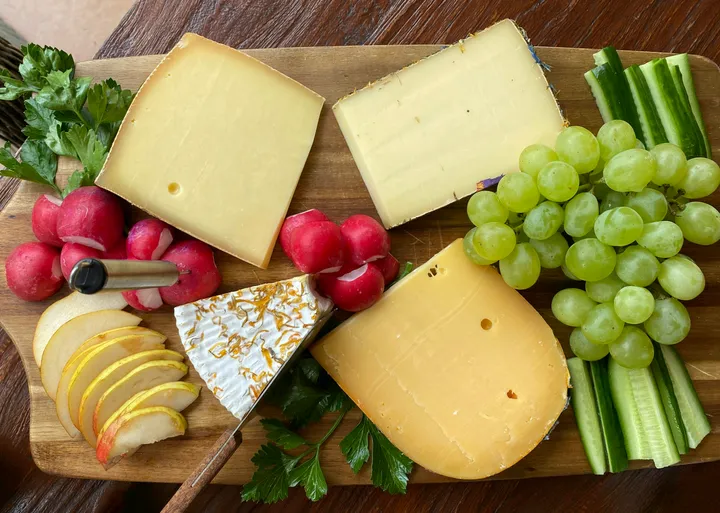
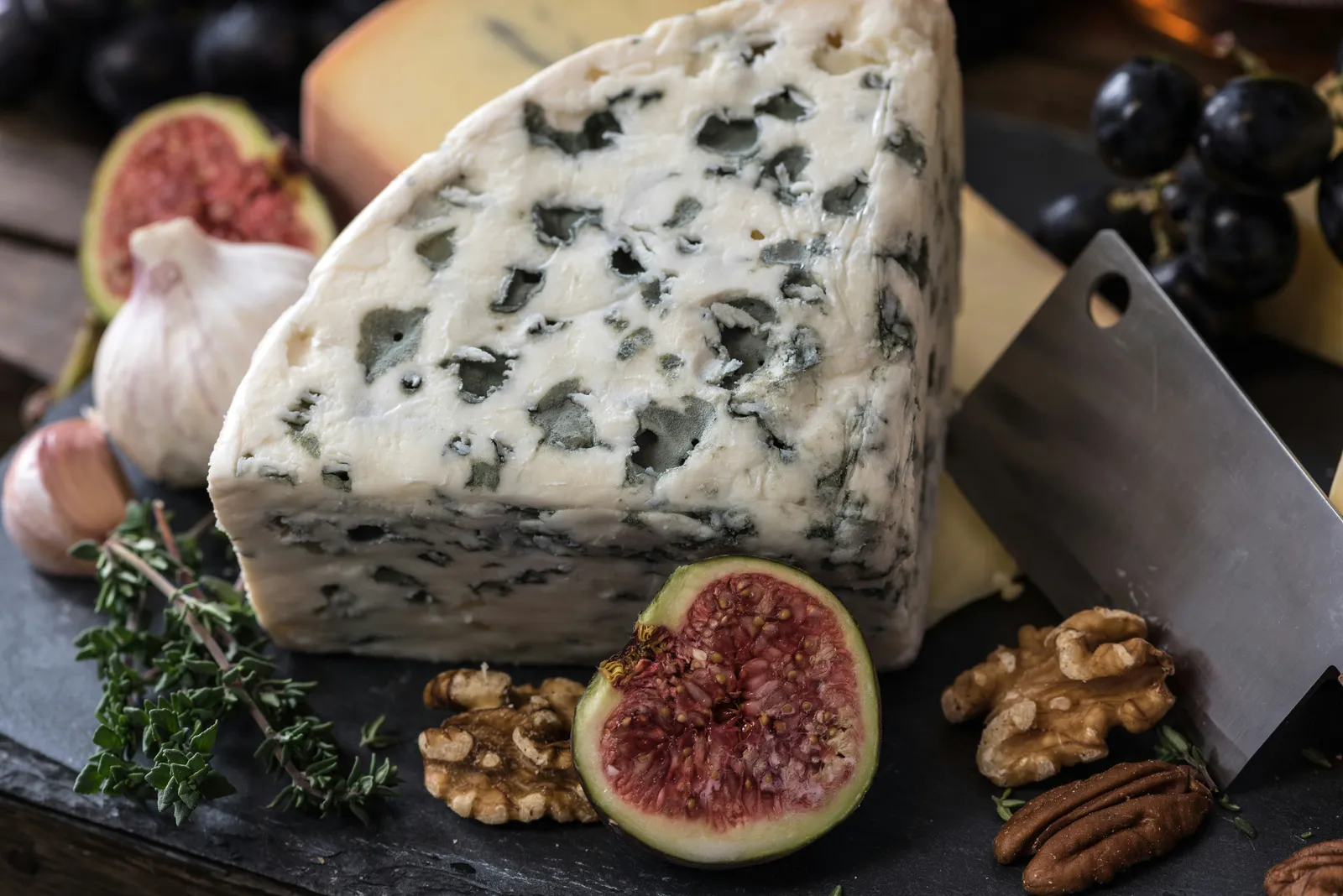
- 3 cheeses: one hard (aged cheddar, Manchego, Parmigiano-Reggiano), one soft (Brie, Camembert, goat cheese), one in-between (a blue cheese, an aged Gouda, a Comté). The point of three is variation, not quantity. If you put out three cheddars, you’ve made a cheese plate, not a charcuterie board.
- 3 meats: one cured slicing meat (prosciutto, soppressata, salami), one harder dry-cured (chorizo, finocchiona, capicola), and one wild card. The wild card can be a spreadable like rillettes, a ‘nduja, a bresaola, or a non-pork option like turkey or duck. Texture variation matters more than meat variation.
- 3 accompaniments: something briny (olives, cornichons, pickled vegetables), something sweet (fig jam, honey, fresh grapes or apples), something crunchy (Marcona almonds, candied pecans, salty nuts).
This is the starting framework. For a board for two to four people, 3-3-3 is exactly enough. For six to eight, scale to 4-4-4. For ten or more, you’re better off building two smaller boards in different parts of the room rather than one massive one, because the people on the wrong side of a single big board never reach the good stuff.
How much per person (the math nobody publishes)
Recipe blogs almost never give you a per-person number, because food blogs are not in the business of helping you stop shopping. Here are the actual numbers, calibrated against what gets eaten.
When the board is an appetizer (dinner is coming after)
- 2 oz cheese per person
- 2 oz cured meat per person
- 2 oz combined accompaniments per person (olives, fruit, jam, etc.)
- 6-8 crackers per person, plus a few slices of bread
For 6 guests: 12 oz cheese (split across 3 cheeses, so ~4 oz each), 12 oz meat (split across 3 meats), about 12 oz of accompaniments, 50 crackers, half a baguette.
When the board is the meal (drinks party, no dinner)
Double everything, plus add nuts and a dip or two for substance.
- 4 oz cheese per person
- 4 oz meat per person
- 4 oz accompaniments + 2 oz nuts per person
- A real bread option (sliced baguette + crackers, not just crackers)
The mistake most hosts make is buying enough cheese for a meal and not enough meat for an appetizer. Cured meat fills people up slower than cheese does, so guests reach for it more often. Cheese is the visual anchor. Meat is the calories.
Do not over-shop
If you’re buying for eight and the recipe says “a wedge of Brie,” that’s about 8 oz, which is enough for a dinner-after appetizer. You do not need three wedges of Brie. You will eat the leftover cheese in your fridge for a week.
Unless you’re feeding a crowd of fifteen, the entire shopping list for a 3-3-3 board for six people fits in a single grocery bag.
The shopping list, broken down by category
This is what you’re actually buying. Quantities scaled for 6 people, dinner-after appetizer.
Cheeses (12 oz total, split three ways)
- Hard: 4-5 oz aged cheddar, Manchego, Parmigiano-Reggiano, or Comté. Pre-cut wedges from a real cheese counter beat anything wrapped in plastic at the standard supermarket dairy section.
- Soft: 4-5 oz Brie, Camembert, fresh goat cheese, or Boursin. Brie is the safe default.
- Middle: 4-5 oz blue cheese (Gorgonzola, Roquefort, Stilton, pick one mild if guests are blue-averse), aged Gouda, or a more interesting option like Délice de Bourgogne.
Whatever you do, do not buy pre-shredded cheese for a board. It’s coated in cellulose to prevent caking and the texture is wrong.
Meats (12 oz total, split three ways)
- Sliced cured: 4 oz prosciutto, soppressata, or Genoa salami. Prosciutto folds nicely into roses or ribbons, which is the easiest way to make a board look intentional.
- Hard dry-cured: 4 oz finocchiona (fennel salami), chorizo, capicola, or a regional favorite. Slice these about 1/8 inch thick, too thin and they fall apart, too thick and they’re hard to chew.
- Wild card: 4 oz of something different. A pork rillette in a small bowl, ‘nduja for spreading, bresaola, lonza, or for a non-pork option, smoked duck breast or turkey.
If your store doesn’t have an Italian or specialty deli counter, prosciutto + Genoa salami + a third option from the pre-packaged Italian section is fine. The packaging matters less than the variation in texture.
Accompaniments (12 oz combined)
- Briny: Castelvetrano olives (the bright green ones, mild and buttery), cornichons, pickled red onions, or marinated artichokes. About 1/3 cup.
- Sweet: fig jam, hot honey, or fresh fruit. Grapes and pear slices are the most reliable. Avoid berries on a board with cheese; the moisture spreads.
- Crunchy: Marcona almonds (the Spanish ones in oil with rosemary, worth the small price increase), candied pecans, or a mix of salted nuts. About 1/2 cup.
Vehicle (bread + crackers)
- Half a sliced baguette (sliced thinly, on the diagonal)
- One sleeve of plain water crackers or a single nice cracker (Carr’s, La Panzanella croccantini, Effie’s oatcakes if you can find them)
- Optional: a few breadsticks or grissini for vertical interest
Do not buy three different boxes of crackers. Two crackers maximum. Three or more is visual noise; nobody eats the third one.
Build order: what goes on first, last, and never
This is the part nobody publishes. Building a board in the wrong order is why most home boards look messy after thirty minutes of guests eating from them.
1. Bowls and structural pieces first
If you’re using small bowls or ramekins for olives, jam, dips, or wet items, place those on the board first. Decide their position before you start filling the surface. Bowls anchor the board and define the negative space; trying to add them later means rearranging everything.
For a standard rectangular board, place bowls in a triangle (one in each corner, leaving the fourth open) or in a zig-zag. Don’t line them up.
2. Cheeses second
Place cheeses next. Each cheese gets its own zone. Leave 4-6 inches between them so people can cut without their knife touching another cheese. Hard cheese can be pre-cut into rough triangles or cubes. Soft cheese stays whole or in a wedge with one corner sliced off as an invitation.
Each cheese should have its own knife, otherwise people will use the same knife across all of them and the flavors muddle. A standard set of three cheese knives (a soft-cheese spreader, a hard-cheese plane, and a fork-tipped one) is enough.
3. Meats third
Meat fills the gaps around the cheeses. Folded prosciutto, ribboned salami, stacked rounds. The trick: don’t pile meat in one spot. Spread it across the board so guests can reach a different meat from any approach angle.
Salami stacked in fans (overlapping rounds in a curve) takes up real estate and looks intentional with almost no effort.
4. Accompaniments fourth
The bowls are already placed; now fill them. Olives go in their bowl. Jam goes in its bowl with a small spoon resting in it. Nuts can go directly on the board or in a small dish, both work.
If you have fresh fruit, place it now. Halved grapes in small bunches, not a single big pile. Pear slices fanned out near the cheese they pair with.
5. Bread, crackers, fillers last
Crackers and bread fill the remaining negative space. Don’t pre-arrange the entire space and then realize you have nowhere to put crackers; build outward and let the bread fill the gaps.
A small pile of crackers on one corner, sliced bread fanned along an edge, breadsticks bridging two areas. The bread is structural, it holds the visual together, but it’s also the easiest thing to refill mid-party.
Never put on a board
- Hot food. It steams and warms anything next to it, ruining cheese texture.
- Sliced soft cheese. It dries out in 20 minutes. Keep soft cheese whole or barely cut.
- More than two breads. Visual clutter, and people eat the same one twice anyway.
- Anything you wouldn’t eat on its own. Decorative herbs that look pretty in photos but nobody touches are filler.
- Berries, especially raspberries and blueberries. They release moisture, stain the board, and roll.
Timing: when to assemble (and when to take it out of the fridge)
Cold cheese tastes like nothing. The single biggest improvement most home hosts can make to a charcuterie board is taking the cheese out of the fridge 45 minutes before guests arrive. Room-temperature soft cheese is creamier; room-temperature hard cheese has more flavor.
The full timing:
- 2 hours before guests: shop, if you haven’t yet. Slice baguette, set out crackers, prep bowls.
- 1 hour before: take cheese out of the fridge to come to room temperature. Slice harder cheeses now if you’re pre-slicing.
- 30-45 minutes before: assemble the board. Cheese, meat, accompaniments, fillers. Place it on the table you’re serving from.
- 15 minutes before: add fruit (so it doesn’t dry out), pour the olive bowl, set out cocktail napkins or small plates.
- As guests arrive: the board is ready. Don’t fuss with it.
Once guests are eating, the board needs zero maintenance for the first hour. After that, refill bread or crackers if they’re running low, and rotate any meat that’s gone untouched into a more visible spot.
5 things to skip
The PAA snippet question. Here are the real answers.
- Pre-shredded or pre-grated cheese. It’s coated in cellulose or potato starch to prevent caking, which kills the texture. Buy a wedge and cut it yourself. Even pre-cut cubes from the cheese counter beat the bagged stuff.
- Three or more types of bread. Two maximum: a sliced baguette and one cracker. Anything more crowds the board and confuses guests about what to pair with what.
- Sliced soft cheese. Slicing a wheel of Brie ahead of time means it’s dried out by the time anyone reaches it. Leave it whole, or cut a single wedge as an invitation. Same rule for goat cheese logs and triple-creams.
- Filler herbs and decorative greens. Rosemary sprigs and bay leaves photograph well but nobody eats them. They take up space that could hold something edible. If you want green on the board, use parsley, fresh basil, or microgreens that are actually edible with the cheese.
- Anything you wouldn’t eat on its own. That weird mustard from the back of your pantry. The pickled okra you bought once. The artisan cracker that’s flavored with rosemary AND fennel AND lemon zest. If you wouldn’t grab it as a snack on its own, it’s filler. Filler ends up on the board and stays on the board.
Budget tiers: weeknight, dinner party, holiday spread
What to buy depending on the occasion and the budget. All scaled for six people, appetizer portion.
Tier 1: Weeknight casual (~$40-55)
Goal: a board that’s better than a bag of chips, doesn’t require a special trip.
- Cheeses: A wedge of cheddar (
$8), Brie wheel ($8), pre-cut Manchego (~$10) - Meats: A pre-packaged Italian three-pack (prosciutto, salami, capicola, ~$10-15) or a single 8 oz package of prosciutto plus a small log of salami
- Accompaniments: Castelvetrano olives ($5), grapes ($3), Marcona almonds ($6) or regular roasted almonds ($3)
- Bread: Half a baguette ($2) and a sleeve of water crackers ($4)
This is grocery-store sourced, no specialty stops. Your guests will not know the difference.
Tier 2: Dinner party (~$70-90)
Goal: a board worth talking about, but not a project.
- Cheeses: A real cheese counter visit. 4 oz aged cheddar or Comté (
$12), 4 oz Brie or a triple-crème like Saint-André ($10), 4 oz blue (Gorgonzola dolce or Roquefort, ~$12) - Meats: Counter-sliced prosciutto di Parma (
$10), Genoa or finocchiona salami ($8), a small jar of pork rillettes or ‘nduja (~$10) - Accompaniments: Castelvetrano olives, fig jam ($8), Marcona almonds ($7), fresh figs or pears in season ($5)
- Bread: A real baguette from a bakery ($4), one nice cracker (Effie’s, La Panzanella) ($6)
Total prep is still under 30 minutes, but the board reads as intentional.
Tier 3: Holiday or special-occasion spread (~$120-160)
Goal: the centerpiece of a party where the board is the main event.
- Cheeses: 6 oz of aged or unusual hard cheese (Comté 24-month, Mimolette, Parmigiano-Reggiano with balsamic), 6 oz of a wheel-format soft (Brillat-Savarin, Délice de Bourgogne, Saint-André), 6 oz of a memorable blue (Stilton, Roquefort, Cabrales), and a fourth wild-card cheese like a fresh burrata or a smoked Gouda
- Meats: Imported prosciutto di San Daniele, finocchiona, bresaola, plus a meat-focused wild card like duck rillettes or ‘nduja
- Accompaniments: Three dips/spreads (fig jam, hot honey, whole-grain mustard), two olive types, fresh fruit, candied pecans, a small dish of cornichons
- Bread: Two breads (a baguette plus a fruit-and-nut crisp, or a baguette plus grissini), one cracker
At this tier, you’re spending more on ingredients than on the dinner itself, which is fine if the board is the centerpiece. Don’t combine this tier with a multi-course dinner. People will be too full.
Pairing it with what you’re serving after
A charcuterie board sets the tone for the rest of the meal. The board should match what’s coming.
- Italian dinner: Lean into Italian cured meats (prosciutto di Parma, finocchiona, capicola) and Italian cheeses (Pecorino, Parmigiano, Taleggio). Skip the French triple-crème.
- Heavier American dinner: A more familiar board (cheddar, Brie, salami, prosciutto). Don’t show up with a Spanish-themed board before serving meatloaf.
- Holiday or feast: The board is part of the showpiece. Go heavier on the wild-card cheeses and meats. Lean into the season (fresh figs in fall, citrus in winter, stone fruit in summer).
- Cocktail-only party with no dinner: Double everything, add a few hot or warm small bites later in the evening (warm olives, cheese-stuffed dates, a pot of whipped feta). Our finger foods for a party guide covers the bites that scale to a crowd. For the French version of this same pre-dinner pattern (apéro), see our French appetizer ideas. For a bigger crowd, scale the board into a full grazing table built across the table.
What the board does is buy you forty-five minutes of social time before dinner is on the table. Use it.
Seasonal and dietary variations
The same build adapts to the occasion and the crowd. We have worked out four full versions:
- Halloween charcuterie board: the spooky look built from real food instead of plastic props, with edible decorations and a make-ahead plan for a long party.
- Thanksgiving charcuterie board: built around its real job, holding hungry early guests while the turkey finishes, without duplicating the dinner.
- Christmas charcuterie board: festive color from real food (not dye), make-ahead for a busy December, and an honest take on the tree and wreath shapes.
- Vegetarian charcuterie board: how to replace the savory anchor that cured meat usually plays, plus the cheese rule nobody mentions (many cheeses are not actually vegetarian).
And for the end of the meal, a dessert charcuterie board applies the same build-by-role method to sweets, while a breakfast charcuterie board brings it to brunch. The all-vegetable version, a veggie platter or crudite, uses the same build-a-board logic for the fresh, cheap end of the spread.
If the board is part of a full table, our guide to the best everyday dinnerware sets covers what to serve the rest of the meal on.
FAQ
What is the 3-3-3 rule for a charcuterie board?
Three cheeses (one hard, one soft, one in-between), three meats (one cured slicing, one dry-cured, one wild card), three accompaniments (briny, sweet, crunchy). For a board for two to four people, 3-3-3 is exactly enough. For larger groups, scale to 4-4-4 or 5-5-5 in the same categories rather than buying duplicates.
How much charcuterie do I need per person?
For an appetizer board with dinner coming after: 2 oz of cheese, 2 oz of meat, and 2 oz of accompaniments per person. For a board that’s the meal: double those numbers and add nuts plus a real bread option. Most hosts under-order meat, cheese fills people up faster, so guests reach for meat more often.
What does charcuterie mean literally?
In French, charcuterie literally means “cooked flesh,” from chair cuite. Historically it referred specifically to cured and prepared pork: pâté, rillettes, saucisson, jambon. The American usage has expanded it to mean a meat-and-cheese board, which is technically a cheese and charcuterie board in the strict sense, but the looser term has won.
What is replacing charcuterie boards?
Nothing’s actually replacing them. The “butter board” had a brief moment in 2022 but didn’t last. What’s evolving is the format: themed snack boards (Mediterranean, breakfast, picnic, dessert) are growing because they remove the meat-and-cheese rule and let hosts build around what they actually want to serve. The classic charcuterie board still anchors most pre-dinner hosting.
Can I make a charcuterie board the night before?
You can prep components the night before, but assemble within 45 minutes of serving. Pre-cut hard cheese can be wrapped and refrigerated; meats can be pre-sliced; bowls of olives, jam, and nuts can be set out. Soft cheese should not be cut until day-of, and assembled boards lose visual structure within an hour or two if held in the fridge. The 30-45 minute pre-service window is the sweet spot.
What’s the easiest mistake to fix?
Taking the cheese out of the fridge in time. Forty-five minutes at room temperature is the difference between a board that tastes flat and one that tastes alive. This single change improves more home charcuterie boards than any other adjustment.