The Thanksgiving table is the highest-stakes hosting moment of the year. It’s the meal where the people you didn’t choose (in-laws, distant family) sit at a table you set, eating food you cooked, judging the experience for the next eleven months.
Most Thanksgiving table decor articles dump 62 different settings and let you sort. That doesn’t help. You don’t need 62 ideas. You need one path that fits your house, your guests, and your patience level.
This is the 3-path framework: simple, elegant, or modern. Pick one. Apply the 3-5-7 rule. Skip the plastic. The table you build will look intentional, take less time than you think, and feature items you’ll actually use again.
TL;DR
- Pick one path: simple (warm whites, fresh greenery), elegant (real silver or brass, restrained palette), or modern (matte tones, geometric, monochrome). Don’t mix paths.
- The 3-5-7 rule: arrange decor in odd-numbered groupings of 3, 5, or 7. Three candles, five small pumpkins, seven sprigs of greenery. Even numbers feel staged.
- Real produce beats fake decor. Mini pumpkins ($1 each), persimmons, pomegranates, and fresh greenery look better than $20 craft-store fakes and don’t need storage.
- Reuse-after-Thanksgiving rule: every component should work past November 27. Brass candleholders work at Christmas. Linen runners work year-round. Plastic turkey figurines do not.
- Plate setting: see how to set a table for the actual fork placement; this guide is about everything else on the table.
First, decide which path: simple, elegant, or modern
The single biggest mistake hosts make is trying to combine paths. A linen runner with brass candleholders next to plastic gourds with Pilgrim hats reads as cluttered, not layered. Pick one and commit.
Simple
The friend’s-house Thanksgiving. Warm, intentional, low-effort. Reads as “we cared, but we didn’t perform.”
- White or cream tablecloth or natural-linen runner
- Fresh greenery (eucalyptus, magnolia leaves, or just olive branches from the garden)
- Three pillar candles or five tea lights down the center
- Real mini pumpkins (3 or 5, not arranged in a line)
- Real fruit: a small bowl of persimmons or pomegranates
- White plates, simple flatware, cloth napkins (linen, ideally)
When this is right: dinner for 4-10 friends or close family. Casual mood. You’d rather spend 90 minutes cooking than 90 minutes arranging.
Elegant
The hosting-the-in-laws Thanksgiving. The table that earns the “this looks beautiful” comment without trying for it.
- Real linen tablecloth (white or oatmeal)
- Real silverware or weighted brass-plated flatware
- Three taper candles in matching candleholders (brass, glass, or polished pewter)
- One restrained centerpiece: a low arrangement of greenery and a few seasonal blooms in cream, white, or dusty rose (no oranges, no harvest-orange)
- Real silver or brass napkin rings (one knot or one loop, not the whole craft store)
- White or off-white china plates, no patterns
- Crystal or stemmed wine glasses (see coupe glasses or champagne flutes)
- Place cards (folded card stock with first names, not laminated, not seasonal-themed)
When this is right: Thanksgiving for 8-14 with at least one set of guests you don’t see weekly. The table itself is part of the impression.
Modern
The “we don’t do gourds” Thanksgiving. Restrained, contemporary, often monochrome. Looks like a restaurant table designed by a 30-year-old.
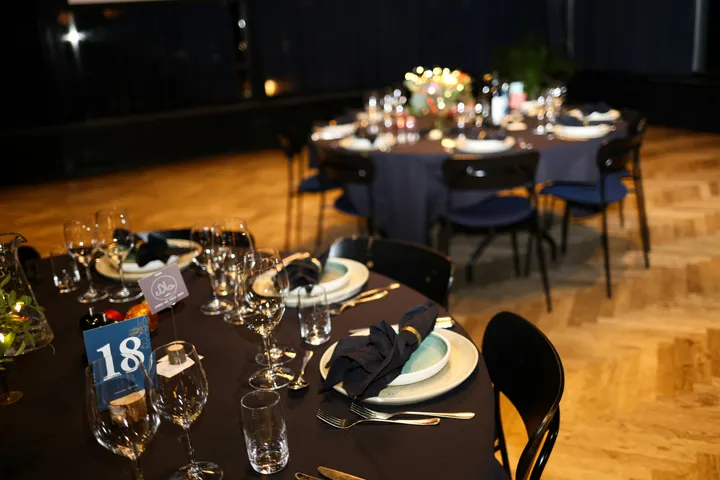
- Black, charcoal, or stone-colored tablecloth or no cloth (the bare wood table is the backdrop)
- Matte black or stoneware plates (see dinnerware sets)
- Geometric or sculptural candleholders (Stelton, Audo, Tom Dixon, clean lines, no curlicues)
- One single-form centerpiece: an oversized branch in a vase, a sculptural arrangement of dried wheat, a low ikebana-style stem grouping
- Linen napkins in stone, charcoal, or saturated dark color (forest green, oxblood, navy)
- Black or matte-finished flatware
- Smoked-glass or matte-finished glassware
- No traditional fall icons. No pumpkins. No leaves printed on anything. No turkey figurines.
When this is right: you and your guests are urban or design-conscious. Your other dinner parties don’t have themes. Thanksgiving doesn’t need to look like Thanksgiving for it to feel like Thanksgiving.
The 3-5-7 rule (and how to actually use it)
The 3-5-7 rule is the most-asked Thanksgiving decor question on Google. The answer is short, but it’s worth understanding.
The rule: arrange decorative items in odd-numbered groupings of 3, 5, or 7. Avoid even numbers (2, 4, 6) for decor groupings.
Why it works: odd groupings feel natural because the brain doesn’t immediately pair them. Two candles read as a couple. Three candles read as a composition. Four pumpkins look like an arrangement; five pumpkins look like they were dropped where they sit.
Where to apply it:
- Candles down the center: 3 pillar candles, or 5 taper candles, or 7 tea lights. Not 2, 4, or 6.
- Small decor objects: 3 small pumpkins clustered, 5 persimmons in a bowl, 7 stems in a low arrangement.
- Place card details: if you’re using a small object on each place setting (a sprig of rosemary, a tiny pumpkin, a persimmon as an edible name card), use it on every setting (matching the guest count) but apply the 3-5-7 rule to any extra centerpiece groupings.
Where NOT to apply it:
- Plate placement: plates always match the guest count. If you have 8 guests, you set 8 plates, not 7 or 9.
- Glasses, flatware, napkins: also match the guest count.
- Long arrangements (centerpiece runners): these are continuous, not grouped. The rule applies inside the arrangement (3 or 5 dominant elements), not to the arrangement as a unit.
The 3-5-7 rule is a styling shortcut, not a religion. It works because most people don’t know to apply it. Once your table follows it, your table will read as more intentional than 80% of home Thanksgiving tables.
Path 1: Simple (the “we’re hosting 6 close friends” version)
The most-attempted, easiest-to-nail path. The trick is committing to it instead of adding “just one more thing.”
The components:
- Tablecloth or runner: natural linen in cream, oatmeal, or white. Avoid orange, brown, or “harvest plaid.”
- Greenery: one type, not three. Eucalyptus is the most reliable (cheap at Trader Joe’s, lasts 7-10 days). Olive branches work if you can find them. Magnolia leaves are heavier and more dramatic. Skip “fall leaves”, they look like a craft project. Two long sprays of greenery laid down the center create a runner effect; if you have a vase, one tall arrangement at one end of the table works for tables under 8 people.
- Candles: three pillar candles (cream, white, or warm beige, never orange) on small plates or in glass holders. Light them 30 minutes before guests arrive so the room smells like beeswax when they walk in.
- Real pumpkins: five mini pumpkins ($5-8 total at any grocery store). Cluster three near one end, two near the other end. Don’t line them up. White or pale-orange varieties beat the deep-orange Halloween pumpkins for a Thanksgiving table.
- Real fruit: a small wooden bowl with persimmons or pomegranates. Doubles as decor and dessert.
- Plates: white or cream china, no pattern. Cloth napkins folded loosely (not in fan shapes, not stuffed in glasses).
Total spend: $30-50 if you don’t own any of this. Most of it sits in storage and reappears next year.
What it signals to guests: you cared, you didn’t try too hard, the meal is the centerpiece (which it should be).
Path 2: Elegant (the “in-laws are coming” version)
The path that earns silent respect from guests who know the difference. Slightly more effort, meaningfully better outcome for high-stakes Thanksgiving dinners.
The components:
- Tablecloth: real linen, ironed, in white, oatmeal, or pale cream. A real linen tablecloth costs $80-150 from West Elm or Crate & Barrel and lasts 20+ years. This is the single highest-leverage upgrade you can make to a Thanksgiving table.
- Charger plates: see whether you actually need charger plates first. At the elegant tier, chargers are required, not optional. Brass, polished pewter, or carved wood. Set the dinner plate on the charger.
- Centerpiece: one low arrangement (under 6 inches tall, guests need to see across the table). Cream and white blooms (peonies if you can find them, garden roses, ranunculus, hellebores), with eucalyptus or olive branches for green. No bright orange, no rust, no “fall florist” colors. The arrangement should look like it could be on a March table or a May table; it’s just seasonal flowers, not “fall décor.”
- Candles: three matching taper candles in matching candleholders. Brass is the safest choice, it works at Thanksgiving, Christmas, and any year-round dinner. Light them 30-45 minutes before serving.
- Napkins: linen, in cream, white, or a saturated muted color (forest green, dusty rose, deep oxblood). Folded simply (a rectangle on the plate, or a loose roll tied with a sprig of rosemary). Skip napkin rings unless they’re real silver or polished brass; cheap napkin rings read as costume.
- Glassware: real wine glasses (one for white, one for red if serving both, see our glassware guide for what to actually buy). Crystal or weighted lead-free crystal. No “Thanksgiving-themed” stemware.
- Place cards: small folded card stock with first names handwritten. Skip preprinted “Welcome to our Thanksgiving table” cards. Plain ivory cards, navy or black ink, name only.
- Salt and pepper: small individual cellars, or one shared shaker each, but not a pre-bagged “fall harvest spice rub.”
What it signals: the host respects the occasion enough to invest in real materials and the restraint to use them quietly.
Total spend: $200-400 first-time setup; almost zero in subsequent years (you reuse everything).
Path 3: Modern (the “we don’t do gourds” version)
The path for hosts whose other dinner parties already feel intentional. Modern doesn’t mean cold; it means restrained.
The components:
- Surface: the bare wood or stone table is the backdrop, no tablecloth. If you need a runner, a single long piece of muted linen or a charcoal-grey wool runner.
- Plates: matte stoneware (Heath Ceramics, Notary Ceramics, or any well-made small studio brand) or matte black porcelain. White is fine if it’s the right tone (chalk white, not blue-white or cream).
- Centerpiece (option A, sculptural): one oversized branch in a tall ceramic or smoked-glass vase. Cherry blossom branches in spring colors, or a bare branch in a dramatic shape. The centerpiece is one object, not an arrangement.
- Centerpiece (option B, minimal grouping): 3 small low ceramic vases, each with a single stem (a single rose, a single dried protea, a single sculptural branch). Spaced down the table with intention.
- Candles: taper candles in saturated dark colors (oxblood, forest green, charcoal) in matching modern holders. Stelton, Skagerak, or Audo make the cleanest options. Three or five down the center, never more.
- Napkins: stone-colored, charcoal, or oxblood linen. Folded in a clean rectangle on the plate. No napkin rings.
- Flatware: matte black, brushed brass, or polished steel. Avoid ornate Victorian-style silverware; it fights the modern table.
- Glassware: smoked or matte-finished glasses, or simple lead-free crystal in clean shapes. Stemmed but minimal.
What modern explicitly rejects:
- Pumpkins (real or fake)
- Maple leaves (printed, real, or otherwise)
- Anything with “harvest” in the name
- Plaid anything
- Orange in any form
- Rustic wood signs
What it signals: the host has design literacy and isn’t going to perform the holiday by checking off a list of expected props.
Total spend: $300-600 first time; less if you already own modern dinnerware. Highest reuse value of any path because every component works at any dinner all year.
Components that earn their keep year after year
The best Thanksgiving decor isn’t Thanksgiving-specific. The pieces below work for Thanksgiving and at least three other meals during the year.
- Brass or pewter taper candle holders. Work at Thanksgiving, Christmas, NYE, anniversary dinners, any winter dinner party. Buy three matching ones; they’ll outlast you.
- A real linen runner. Cream, oatmeal, or charcoal. Works year-round, every season.
- A real linen tablecloth. Same logic as the runner but for full coverage. Buy white or oatmeal once; iron before each use; lasts decades.
- Cloth napkins (linen, 12+ count). The single biggest “this feels like a real dinner” upgrade. Linen in cream, oatmeal, or one saturated color (deep green, navy, or oxblood). Wash and iron between uses.
- A neutral large bowl or platter. Wood, ceramic, or matte-finish. Holds the seasonal fruit at Thanksgiving, the bread at Christmas, the salad in spring.
- Three to five plain-glass or smoked-glass vases of varying heights. Use them for grocery-store flowers any week of the year; cluster them for Thanksgiving and holiday dinners.
- Pillar candles in white, cream, or warm beige. Reusable across any season; just don’t burn them all the way down for Thanksgiving so you can use them again at Christmas.
Things that don’t earn their keep: anything with the words “harvest,” “Thanksgiving,” “fall,” or “autumn” printed on it. Anything in plastic. Anything you’d be embarrassed to have on your table on December 15.
What to skip
The Thanksgiving table industry has accumulated a lot of decor that should not exist. Specifically:
- Plastic gourds and faux pumpkins. They look plastic in any photograph with natural light. Real mini pumpkins cost $1-2 each. The math is not close.
- Turkey figurines. Even ironic ones. Even ceramic ones. Even “vintage” ones. The turkey is the meal, not the centerpiece.
- Pilgrim or Native American figurines. Beyond cheesy, also a fraught representation of a complicated history. Skip entirely.
- “Give thanks” wood signs. The single most overdone Thanksgiving decor item of the last decade. The signal-to-noise ratio is terrible.
- Plaid anything. Plaid napkins, plaid runners, plaid table skirts. Plaid is for hunting cabins, not Thanksgiving tables.
- Mason jars used as anything except mason jars. Mason jars as candle holders. Mason jars as flower vases. Mason jars as drinking glasses at a formal table. Skip.
- Burlap. As runners, as napkin material, as anything. Burlap was the 2014 wedding-decor trend and it’s never coming back.
- Bright orange pumpkins as centerpieces. Halloween pumpkins are wrong for Thanksgiving. Use white pumpkins, pale-orange varieties (like Cinderella or Long Island Cheese), or skip pumpkins entirely.
- Anything with the year printed on it. “Thanksgiving 2026” anything is unusable in 2027.
- Place cards with seasonal puns. “Gobble til you wobble” name cards. Skip.
A short FAQ
What is the 3-5-7 rule for decorating?
Arrange decorative items in odd-numbered groupings of 3, 5, or 7. Three candles down the center beats two or four. Five clustered pumpkins beats four or six. Apply it to centerpieces and small decor groupings; ignore it for plates and flatware (which match guest count).
How do I decorate my table for Thanksgiving?
Pick one of three paths (simple, elegant, modern), commit to it, apply the 3-5-7 rule for any decorative groupings, and skip anything plastic or seasonally themed in a literal way. The table sets itself once you’ve picked the path.
Should I use real or fake pumpkins?
Real, almost always. Real mini pumpkins are $1-2 each and look unmistakably real. Fake pumpkins from craft stores cost $8-20 each and read as plastic in photos. Exception: solid-color ceramic pumpkins (white or matte natural) work at the elegant tier and last decades.
What color tablecloth for Thanksgiving?
White, cream, oatmeal, or a deep saturated solid (forest green, deep oxblood, charcoal) for modern tables. Avoid orange, brown, or harvest-plaid, they age the table 30 years and date the photos to 1987.
How tall should the centerpiece be?
Under 6 inches tall, always. Guests need to see across the table to the people opposite them. A tall centerpiece breaks the social geometry of the dinner and isolates one side from the other. The exception: a single tall sculptural branch in a narrow vase (modern path) is acceptable because it’s a vertical line, not a visual wall.
Do I need place cards?
For 8 or more guests, yes. Even casual ones (folded card stock, first names) prevent the awkward “where do I sit?” moment as guests arrive. For 6 or fewer, optional.
How early should I set the table?
Tier 1 (simple): morning of Thanksgiving. Tier 2 (elegant): the night before, or first thing morning of. Tier 3 (modern): the night before. Setting the night before saves you from a stressful morning when the bird is in the oven and 12 guests are arriving in two hours.
What about Christmas? Do I redo all of this?
The components labeled “earn their keep” above (brass candleholders, linen runner, linen napkins, pillar candles, vases) all work at Christmas with minor swaps: replace the persimmons with pomegranates, swap eucalyptus for fresh pine boughs, add red or gold accents only if they fit your path. See our christmas dinner ideas and christmas cocktail recipes for the broader Christmas hosting plan.
For the actual fork-and-knife placement that goes underneath all this decor, see how to set a table and silverware setting. For the dinnerware itself, see dinnerware sets, and if you are setting for twelve on a budget, the 30-piece option in our Corelle dinnerware sets guide is the cheapest way to get there.