If you’re hosting and you’ve stalled out at “wait, which side does the fork go on?”, this is for you. The right silverware setting depends on the kind of dinner, and we’re going to make it less complicated than the etiquette books make it sound.
TL;DR: the 30-second answer
- Forks go to the left of the plate.
- Knives and spoons go to the right, with the knife blade facing in toward the plate.
- Water glass sits above and slightly to the right of the knife.
- Napkin goes to the left of the forks, or folded on top of the plate.
- For multi-course meals, line up utensils in the order you’ll use them, outside in. First course = outermost fork.
- That’s the whole system. Everything else is variation.
First, decide which kind of dinner this is
Most “how to set silverware” guides walk you through the formal dinner first, scare you, and then mention casual settings as an afterthought. We’re going to do the opposite. Pick the setting that matches the actual occasion:
- Casual, weeknight dinners, family dinners, friends-coming-over-for-pasta. Three pieces, one glass, done in 90 seconds per seat.
- Dinner party, Friday-night-with-friends, a small Sunday lunch, a thoughtful birthday dinner. Adds a salad fork, a bread plate, and usually a wine glass.
- Formal, Thanksgiving with extended family, the in-laws’ first visit, an anniversary dinner. Multiple forks and knives, courses come in defined order.
Pick one and use the relevant section below. You don’t need to know all three on the same night.
The casual setting (most weeknight dinners)
This is the setting that covers 90% of the meals you’ll ever serve. Three pieces, one glass.
What goes where
- Dinner plate in the center.
- Fork to the left of the plate, tines up.
- Knife to the right of the plate, blade facing in toward the plate.
- Spoon to the right of the knife, only if the meal needs one (soup, dessert at the table, something saucy).
- Napkin to the left of the fork, folded simply. (Or under the fork, or on top of the plate, all three are fine.)
- Water glass above and slightly right of the knife.
That’s it. If the meal is a one-bowl pasta or a stew, you can drop the knife. If it’s finger food, you’re already done, skip to the napkin.
When this is the right call
- Weeknight family dinners
- Casual friends coming over for pizza, tacos, soup, pasta
- A cookout or barbecue plated indoors
- Brunch
- Any meal where someone is wearing sweatpants
A note on the “all utensils on the napkin” variant
Many casual setups put the fork, knife, and spoon directly on top of the napkin (which sits to the left of the plate). This is fine. It’s actually faster to set, easier to clear, and looks intentional. Use this in tight spaces or when you’re setting a coffee-table dinner.
The dinner-party setting (Friday-night-with-friends)
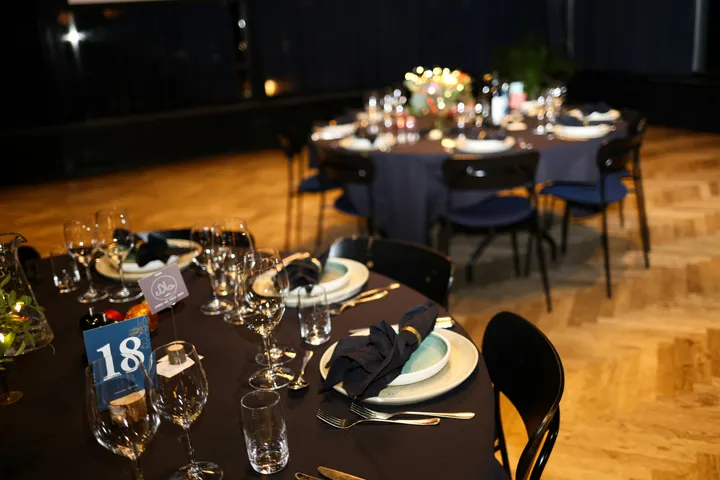
This is the one to learn well, it’s the setting you’ll use the most as you start hosting. It signals “I made an effort” without crossing into “I rented a butler.”
What goes where
- Dinner plate in the center.
- Salad fork on the far left (you use it first, so it goes outermost).
- Dinner fork between the salad fork and the plate.
- Knife to the right of the plate, blade facing in.
- Spoon to the right of the knife (skip if you’re not serving soup or anything spoonable).
- Bread plate above the forks, slightly left, with a small butter knife laid horizontally across it (handle to the right).
- Napkin folded on top of the dinner plate, or to the left of the forks.
- Water glass above and right of the knife.
- Wine glass to the right of the water glass, slightly forward.
The one rule that actually matters: “outside in”
If you only remember one principle from this entire guide, remember this: utensils are placed in the order you’ll use them, working from the outside in.
That means: first course (salad) gets the outermost fork. Main course (the dinner) gets the inner fork. Same logic on the right side, if you have a soup spoon and a dinner knife, the soup spoon goes outermost because soup comes first.
This is why “formal” settings look intimidating: they’re not random. Each utensil maps to a course. If you serve three courses, you set three forks. If you serve one course, you set one fork. The “rule” is just: match the silverware to the actual menu.
When this is the right call
- A planned dinner party with 4-8 guests
- Sunday lunch when grandparents are visiting
- A birthday dinner you’re hosting at home
- Any meal where you’ve made a salad as a separate course
- The first time you have your partner’s parents over
The formal setting (holidays, the in-laws’ first visit)
You’ll use this maybe 2-4 times a year. The trick: it looks complicated but it’s just the dinner-party setting plus one or two additional pieces, depending on how many courses you’re serving. (For the deepest reference on the most-formal end of the spectrum, the Emily Post Institute’s table setting guide is the etiquette standard, though it doesn’t tell you what to skip.)
What goes where
For a 4-course meal (soup, salad, main, dessert), working outside in:
- On the left of the plate, outside in: salad fork, dinner fork.
- On the right of the plate, outside in: soup spoon, dinner knife.
- Above the plate, horizontal: dessert fork (tines pointing right) above dessert spoon (bowl pointing left). Or, and this is what we’d actually do, bring dessert silverware out with dessert and skip placing it above.
- Bread plate: above the forks, slightly left, butter knife across it.
- Charger plate under the dinner plate (optional, a larger decorative plate that stays on the table during the meal). Skip if you don’t already own them.
- Water glass above and right of the knife.
- Wine glasses: red wine glass to the right of the water glass; white wine glass forward and to the right of that.
- Napkin folded on top of the dinner plate or charger.
How many courses change the setup
The headline rule: set as many utensils as the courses require. No more.
- 3 courses (salad, main, dessert): salad fork + dinner fork on left; dinner knife on right; dessert silverware brought with dessert.
- 4 courses (soup, salad, main, dessert): add a soup spoon outside the dinner knife.
- 5 courses (appetizer, soup, salad, main, dessert): add an appetizer fork outside the salad fork and an appetizer knife outside the soup spoon.
You don’t need to memorize this. Just count your courses and set one fork per course on the left, one knife or spoon per course on the right, in the order you’ll serve them.
When this is the right call
- Thanksgiving, Christmas, Easter dinner, Passover
- A milestone birthday or anniversary
- The dinner where you’re meeting someone’s family for the first time
- A formal seated dinner of 8 or more
For casual: drop everything except one fork (left), one knife (right), one spoon (right of knife), and the water glass.
For formal: add a soup spoon outside the knife, a charger plate under the dinner plate, and a wine glass.
What to skip
This is the part most guides skip. We don’t.
- Charger plates for casual dinners. Skip them entirely unless you already own a set you love. They’re decorative and add cleanup.
- Fish forks, oyster forks, and dessert silverware “above the plate.” Skip unless you’re specifically serving fish, oysters, or want the formal effect. Nobody’s offended by silverware brought with the course.
- Individual butter knives on bread plates if you don’t have them. Set out a single butter knife on the butter dish; guests pass it.
- Place cards for groups under 8. Let people sit where they want, it’s friendlier and saves you the seating-chart anxiety.
- A separate wine glass for whites and reds at casual or even most dinner-party meals. One universal wine glass per person is enough. If you’re pouring two wines back-to-back, swap glasses or rinse, guests don’t notice.
- Folded “art” napkin shapes. A simple square or rectangle fold beats a swan every time. Save the swans for someone else’s life.
- The dessert fork and spoon placed above the plate. It’s classical formal etiquette, but for any non-state-dinner occasion, just bring dessert silverware out with dessert.
- Salad forks if there’s no actual salad course. Set one fork.
The goal isn’t to display every utensil you own. It’s to make it easy for guests to eat what you’re serving.
Choosing the actual silverware
If you’re starting from scratch (or replacing the bent fork situation that’s been your everyday set since college), there are three real tiers worth considering. Buy a 5-piece setting per person (dinner fork, salad fork, dinner knife, soup spoon, teaspoon), service for 8 minimum if you ever plan to host.
Starter ($30-80 for service for 8)
A clean modern stainless flatware set from Amazon, Target, or IKEA’s “Förnuft” line. Look for 18/10 stainless steel (the second number, 10% nickel, is what gives flatware its weight and corrosion resistance). Skip anything cheaper than 18/10, it gets pitted in the dishwasher.
Mid-tier ($150-250 for service for 8)
This is the sweet spot for most people. Crate & Barrel “Caesna Mirror” or West Elm “Luna” are both clean, weighty, dishwasher-safe sets that read as “intentional” without being precious. Both retailers run 20% off events constantly, don’t pay full price.
Splurge ($500+ for service for 8)
Williams Sonoma’s “Hampton” line, Match Pewter (handmade in Italy, generational), or vintage Christofle from a marketplace. These are the sets you’ll pass to your kids. Worth it only if you’ll actually use them, a heritage set that lives in a drawer is a waste.
A note that the splurge isn’t always right
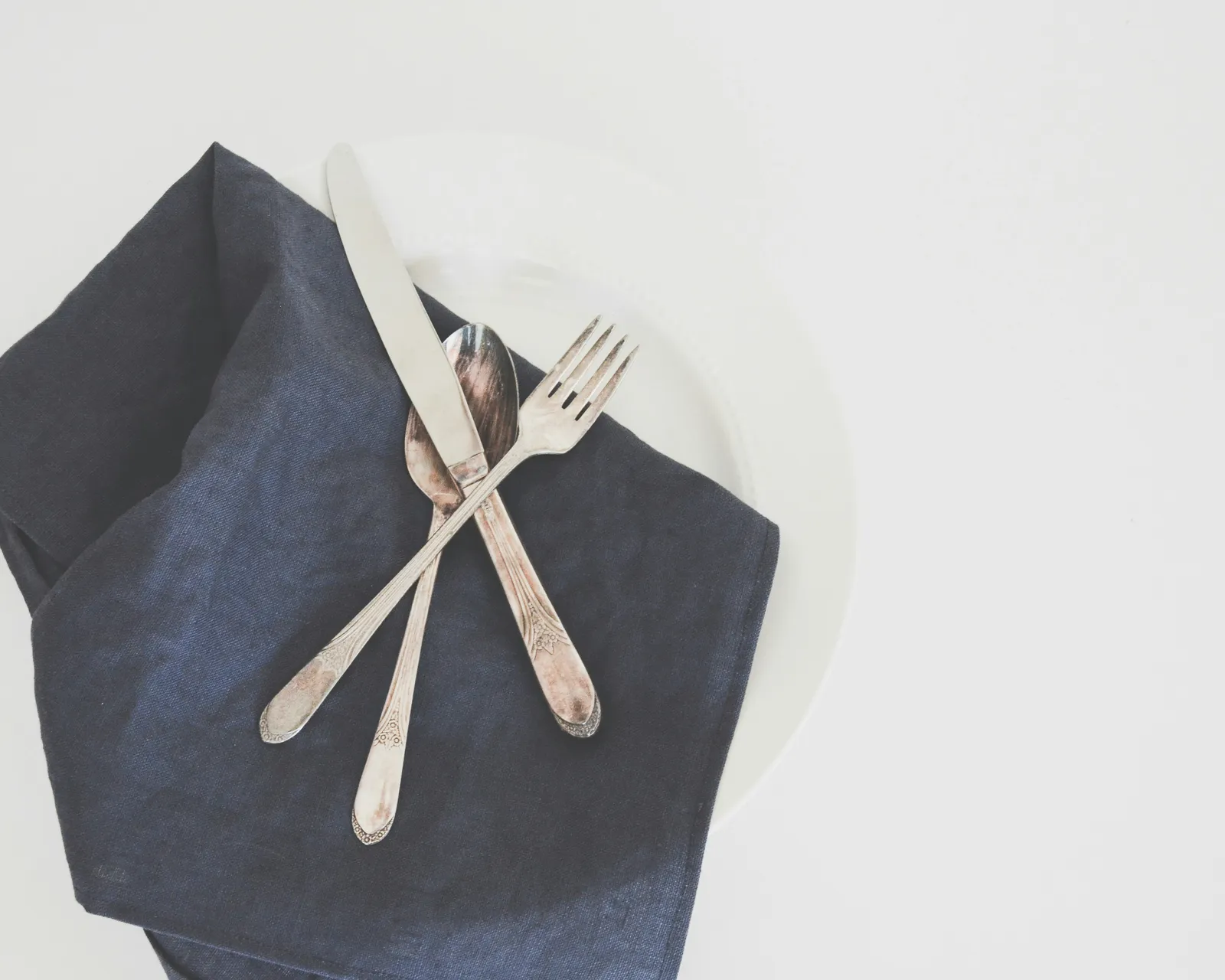
If your grandmother left you silverware, use it. Even mismatched inherited flatware looks more intentional than any modern set, and the story makes a better dinner conversation than the brand. The same goes for thrift-store hauls: a mismatched-but-coherent set of vintage silver is one of the best moves in tablescaping. We’d take that over anything brand new.
A short FAQ
What is the correct place setting for silverware? Forks left, knives and spoons right (knife blade facing in toward the plate), water glass above the knife, napkin to the left of the forks or on the plate. For multi-course meals, set one utensil per course, in the order you’ll use them, working from outside in.
Does the napkin go on the left or the right? Either works. Classic placement: to the left of the forks. Two practical alternatives: folded on top of the plate (looks more polished), or under the forks (saves space). All three are acceptable.
What’s the difference between flatware and silverware? In modern usage, the same thing. Strictly, “silverware” meant actual silver utensils; “flatware” is the generic word that covers stainless. Today, “silverware setting” just means how you arrange the metal utensils.
What are the 5 classic table settings? Casual, informal, formal, those are the three that matter. The other two often listed: buffet (utensils next to the food, not at each seat) and afternoon tea (small fork, dessert spoon, teacup with saucer). For 99% of hosting, you only need the first three.
Where do you put silverware when you’re done eating? Fork and knife together, roughly the 4 o’clock position on the plate. Fork tines up, knife edge facing in. This is the universal “I’m done” signal. If you’re just pausing, cross them in the middle of the plate. The rest of the rules worth keeping are in our table manners guide.
What this earns you
A correctly set table tells your guests, before they’ve eaten a bite, that you put care into the meal. It signals competence without performance. It’s the kind of small gesture that lands harder than the elaborate ones, your friends notice that the wine glass was already at their seat, not that you arranged seventeen pieces of silver.
The setting takes 90 seconds per seat once you know it. The reputation it builds, the friend who hosts well, lasts the rest of your hosting life.
For the full dinner-party game plan that this setting fits into, see our how to host a dinner party guide, a 5-day plan with menu math, drink math, and a real day-of timeline. The dinner plate at the center of the setting matters too; our Corelle dinnerware guide covers the everyday plates that hold up to real hosting. Or browse the rest of the tablescapes guides, the broader hosting how-to library, or the glassware section for wine, water, and cocktail options at every budget.