A veggie platter is the workhorse of easy hosting: it is cheap, it is make-ahead, half your guests are relieved to see something green, and it takes zero cooking. It works for a party, a shower, a barbecue, a game day, or as the fresh counterweight to a table full of richer food.
The catch is that most veggie platter guides stop at a list of vegetables and a few arrangement tips, and skip the parts that actually matter to a host: how much to buy so you neither run out nor drown in leftover celery, whether it is cheaper to buy or make one, and how to prep it ahead without ending up with a soggy tray. This guide gives you the real spread, the exact per-person math for 10, 25, or 50 guests, an honest buy-versus-make cost breakdown, the dips worth making, and what to skip.
Who this is for
You need to bring or set out something fresh, easy, and crowd-friendly, and you want it to look intentional rather than like the sad grocery-store tray with the ranch tub in the middle. Maybe it is a party, a shower, a potluck, or a 4th of July cookout. You want to buy the right amount, prep most of it ahead, and have it hold up on the table without wilting.
This is the vegetable member of our board family. It is really a crudite platter, the same build-a-board logic as a charcuterie board applied to vegetables, and for a bigger crowd it scales into a grazing table.
TL;DR: the veggie platter plan
- Build from 4 parts: crunchy raw vegetables, one or two dips, a color-or-texture accent (olives, pickles, marinated artichokes), and a fresh-herb garnish.
- Do the math: about 4 to 5 ounces of vegetables and 2 tablespoons of dip per guest. The table below scales it for 10, 25, and 50.
- Making it is cheaper (roughly $10 to $15 vs $15 to $25 for a store tray for 10 to 12), but costs you 20 to 30 minutes of prep.
- Prep sturdy vegetables up to 24 hours ahead in water or a damp towel; cut watery ones (cucumber, tomato) the morning of.
- Group by color in tight clusters, not scattered rows, and nest the dips in bowls. That is the whole “make it fancy” trick.
- Mind the clock: cut vegetables and dairy dips are perishable, so keep them chilled and follow the 2-hour rule.
For a printable countdown for the whole event, our free Dinner Party Checklist adapts to any gathering a veggie platter anchors.
Why most veggie platters underwhelm
A veggie platter is simple, which is exactly why it is easy to get wrong in small ways that add up.
The first mistake is buying blind. Hosts either grab a pre-made tray that is 40 percent celery and cauliflower (the cheap filler), or they buy a random pile of produce with no sense of how much a crowd actually eats, and end up with either a bare platter by hour one or three pounds of leftover vegetables. A little math fixes both.
The second is prepping wrong. Cut vegetables are perishable and some of them weep, so a tray assembled the night before and left out can be watery and limp by the party. The fix is knowing which vegetables to cut ahead and which to cut last, and keeping the whole thing cold.
Get those two right and a veggie platter is one of the highest-value things you can put on a table, generous-looking, healthy, cheap, and almost entirely make-ahead. That do-the-prep-ahead instinct is the same one behind our guide to hosting a dinner party.
What goes on a veggie platter (the 4 parts)
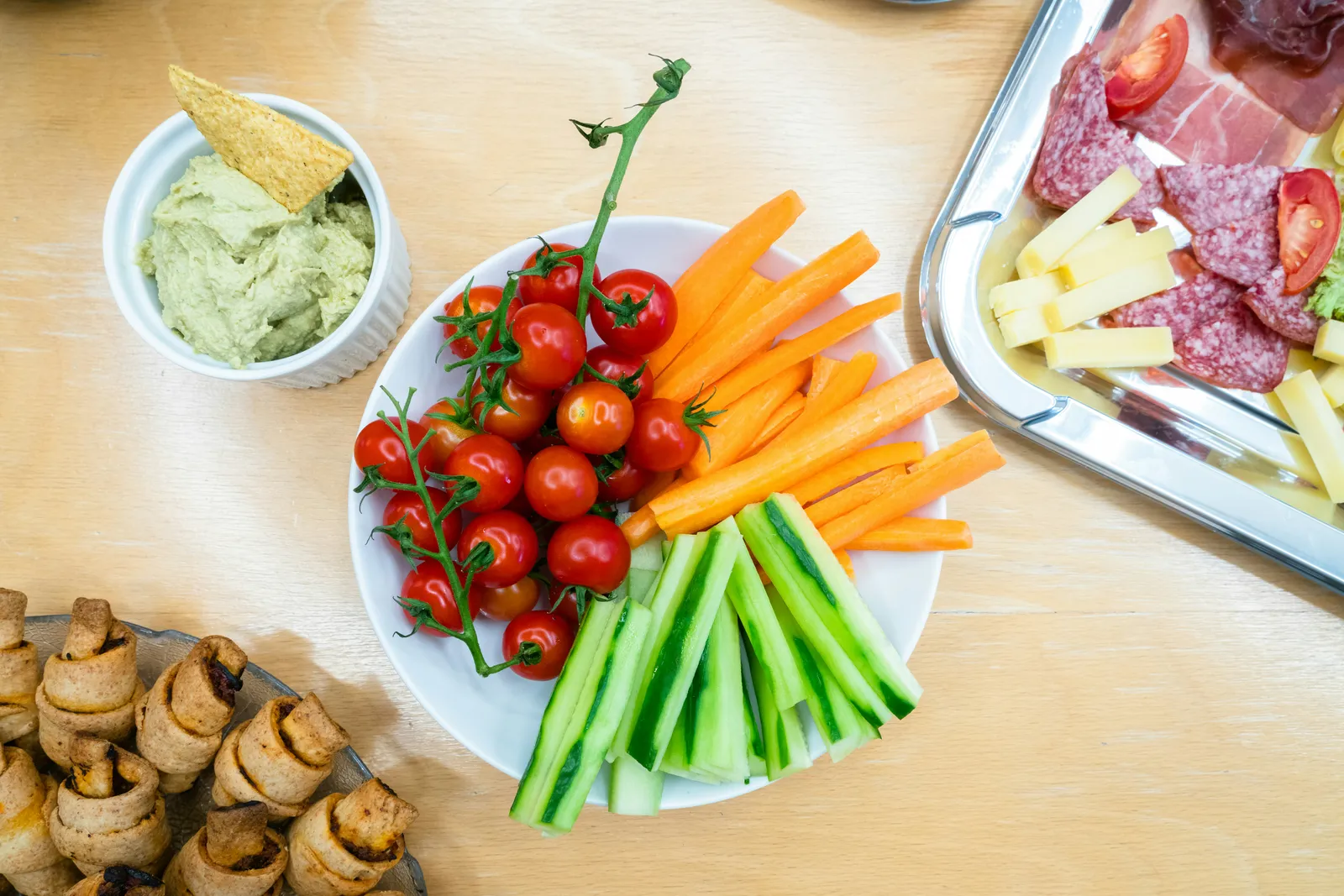
Strip away the styling and a good veggie platter is four parts. Hit all four and it reads as intentional instead of a bag of baby carrots dumped on a plate:
- Crunchy raw vegetables. The core. A range of colors and both sturdy and tender types (see the vegetable section below).
- One or two dips. Ranch is expected; one more interesting option (hummus, whipped feta, green goddess) makes it feel considered.
- A color or texture accent. Olives, marinated artichokes, pepperoncini, cornichons, or a few blanched green beans. Small additions that break up the raw-vegetable sameness.
- A fresh-herb garnish. A few sprigs of parsley, dill, or chives tucked in. Cheap, and it is the difference between “tray” and “platter.”
The next sections cover which vegetables, how much of each, and how to arrange them. If you want the underlying board method, it is the same one in our charcuterie board guide, applied to vegetables instead of meat and cheese.
The best vegetables for a platter (and what to skip)
Aim for a mix of colors and a mix of sturdy and tender. The reliably popular ones, roughly in order of how fast they disappear:
- Carrots (whole peeled, cut into sticks or coins; rainbow carrots look great)
- Bell peppers (red, orange, yellow strips; skip most of the green, it is bitter and gets left)
- Cucumber (rounds or spears; cut the morning of)
- Cherry or grape tomatoes (whole, so they do not weep)
- Snap peas or snow peas (sweet, crunchy, no prep)
- Broccoli and cauliflower florets (blanch for 60 seconds and shock in ice water if you want them brighter and less raw-tasting)
- Celery (useful for scooping, but do not let it take over)
- Radishes (color and pepper; halve or slice)
What to skip: raw green beans and asparagus unless blanked first (tough and squeaky raw), whole cherry tomatoes cut in half ahead of time (they weep and make everything wet), pre-cut avocado (browns fast), and a platter that is mostly celery and cauliflower because they are cheap. The store trays lean on those two for a reason, and they are always the leftovers.
How much to buy: veggie platter quantities by guest count
This is the part no competitor publishes, and the part that decides whether you run short or waste money. Plan on about 4 to 5 ounces of vegetables and 2 tablespoons of dip per guest when the platter is an appetizer or one of several snacks. If it is the main thing people are grazing on, bump it up by a third.
| Guests | Vegetables (total) | Dip (total) | Rough breakdown |
|---|---|---|---|
| 10 | 3-4 lb | 2-3 cups | ~2 lb “popular” (carrots, peppers, cucumber) + ~1.5 lb rest |
| 25 | 8-9 lb | ~1 quart | scale the popular vegetables up first |
| 50 | ~15 lb | ~1.5 quarts | build 2-3 platters, refill from the fridge |
A few notes on the math. Build long on the popular vegetables (carrots, peppers, cucumber, snap peas) and short on the ones that get left (celery, cauliflower). For a crowd of 50, do not build one enormous platter that looks wrecked within the hour; make two or three medium ones and refill from a backup stash in the fridge, the same tactic as our grazing table guide. One 16 oz tub of dip covers roughly 12 to 15 people, so plan two to three dips for a party of 25.
Is it cheaper to buy or make a veggie tray?
Every competitor lists the vegetables; none answers the question people actually search. Here is the honest breakdown.
Making it is cheaper, but you pay in time. A pre-made store veggie tray for 10 to 12 people typically runs about $15 to $25. Buying the same vegetables whole and cutting them yourself costs roughly $10 to $15, so you save around $5 to $10 on a small tray, and more at scale. (These are typical ranges, not a specific store’s prices; produce cost varies by season and region.)
The bigger differences are quality and control. When you make it, the vegetables are fresher and crisper, you choose the good stuff instead of the celery-and-cauliflower filler, and you can match the dips to your crowd. The trade-off is 20 to 30 minutes of washing and cutting.
The practical rule: for a small, last-minute gathering, a store tray is a reasonable convenience buy. For a party, a crowd, or anytime you care how it looks and tastes, make it. And if you make it, the make-ahead section below means the 30 minutes of prep does not have to happen the day of.
The dips (the ones worth making)
Two dips is the sweet spot: one familiar, one interesting. The ones that earn their place:
- Ranch or a herby buttermilk dip. The expected one, and there is a reason. A homemade version (sour cream, mayo, buttermilk, fresh dill and chives) is worlds better than the bottle.
- Hummus. Store-bought is fine; swirl it in a bowl with olive oil and a dusting of paprika and it looks made.
- Whipped feta. Feta blended with cream cheese or Greek yogurt and a little lemon. Tangy, a little unexpected, and it clings to vegetables well.
- Green goddess. Herb-forward and bright, the most “considered” looking of the group.
Keep the dips in their own bowls nested into the platter, never poured over the vegetables, so nothing goes soggy. If you are serving a crowd, put dips at both ends so the line keeps moving.
How to arrange it so it looks intentional
Making a veggie platter look considered is almost entirely about grouping, not skill. The whole trick:
- Cluster each vegetable tightly in its own section instead of scattering everything evenly. Blocks of color read as deliberate; confetti reads as a dump.
- Arrange by color so similar tones flow into each other or contrast on purpose (orange carrots next to purple cabbage, red peppers next to green snap peas).
- Nest the dip bowls into the platter first, then build the vegetables around them.
- Vary the cuts (carrot coins, pepper strips, cucumber rounds) so it is not all sticks.
- Add a little height with a few upright spears (celery, asparagus, pepper strips leaning in a bowl).
- Finish with fresh herbs tucked into the gaps.
Curved, flowing lines look more intentional than straight rows. That is the “fancy” version, and it is really just a crudite platter: the same build-a-board method as a charcuterie board, applied to vegetables.
Make-ahead and keeping it crisp
A veggie platter is one of the most make-ahead-friendly things you can serve, if you cut the right things at the right time.
- Up to 24 hours ahead: wash and cut the sturdy vegetables (carrots, celery, peppers, broccoli, cauliflower, snap peas, radishes). Store them in airtight containers. Carrots and celery keep crispest submerged in water in the fridge; the rest do well with a damp paper towel in the container.
- The morning of: cut the tender, watery vegetables (cucumber, tomatoes) so they do not weep and soften overnight. Make or portion the dips.
- Within an hour or two of serving: assemble the platter and keep it chilled until go-time.
On food safety, cut vegetables and especially dairy-based dips are perishable. Keep them cold, and once the platter is out, follow the 2-hour rule: perishable food should not sit out longer than 2 hours (1 hour if it is above 90 degrees, like an outdoor summer party). The reason is simple, per the USDA: bacteria multiply fastest in the 40 to 140 degree danger zone, doubling in as little as 20 minutes. For a long outdoor party, set the platter in a larger tray of ice, or put out half and refill from the fridge.
What to skip
Half of a good veggie platter is leaving things off. Skip these:
- The all-celery-and-cauliflower tray. They are cheap filler and they are always the leftovers. Buy them, but do not let them dominate.
- Cutting watery vegetables the night before. Cucumber, tomatoes, and radishes weep and soften. Cut them the morning of.
- Raw green beans and asparagus. Squeaky and tough uncooked. Blanch for 60 seconds and shock in ice water, or leave them off.
- Pre-cut avocado or anything that browns. It looks sad within the hour. Skip it or add guacamole as a dip instead.
- Pouring dip over the vegetables. It turns the whole platter watery. Dips go in their own bowls.
- One giant platter for 50. It looks demolished by the second wave of guests. Build two or three and refill.
- Overcrowding. A platter jammed edge to edge looks messy, not abundant. Leave a little breathing room and refill instead.
FAQ
What should be on a vegetable platter? Four parts: a range of crunchy raw vegetables (carrots, peppers, cucumber, cherry tomatoes, snap peas, broccoli), one or two dips in their own bowls, a color or texture accent (olives, marinated artichokes, pickles), and a fresh-herb garnish. Aim for variety of color and texture over a huge pile of any one thing.
Is it cheaper to buy or make a veggie tray? Making it is cheaper, usually by $5 to $10 on a tray for 10 to 12 (about $10 to $15 in produce vs $15 to $25 for a store tray), and it tastes fresher. The cost is 20 to 30 minutes of prep. For a crowd, make it; for a small last-minute gathering, a store tray is a fine convenience.
Can you prepare a veggie tray the day before? Yes. Cut sturdy vegetables (carrots, celery, peppers, broccoli) up to 24 hours ahead and keep them crisp in water or a damp towel. Cut watery ones (cucumber, tomato) the morning of. Assemble within an hour or two of serving and keep it chilled.
How much do you need per person? About 4 to 5 ounces of vegetables and 2 tablespoons of dip per guest as an appetizer: roughly 3 to 4 pounds of vegetables and 2 to 3 cups of dip for 10, scaling to about 15 pounds and 1.5 quarts of dip for 50.
How do you make it look fancy? Group each vegetable in tight color blocks instead of scattering them, nest the dips in bowls, vary the cuts, add a little height, and finish with herbs. It is really just a crudite platter built with the same method as a charcuterie board.
What this earns you
A veggie platter is the rare hosting move where cheap, healthy, easy, and make-ahead all line up in one dish. Buy the right amount, cut the sturdy things ahead and the watery things last, group by color, and keep it cold, and you have a generous, fresh centerpiece that took almost no cooking and cost almost nothing.
If you like the board format, it runs through our whole charcuterie board cluster, from the grazing table for a crowd to the breakfast charcuterie board for the morning. Same build-a-board method, different ingredients.