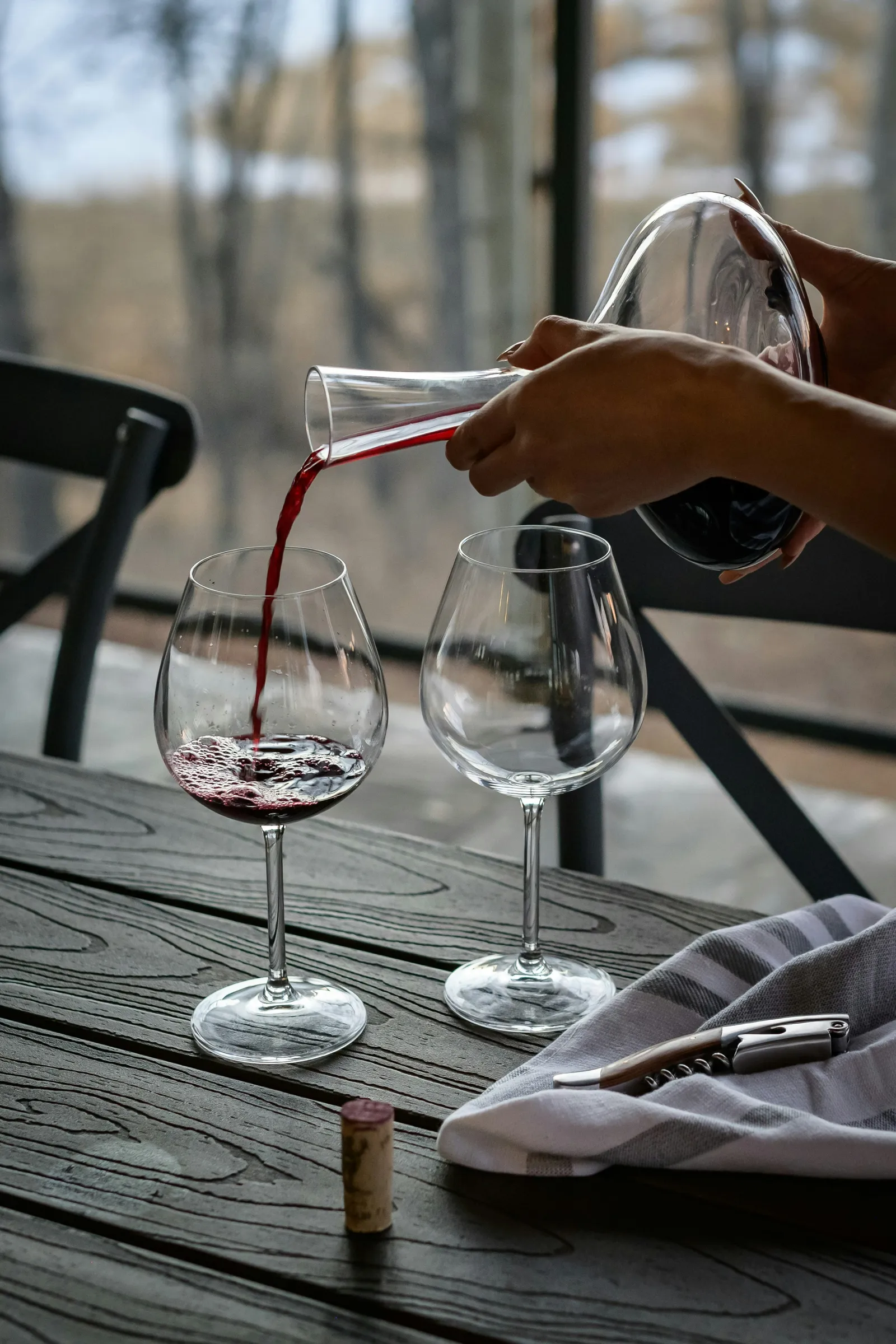
The best wine decanter for most homes costs $60, holds one bottle, and goes in the dishwasher. Past that, the honest answer is that almost any wide glass vessel does the job: a $25 IKEA carafe with the right shape does the same basic work as a $210 mouth-blown one. What you pay for is how easy it is to pour, clean, and store.
We read the decanter tests that Google leans on (Serious Eats, Food & Wine, and Wine Folly), checked every price and spec on the maker’s own site on November 3, 2026, and sorted out where the experts contradict each other. They contradict each other a lot.
Who this is for
You’re hosting a dinner, you bought one nicer bottle of red, and you’ve read that it “needs to breathe.” Or you’re shopping for a gift for the wine person in your life and every decanter on the first page of results looks like a glass swan.
You don’t need to know your Burgundy from your Bordeaux to use this. If you’re still choosing what to pour it into, our types of wine glasses guide covers that side. This article is about the vessel the wine sits in first.
TL;DR: the best wine decanters
- Best overall: Riedel Wine Friendly Decanter, $60. The only decanter both Serious Eats and Food & Wine named a winner. Holds one 750 ml bottle, slim enough for the fridge, dishwasher safe.
- Best decanter for red wine with sediment: Riedel Cabernet Decanter, $70. Sloped shoulders catch sediment and pour to the last glass.
- Best for parties: Riedel Cabernet Magnum Decanter, $99. Takes a standard bottle or a 1.5-liter magnum.
- Best budget: IKEA STORSINT carafe, $24.99. Mouth-blown, wide base, narrow neck: a real decanter shape at a third of the price.
- The $7 option: IKEA 365+ carafe, $6.99. Separates sediment and serves box wine well; aerates more slowly.
- Best splurge: Josephinenhütte Josephine N° 7, $210. Mouth-blown, lead-free, and Food & Wine’s splurge pick.
- Best whiskey decanter: Godinger Dublin Round, $57, unleaded crystal that actually holds a full bottle.
- The rule: decant young reds 30-60 minutes before dinner, pour old ones right before serving, and taste every 15 minutes instead of trusting a chart.
Best wine decanters compared
Prices and specs are from each maker’s site on November 3, 2026. “Holds” is what the maker says the decanter is built for. Several makers also list the brim volume, which is larger on purpose: the empty space above the wine is where it meets air.
| Decanter | Price | Holds | Size (height x widest) | Material | Dishwasher (per maker) | Best for |
|---|---|---|---|---|---|---|
| Riedel Wine Friendly | $60 | One 750 ml bottle | 11.2 x 4.3 in | Machine-made crystal glass | Yes | Everyday, older wines, small kitchens |
| Riedel Cabernet | $70 | One 750 ml bottle | 9.1 x 4.9 in | Machine-made crystal glass | Yes | Young reds, sediment |
| Riedel Cabernet Magnum | $99 | 750 ml or a 1.5 L magnum | 10.6 x 5.7 in | Machine-made crystal glass | Yes | Parties, magnums |
| IKEA STORSINT carafe | $24.99 | 57 oz brim volume | Not listed | Mouth-blown glass | No, hand wash | Budget decanting |
| IKEA 365+ carafe | $6.99 | 34 oz brim volume | 11 x 3.5 in | Tempered glass, cork stopper | Glass yes, cork by hand | Serving, sediment, box wine |
| Josephinenhütte Josephine N° 7 | $210 | Sized for one bottle (77.8 oz brim volume) | 7.5 x 9 in | Mouth-blown lead-free glass | Yes (hand wash recommended) | Splurge, gifts |
What a wine decanter actually does (and what it doesn’t)
A decanter has two jobs. It separates a wine from the sediment at the bottom of the bottle, and it exposes the wine to more air than an open bottle can. Wikipedia’s decanter entry notes that most are sized for one standard 750 ml bottle.
The air part is about surface area. A standard wine bottle’s opening is 18.5 millimeters across, Serious Eats points out, barely bigger than a dime. That’s why an uncorked bottle can take hours to open up, while most reds need less than an hour once they’re spread across the wide base of a decanter.
Now the part the product pages leave out. Many modern wines throw very little sediment, so the original reason to decant has faded. Decanting for a few hours also probably doesn’t soften tannins, despite what many listings claim: tannins change during winemaking and oak aging over days or weeks, and decanting mostly changes how you perceive sulfur compounds and other aromas. The French oenologist Émile Peynaud argued that long decanting dissipates more aroma than it releases. Wine writer Jancis Robinson, on the other side, holds that it does little harm to all but the most fragile wines and looks good on the table. (All three points are summarized, with sources, on the same Wikipedia page.)
So a decanter is a modest tool. It helps young, tannic reds taste rounder sooner, it keeps grit out of glasses when you open an old bottle, and it makes a $15 wine look like a choice. It doesn’t rescue a wine you don’t like. Serious Eats says the same thing: decanters “aren’t miracle machines.”
Best overall: Riedel Wine Friendly, $60
The Riedel Wine Friendly Decanter is the one decanter on both major test lists. Serious Eats named it best for older wines. Food & Wine (which lists it as the “Riedel Wine Decanter”) named it best compact.
Why it wins for a normal home:
- It pours from the base. Serious Eats found it was the only model in its test you could hold by the body instead of the neck, which puts your hand under the weight of the wine. A full decanter is heavier than it looks: 750 ml of wine weighs about 1.65 pounds before you add the glass.
- It stores like a vase. It’s 11.2 inches tall and only 4.3 inches across at its widest. Food & Wine notes it fits in the fridge or an ice bucket, so it doubles as a server for a chilled white.
- It’s rated for the dishwasher. Riedel’s product page says this machine-made line is dishwasher safe. Most fancier decanters are hand wash only.
- Riedel sizes it for one bottle. Both testers list its capacity at about 1.4 liters. That gap is headroom for air.
The trade-off: the slim body gives the wine a deeper, narrower pool, so it aerates more gently than a wide-bottomed decanter. That’s a feature for older or delicate wines and a slight slowdown for a young, grippy Cabernet. If you mostly drink big young reds, buy the next pick instead.
Best decanter for red wine with sediment: Riedel Cabernet, $70
The Riedel Cabernet Decanter is Serious Eats’ pick for capturing sediment, and it’s the better shape for young, full-bodied reds. It’s shorter and wider than the Wine Friendly (9.1 inches tall, 4.9 at its widest), with a flared neck that’s easy to pour a bottle into.
The detail that matters at the table is the slope. Serious Eats found its gently sloping shoulders let you pour the last glass without turning the decanter upside down, which also traps sediment in the corner instead of sending it into someone’s glass. It also has a thin rim that stops the pour without a drip. Like the Wine Friendly, it holds one 750 ml bottle and Riedel lists it as dishwasher safe.
It’s plain. Serious Eats called it “hardly the life of the party.” For a host, plain is the point: it looks right next to any glass and doesn’t need its own shelf.
Best for parties and magnums: Riedel Cabernet Magnum, $99
If you host more than six people, the Riedel Cabernet Magnum Decanter is the one we’d add second. Riedel says it holds either a standard bottle or a 1.5-liter magnum, which is the same volume as two standard bottles. It’s 10.6 inches tall and 5.7 inches wide, in the same dishwasher-safe line.
Neither big test reviewed this model, so this pick rests on Riedel’s specs rather than a tasting panel. The case for it is arithmetic: one decanter that takes two bottles covers the main course for eight. Food & Wine’s advice is the counterpoint: if you usually decant standard bottles, there’s no reason to buy a large one.
Best budget wine decanter: IKEA STORSINT, $24.99
The IKEA STORSINT carafe is the budget pick because it’s actually decanter-shaped. IKEA describes a wide base and narrow neck that let wine breathe, and sums it up as “decants, breathes and serves.” It’s mouth-blown, holds 57 ounces to the brim (more than twice a standard bottle), and matches the STORSINT wine glasses if you already own them.
Two catches, both from IKEA’s page. It’s hand wash only, and it isn’t rated for anything warmer than 120°F, so don’t fill it with hot water to clean it. Neither test reviewed it; we’re recommending it on shape, price, and IKEA’s own description.
The $7 option: a plain carafe
Before you buy any decanter, know this: Serious Eats’ own tester wrote that almost anything can be used as one, a pitcher included. The IKEA 365+ carafe is $6.99, holds 34 ounces, is made of tempered glass, and goes in the dishwasher (wash the cork by hand).
It’s tall and slim (11 inches high, 3.5 across), built for a fridge door, so it aerates slowly. It does everything else well: it leaves sediment behind, it makes box wine look presentable on the table, and it holds a full bottle with room to spare. If you open one serious red a year, this is your decanter.
Best splurge: Josephinenhütte Josephine N° 7, $210
The Josephine N° 7 is Food & Wine’s splurge pick. It’s mouth-blown from lead-free glass, handmade in Europe, and designed by Kurt Josef Zalto (Josephinenhütte notes it has no business ties to Zalto Glas, the company that bears his name).
It’s low and wide: 7.5 inches tall and 9 inches across, with a 77.8-ounce brim volume, so a single bottle spreads into a shallow pool with lots of surface. Food & Wine found the shorter shape easy to pour from, even one-handed. Josephinenhütte says it’s dishwasher safe but recommends hand washing, and Food & Wine ran it through the dishwasher in testing.
This is the gift pick. You’re paying for craftsmanship more than for better wine (the Riedel Cabernet is a third of the price), but it’s the one a wine person won’t buy for themselves.
Where the big decanter tests disagree
Serious Eats and Food & Wine tested overlapping decanters and reached different conclusions often enough that it’s worth seeing side by side.
| Decanter | Serious Eats | Food & Wine | Our read |
|---|---|---|---|
| Riedel Wine Friendly | Best for older wines | Best compact | The only decanter both name a winner, so it’s our best overall |
| Rabbit Pura (with filter) | Filter backed up and didn’t remove all the sediment | Best for collectors | Skip the filter; a slow pour does the same job |
| Le Chateau | Sharp neck-to-base angle made the last glasses hard to pour | Didn’t make the list: long neck, thick lip, frequent drips | Google’s AI Overview calls it the “best classic design.” Neither test agrees |
| Zalto | Denk’Art Axium: short neck made pouring difficult | Denk’Art Carafe No. 150: best oversized | Different models, so it’s not a true contradiction |
| Spiegelau | Authentis: steep angle left wine behind with the sediment | Style: best value at $46, dishwasher safe | Also different models; Spiegelau’s site lists no US price |
| Godinger Wine Decanter Carafe | Best overall, about $25-35 | Not tested | Sold mainly through Amazon; we couldn’t find it on Godinger’s own site to confirm |
The pattern: the decanters that lose points do so for handling, not for wine. Short necks, sharp shoulders, and thick lips cost them, and so do filters that clog. That’s the checklist to shop with.
How to choose the best decanter for red wine
Five things matter, roughly in this order.
- Base width. Wider spreads the wine out and opens it faster. Wine Folly’s rule of thumb: a wide base for full-bodied reds like Cabernet Sauvignon and Tempranillo, a medium decanter for medium-bodied reds like Merlot and Sangiovese, and a small or medium chilled one for light reds like Pinot Noir.
- Neck and lip. A flared, angled opening is easy to fill and pour, and a thin lip stops drips. Serious Eats found decanters with very short necks hard to control once full, and Food & Wine’s testers marked down thick rims for dripping.
- Shoulders. Gentle slopes pour to the last glass and trap sediment. A sharp, nearly 90-degree corner between neck and base means tipping the decanter upside down for the final pour.
- Capacity. One standard bottle is right for almost everyone. Go bigger only for magnums or parties.
- Material. Food & Wine says plain glass works as well as crystal. Pay for crystal if you want thinner walls and lighter weight, and buy lead-free either way. Riedel says it has made only crystal glass without lead oxide as a principal ingredient since 2015.
On weight, Serious Eats suggests staying under two pounds empty, and Food & Wine puts the sweet spot at 1-2.5 pounds. Either way, anything that feels heavy empty will feel worse with a bottle in it.
How long to decant wine
There’s no single right time, and the sources don’t fully agree. Here’s what each one says, so you can see the range.
| Wine | Decanter shape | How long | Source |
|---|---|---|---|
| Young, full-bodied red (Cabernet, Syrah, Tempranillo) | Wide base | 1-2 hours | Wine Folly |
| Most red wines | Any | Under an hour; about 30 minutes usually does it | Serious Eats; Food & Wine’s expert |
| Inexpensive red | Any | About 20 minutes (after a good shake) | Wine Folly |
| Old red with sediment | Narrow | Sources split: about 2 hours for most (Wine Folly), several hours or more for some 20+ year bottles (Food & Wine), or just before drinking because old wines lose aroma fast (KnowWines; Serious Eats’ sommelier) | See note below |
| Light red (Pinot Noir, Beaujolais) | Small, chilled | Brief, if at all; taste early | Wine Folly (small, chilled decanter); The Wine Bible via Wikipedia (decanting can harm delicate wines) |
| White or rosé | Small, chilled, optional | Usually unnecessary; helps a flat or slightly sulfur-smelling bottle | Wine Folly; Serious Eats |
The note: the advice on old wine splits because old wines differ wildly. The method both big tests used is the one to copy. Taste a little right after you decant, then again every 15 minutes, and serve it when it tastes better than it did. For an old or expensive bottle, start tasting at 10 minutes, because an old wine’s aromas can fade quickly.
Decanting for a dinner party: the timeline
The wine sites explain decanting for a quiet bottle for two. Hosting is different: you have four other things on the stove and guests at the door. Here’s a timeline that works.
- The day before: stand any older bottle upright so the sediment settles to the bottom. A bottle that’s been lying on its side has sediment spread along it.
- About an hour before you sit down (usually when guests arrive): decant the young red you’re serving with the main course. By the time you plate, it’s had the 30-60 minutes most reds need.
- Right before you pour: open and decant any old bottle (a two-prong puller is gentler on an old, crumbly cork than a corkscrew). Pour slowly in one steady motion, watching the neck against a light (a candle is traditional; your phone’s flashlight works), and stop when you see sediment reach the neck. Expect to leave a little wine behind.
- As you serve: taste the decanted wine once more. If it tastes thinner than it did, pour it now; it won’t improve sitting there.
How many decanters you actually need
Fewer than you’d think. Our dinner party wine math is one bottle per two guests plus one extra, so eight guests means five bottles. You don’t need five decanters, and you don’t need to decant all five.
Decant the one or two reds that benefit, and open the rest at the table. If you want a second bottle aerated before guests arrive, use the trick Food & Wine describes: decant it, rinse the empty bottle, and pour the wine back into the bottle (a funnel helps). One decanter can aerate several bottles in a row that way. For a crowd, the magnum decanter takes two bottles at once.
The best whiskey decanter (and why lead matters more here)
A whiskey decanter is a different object. Whiskey has no sediment to remove, and according to Wikipedia’s whisky entry, whiskies don’t mature in the bottle, only in the cask. So a whiskey decanter only serves and shows off the bottle. That’s fine; just buy it for looks and for the right material, not for flavor.
Material matters because whiskey sits in a decanter for weeks or months, and that’s exactly when lead crystal becomes a problem.
Lead crystal: serving is fine, storing is not
Traditional lead crystal is typically 24-32% lead oxide, according to chemist Joe Schwarcz of McGill University’s Office for Science and Society. Lead leaches into whatever sits in it, and the longer it sits, the more it leaches. In the research summarized on Wikipedia’s lead glass page, port stored in lead crystal decanters measured 89 micrograms of lead per liter after two days and 2,000-5,000 after four months. Brandy kept in lead crystal for more than five years reached about 20,000.
Schwarcz’s bottom line: serving drinks from a lead crystal decanter at a dinner party is no problem, but alcohol shouldn’t be stored in one. In practice:
- Buy unleaded for anything that sits. Godinger lists the decanters below as unleaded crystal, and Riedel’s current crystal glass isn’t made with lead oxide as a principal ingredient.
- Treat a vintage cut-crystal decanter as leaded unless it’s marked otherwise. Use an inherited decanter to serve on a holiday, then pour what’s left back into the bottle.
Whiskey decanter picks
- Budget: Godinger Oxford, $40. Unleaded crystal, 8.75 inches tall, hand wash recommended. Know that it holds 24 ounces, slightly less than a full 750 ml bottle (25.4 ounces), so you’ll have a pour left over.
- Best overall: Godinger Dublin Round, $57. The classic cut-crystal look in unleaded crystal, 32 ounces, so a full bottle fits. Godinger’s page lists it as both dishwasher safe and “hand-wash recommended”; we’d hand wash anything cut.
- Splurge: Riedel Spey Decanter, $149. Cut-crystal decoration in Riedel’s crystal glass, 8.1 inches tall, in the line Riedel calls dishwasher safe. Riedel doesn’t list its capacity, so check before you buy if you want a whole bottle to fit.
These are also the best bourbon decanter picks; nothing about bourbon changes the choice. If you’re building out the glasses to go with it, our best whiskey glasses roundup names them by budget.
How to clean a wine decanter (the advice contradicts itself)
Ask five sources how to clean a decanter and you’ll get five answers. Even Riedel disagrees with itself:
- Riedel’s product pages for its machine-made decanters say dishwasher safe.
- Riedel’s own glass care guide says most Riedel decanters should be cleaned by hand only unless the product page says otherwise, and to avoid soap, because residue is hard to rinse out.
- Riedel’s FAQ says to hand wash with warm water and liquid soap.
- Serious Eats says skip soap and use a diluted white vinegar soak for stains. Food & Wine’s expert says the same, and also says never to use the dishwasher.
- Wine Folly says never put vinegar in a crystal decanter and recommends fragrance-free soap.
Here’s the routine that survives all of that:
- Rinse it with warm water the night you use it. Riedel warns that red wine’s acidity can attack the glass if residue sits too long. Don’t use very hot water; Serious Eats warns it can crack the glass.
- Fill it with warm water and let it stand overnight. Riedel’s own method, and it loosens most stains.
- For stubborn stains, swirl with an abrasive. Food & Wine suggests two tablespoons of coarse salt or half a cup of uncooked rice in warm water. Decanter cleaning beads or a long brush work too.
- Use the dishwasher only if the maker’s product page says so, and put the decanter where nothing can knock it.
- Dry it upside down at an angle. Wine Folly rests it in a bowl lined with a towel; Food & Wine props it on a piece of cutlery so air gets in.
One more from Riedel’s care guide: don’t knock the spout against the faucet (it chips), and if the decanter is too tall for your sink, rinse it in the bathtub.
What to skip
- Electric decanters and aerators. Serious Eats tested two at around $250 and found they work, but no better than a standard decanter. Their advice: “Just get a standard decanter.”
- Filter decanting systems. In Serious Eats’ test, the Rabbit Pura’s filter backed up and still let sediment through. A slow, steady pour is a better filter.
- Sculptural decanters for a hosting tool. Riedel sells Swan, Boa, and Mamba decanters at $725 each. They’re glass art. As something you fill, pour, and wash on a Saturday night, the shapes work against you: hard to fill, hard to pour the last glass, hard to dry.
- Paying extra for a stopper on a wine decanter. Stoppers were added in the 1730s to limit air, which is the opposite of what you’re decanting for. You’re finishing the wine tonight.
- Storing anything in lead crystal. Serve from it if it’s what you have; don’t keep whiskey or port in it.
- Decanting every bottle at a party. Two decanted reds and the rest opened at the table is plenty, and nobody will taste the difference on bottle five.
FAQ
What is the best wine decanter?
For most homes, the Riedel Wine Friendly Decanter ($60). It is the only decanter that both Serious Eats and Food & Wine named a winner in their tests, it holds a standard 750 ml bottle, and Riedel lists it as dishwasher safe. For young, bold reds with sediment, the Riedel Cabernet Decanter ($70) is the better shape. On a budget, the IKEA STORSINT carafe ($24.99) has the same wide-base, narrow-neck design.
Should you use a decanter for white wine?
Usually not. Wine Folly says decanting isn’t necessary for white and rosé wines, though a small chilled decanter works for serving. The sommeliers Serious Eats interviewed say decanting can help a white that tastes flat, smells slightly of sulfur, or tastes too sharp. If a white tastes fine from the bottle, skip it.
What wines should you not decant?
Be careful with delicate and very old wines. Karen MacNeil, in The Wine Bible, warns that decanting can harm delicate wines like Chianti and Pinot Noir, and old wines can lose aroma fast once they meet air. Pour those just before serving, slowly, to leave sediment behind. Most whites and rosés don’t need decanting at all.
How long should you let wine breathe in a decanter?
Most red wines need less than an hour in a decanter, according to Serious Eats; Food & Wine’s expert says about 30 minutes usually does it. Wine Folly puts full-bodied reds at 1-2 hours. Taste it when you pour it in and again every 15 minutes, and serve it when it tastes better than it did.
Do you really need a wine aerator?
No. Pouring wine into any wide vessel does the same job with a little more time. Serious Eats tested a roughly $250 electric aerator and found it worked, but no better than a standard decanter. If you already own a decanter or a carafe, an aerator adds nothing.
What is the difference between a carafe and a decanter?
Traditionally, the stopper: a decanter comes with one and a carafe does not. In practice the words overlap. Riedel sells both in one category, and Josephinenhütte calls its Josephine No. 9 a carafe while recommending it for decanting older reds. For wine you will finish tonight, the stopper doesn’t matter.
Do you need a decanter for whiskey?
No. Whiskey has no sediment to remove and does not mature in the bottle, so a decanter only serves and displays it. If you do keep whiskey in one, buy unleaded glass or crystal, because spirits sit in a decanter for weeks or months and lead crystal leaches lead into stored alcohol over time.
The bottom line
Buy one decanter, and make it boring: the Riedel Wine Friendly at $60 if you want the safe answer, the Riedel Cabernet at $70 if you drink big young reds, or the IKEA STORSINT at $24.99 if you’d rather spend the difference on wine. Decant the young red when guests walk in, pour the old one right before you serve it, and taste as you go. Everything past that (swans, filters, motors, stoppers) is for the shelf, not the table.
Pouring into something nice? Our best wine glasses roundup names the eight glasses worth owning, and the bar cart guide covers where a whiskey decanter fits with everything else you pour.