A Christmas cocktail menu is not a list of 24 recipes. It’s five drinks. The host’s job is to curate, not generate.
Every recipe blog publishes the same article: “24 Christmas Cocktails to Try This Year.” Twenty-four is a content-marketing number, not a hosting number. No host actually makes 24 cocktails for a party. They make four or five, in volumes calibrated to the guest list, with at least one batch-able and at least one non-alcoholic.
This is the actual menu framework, with the actual recipes. The five cocktails that should be on a Christmas party menu, why each slot exists, and what to put in it.
TL;DR: the menu framework
For a Christmas party of 8-15 guests, you need:
- A punch, batch-served, low-effort, lasts the night
- A spirit-forward classic, a real cocktail (whiskey, bourbon, or rye-based), made one or two at a time
- A sparkling option, champagne-based, light, for toasts and people who don’t want strong drinks
- A hot drink, mulled wine, hot toddy, or hot buttered rum
- A non-alcoholic option, required, not optional
That’s the menu. Five drinks, four roles each fills, one rule (batch what you can, garnish what people will see).
Why a curated menu beats 24 recipes
The 24-cocktail listicle doesn’t fail because the recipes are bad. It fails because a host can’t actually serve 24 cocktails.
Bartenders at restaurants make 24-plus cocktails on a single shift because there’s a single bartender behind the bar with all the tools, glassware, ice, and bottles laid out, plus a back-of-house person prepping garnishes. At home, you are the bartender, the host, the prep cook, and the person greeting the door. You cannot make a Last Word from scratch while answering the door, refilling someone’s water, and putting the lasagna in the oven.
A curated menu solves this with three rules:
- Batch what you can. Punches and mulled wine sit in a pitcher or pot. People serve themselves.
- Limit “made fresh” cocktails to 1 or 2 types. A spirit-forward classic plus a sparkling option means you only need 2 sets of glassware, 2 sets of ingredients, and 2 garnishes.
- Always have a non-alc. This is non-negotiable. About 36% of US adults don’t drink, and the share is rising. Asking the non-drinking guest to settle for “water?” is the move that makes them feel like a problem to be managed.
The five-slot framework gives every guest something they want without requiring a bartender. That’s the whole game.
Cocktail #1: The punch (batch-served, lasts all night)
The single most important cocktail on the Christmas menu. A good punch does two jobs: it serves itself (guests ladle their own), and it scales (one batch covers 12-15 servings).
The recipe: cranberry-bourbon punch
Serves 12. Make 4-12 hours ahead.
- 2 cups bourbon (a mid-tier bourbon like Buffalo Trace or Maker’s Mark; don’t use top-shelf in punch)
- 1.5 cups fresh cranberry juice (the unsweetened tart kind, from a glass bottle, not Ocean Spray cocktail)
- 1 cup orange juice (freshly squeezed)
- 0.5 cup lemon juice (freshly squeezed)
- 0.5 cup simple syrup (or 0.5 cup maple syrup for a more wintery profile)
- 1 cup club soda (added at serving, not earlier)
- Garnish: fresh cranberries, orange wheels, rosemary sprigs, ice ring (optional)
Method:
- Combine bourbon, cranberry juice, orange juice, lemon juice, and simple syrup in a large pitcher or punch bowl.
- Refrigerate for at least 2 hours (overnight is better; the flavors meld).
- At serving time, add the club soda and stir gently.
- Serve over ice in a coupe or rocks glass, garnished with a few fresh cranberries and a sprig of rosemary.
The bourbon is the key. Vodka punches read as wedding-shower; bourbon-based punches read as adult Christmas. The cranberry-orange combination is the most reliably Christmas flavor profile in a glass.
Why this slot exists: the punch handles the first two hours of the party while you’re still in the kitchen finishing dinner. Guests serve themselves. By the time you emerge, half the party already has a drink. The punch is doing the work of three bartenders.
Cocktail #2: The spirit-forward classic
For the guests who don’t want a punch. These are people who order Manhattans at restaurants. They want something built, not something ladled.
The pick: a Christmas Manhattan
Serves 1. Made to order or batched in a pitcher.
- 2 oz rye whiskey (Bulleit Rye, Sazerac, or Old Overholt)
- 1 oz sweet vermouth (Carpano Antica or Dolin Rouge, keep the bottle in the fridge; vermouth is wine-based and goes off)
- 2 dashes Angostura bitters
- Optional: 1 dash orange bitters
- Garnish: brandied cherry (Luxardo or Filthy brand) and an orange peel
Method:
- Combine rye, vermouth, and bitters in a mixing glass with ice.
- Stir for 25-30 seconds (until the glass is frosted).
- Strain into a chilled coupe glass. (For ice-on-the-rocks, strain into a rocks glass over a single large cube.)
- Express an orange peel over the surface and drop it in. Add the cherry.
The Christmas spin: swap one dash of Angostura for a dash of Christmas-spice bitters (Bitter Truth makes one called “Spiced Chocolate” that’s perfect). Optional but elegant.
Batching for hosting: combine 16 oz rye, 8 oz vermouth, and 16 dashes of bitters in a pitcher; refrigerate (no ice). When a guest asks, pour 3 oz of the mixture over ice, stir for 10 seconds, strain into a coupe, garnish. Cuts the per-cocktail prep time from 90 seconds to 20.
Why this slot exists: spirit-forward drinkers are a third to a half of any cocktail-savvy crowd. They will not touch a punch. The Manhattan is the most universally accepted spirit-forward cocktail; almost everyone knows what it is, and it’s hard to make badly.
For the right glass for this cocktail, see coupe glasses (the historically correct vessel) or martini glasses (if you must).
Cocktail #3: The sparkling option (for toasts and lighter drinkers)
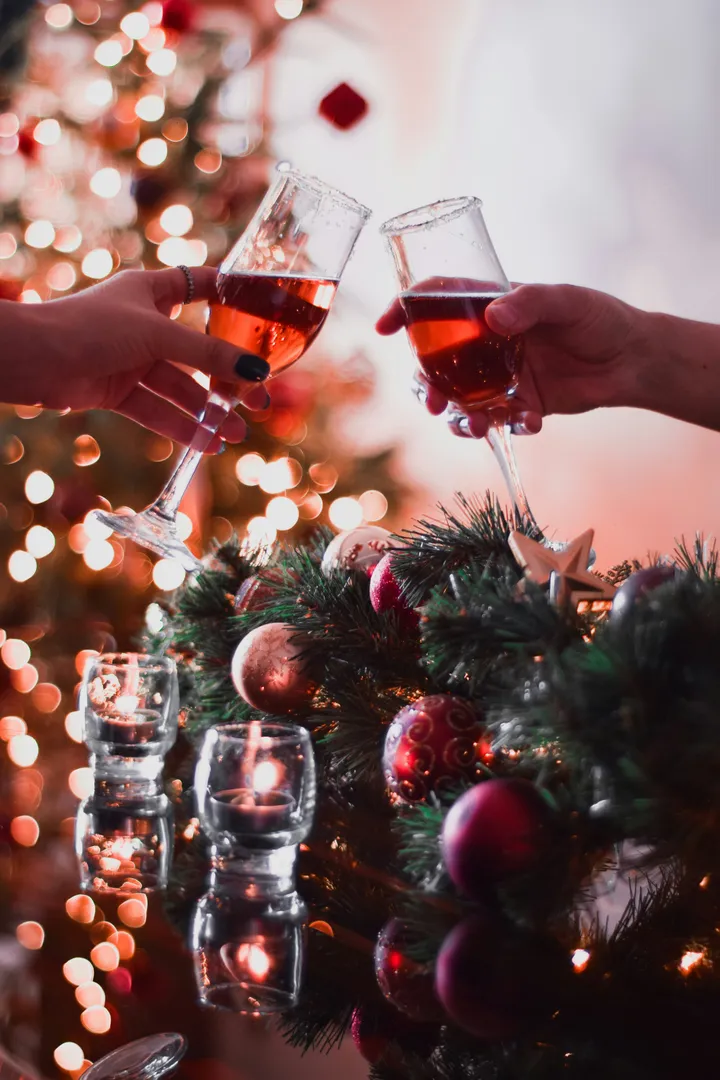
A sparkling cocktail does double duty. It’s the toast cocktail (every Christmas party has at least one toast moment), and it’s the lighter option for guests who don’t want bourbon-strength drinks.
The pick: the Poinsettia (cranberry-champagne)
Serves 1. Made one at a time, no advance mixing.
- 4 oz champagne, prosecco, or cava (cold)
- 1 oz cranberry juice (the unsweetened tart kind)
- 0.5 oz fresh lime juice
- Garnish: lime wheel or fresh cranberries
Method:
- Pour cranberry juice and lime juice into a champagne flute or coupe.
- Top with cold champagne. (Don’t shake or mix, let the bubbles do the work.)
- Garnish with a lime wheel or 3-4 floating cranberries.
Why this slot exists: sparkling cocktails feel celebratory in a way still drinks don’t. They’re also the easiest cocktail on the menu, three ingredients, no shaker, no stirring. The Poinsettia is the most Christmas-coded sparkling cocktail because of the red color; it photographs beautifully and looks intentional even if you’ve made 30 of them in an evening.
Don’t pre-mix. Add the champagne per glass at serving time, not in a batch pitcher. Pre-mixed champagne goes flat within 20 minutes.
For the right glass, see champagne flutes or coupes.
Cocktail #4: The hot drink (mulled wine or hot toddy)
Christmas is the only time of year people actively want a hot cocktail. A pot of mulled wine on the stove is the smell of Christmas in a glass. Skipping this slot is missing the most atmospheric thing about the holiday. If your guest list skews family or includes a lot of non-drinkers, a self-serve hot chocolate bar fills the warm-drink slot for everyone and runs itself in a slow cooker.
The pick: mulled wine (Glühwein-style)
Serves 8. Make 1-3 hours ahead, keep warm.
- 1 bottle of mid-tier red wine (Côtes du Rhône, Garnacha, or any unoaked Spanish or French red, don’t use anything you’d serve on its own at dinner)
- 0.25 cup brandy or Cointreau (optional but recommended)
- 0.25 cup sugar or maple syrup (adjust to taste)
- 1 orange, sliced into wheels
- 1 lemon, sliced into wheels
- 4 cinnamon sticks
- 6 whole cloves
- 4 star anise pods
- 1 fresh ginger slice (optional)
Method:
- Combine all ingredients in a large saucepan or Dutch oven.
- Heat over medium-low until just below a simmer. Do not boil, boiling drives off the alcohol and ruins the wine.
- Hold at low heat for at least 30 minutes; longer is better (up to 2-3 hours total).
- Ladle into mugs or heat-safe glasses, leaving the spices and fruit in the pot.
- Garnish with a fresh orange peel, cinnamon stick, or star anise.
Hot toddy variant: if you’d rather do a single-serving hot drink, the toddy is simpler. Combine 2 oz bourbon or Scotch + 1 oz honey + 0.75 oz fresh lemon juice + 4 oz hot water in a heat-safe mug. Garnish with a lemon wheel studded with cloves and a cinnamon stick. Made one at a time, takes 90 seconds.
Why this slot exists: the smell. Mulled wine on the stove is the single most atmospheric thing you can do at a Christmas party. Guests walk in the door and the air smells like cinnamon and oranges. No other cocktail produces this effect.
Cocktail #5: The non-alcoholic option (always have one)
About 36% of US adults don’t drink, and that number is rising fast. A non-alc option isn’t a courtesy, it’s the standard. The host who only serves alcohol is making a third of their guests feel like an afterthought.
The pick: a spiced cranberry-pomegranate spritz
Serves 1.
- 2 oz fresh cranberry juice (unsweetened)
- 2 oz pomegranate juice
- 0.5 oz fresh lime juice
- 0.5 oz simple syrup or maple syrup
- 4 oz cold club soda or sparkling water
- Garnish: fresh cranberries, rosemary sprig, orange peel
Method:
- Combine cranberry juice, pomegranate juice, lime juice, and syrup in a coupe or rocks glass.
- Add ice (or skip the ice if drinking quickly).
- Top with club soda.
- Garnish heavily, fresh cranberries floating on top, a rosemary sprig, an orange peel.
The garnish is what makes a non-alc drink feel like a cocktail. A drink in a champagne flute with a real garnish reads as celebratory. The same liquid in a tumbler with no garnish reads as juice.
For something stronger: use a non-alcoholic spirit. A 1-oz pour of a non-alc gin (Lyre’s, Seedlip, or Ritual) into the same recipe gives the drink real complexity. We cover the category in detail in non-alcoholic spirits.
Why this slot exists: because it has to. There is no acceptable hosting reason to omit a non-alcoholic option from a Christmas menu in 2026.
How to scale for the size of your party
The five-cocktail framework holds at any size, but the volumes change.
4-6 guests
Skip the punch. Five cocktails for 5 people is overkill, and a full punch bowl for 6 mostly goes to waste.
- The spirit-forward classic
- The sparkling
- The hot drink
- The non-alc
Make each to order, batch the spirit-forward in the pitcher, keep the mulled wine on the stove. Scale: 8-10 servings of each.
8-12 guests
Full menu. The punch is the workhorse.
- 12-15 servings of the punch
- 8-10 servings of the spirit-forward (batched)
- 6-8 servings of the sparkling
- 6-8 servings of the hot drink
- 6-8 servings of the non-alc per non-drinking guest
Total: 30-40 cocktail servings. Buy ingredients for 35-40 servings to allow for spills and seconds.
15-20 guests
Skip the made-to-order spirit-forward. Replace with a second punch.
- 20-25 servings of punch #1 (cranberry-bourbon)
- 15-20 servings of punch #2 (a sangria-style red wine punch, or a spiced rum punch)
- 10-12 servings of mulled wine
- 8-10 servings of the sparkling option
- 10-12 servings of the non-alc
Total: 60-80 servings. At this scale, made-to-order anything fails. Everything is batched.
For the broader hosting math at this size, see christmas dinner ideas which covers menu, table setting, and timeline for groups of 6, 12, or 20.
What to skip
The Christmas cocktail genre has accumulated some clichés worth dropping.
- Eggnog. It’s traditional, but it polarizes. Half your guests love it, half won’t touch it. If you must serve it, make it the side option, not the main. Buy good ready-made eggnog (Vermont Creamery or Kalona) and spike it with bourbon at the table; don’t make it from scratch unless you’re confident in the texture.
- Christmas-themed novelty cocktails. Anything called “Grinch Punch” or “Santa’s Sleigh Sip” or “Naughty List.” The recipes are often artificial-tasting, and the names make adults feel like they’re at a kid’s birthday.
- The tree-shaped garnish. A rosemary sprig is a pleasant garnish. A rosemary sprig with cranberries glued on with sugar to look like an “ornamented tree” is an Instagram move that takes 4 minutes per cocktail and tastes like nothing.
- Snow rims. Sugaring the rim of every glass is a fun bar trick that becomes 60 minutes of prep when you’re serving 30 cocktails. Skip it. A clean glass is fine.
- Edible glitter. It looks fun in photos. It also makes the drink taste like construction paper.
- Anything that requires an immersion blender at a party. Frozen Christmas cocktails are out unless your kitchen is the bar. Stick to stirred and shaken.
A short FAQ
What’s the most popular Christmas cocktail?
In modern hosting, batch cocktails outrank single-serving ones because they scale. Cranberry-bourbon punch and mulled wine are the two most served. Eggnog has the strongest cultural Christmas association but polarizes guests. The most universally well-received single cocktail is probably the Manhattan or a bourbon-based punch.
What’s the easy 3-ingredient holiday cocktail?
The Poinsettia: cranberry juice + lime juice + champagne. Three ingredients, no shaker, makes 1 cocktail in 30 seconds. The simplest universally-good option.
Can I make Christmas cocktails ahead of time?
Most yes. Punches improve overnight in the fridge (8-24 hours). Mulled wine gets better the longer it simmers (up to 3 hours). Spirit-forward stirred drinks (Manhattan, Old Fashioned) can be batched in a pitcher and stirred fresh per glass with ice. The exception: anything sparkling. Add the champagne or prosecco at the moment of serving, pre-mixed sparkling goes flat within 20 minutes.
How much alcohol per person at a Christmas party?
Plan on 3 servings per drinking guest over a 3-4 hour party. So 10 drinking guests = 30 cocktail servings. Add 20-30% buffer for spills, seconds, and surprise guests.
Do I need a bartender?
For 8-12 guests, no, the batch punch + made-to-order Manhattan setup works. For 15+ guests, consider hiring a bartender for 3 hours, especially if you’re also cooking. A college student or a friend who’s bartended can be paid $25-40/hour and removes the host’s bottleneck. For 20+ guests, a bartender is almost mandatory.
What’s a good non-alcoholic Christmas cocktail?
A spiced cranberry-pomegranate spritz with a rosemary garnish (recipe above) is the most universally good. For something more ambitious, use a non-alcoholic gin or aperitif as the base, Lyre’s Italian Spritz over a sparkling base makes a non-alc spritz that’s almost indistinguishable from the alcoholic version. Full coverage of non-alc spirits is in our non-alcoholic spirits guide.
Can I serve only mulled wine?
You can, but most parties need a cold option too. A mulled-wine-only menu reads as a single-track event rather than a hosted party. Pair the mulled wine with a sparkling option and a non-alc and you’ve covered every drinker.
For the broader Christmas hosting plan, the menu, the timeline, the table setting, see our Christmas dinner ideas guide. For the seasonal-cocktail counterpart, our Halloween cocktail recipes follow the same anti-novelty thesis (classic cocktails that fit the holiday, no food coloring or theme garnishes). And for the bar gear that makes any of this faster, see cocktail shakers and bar cart.