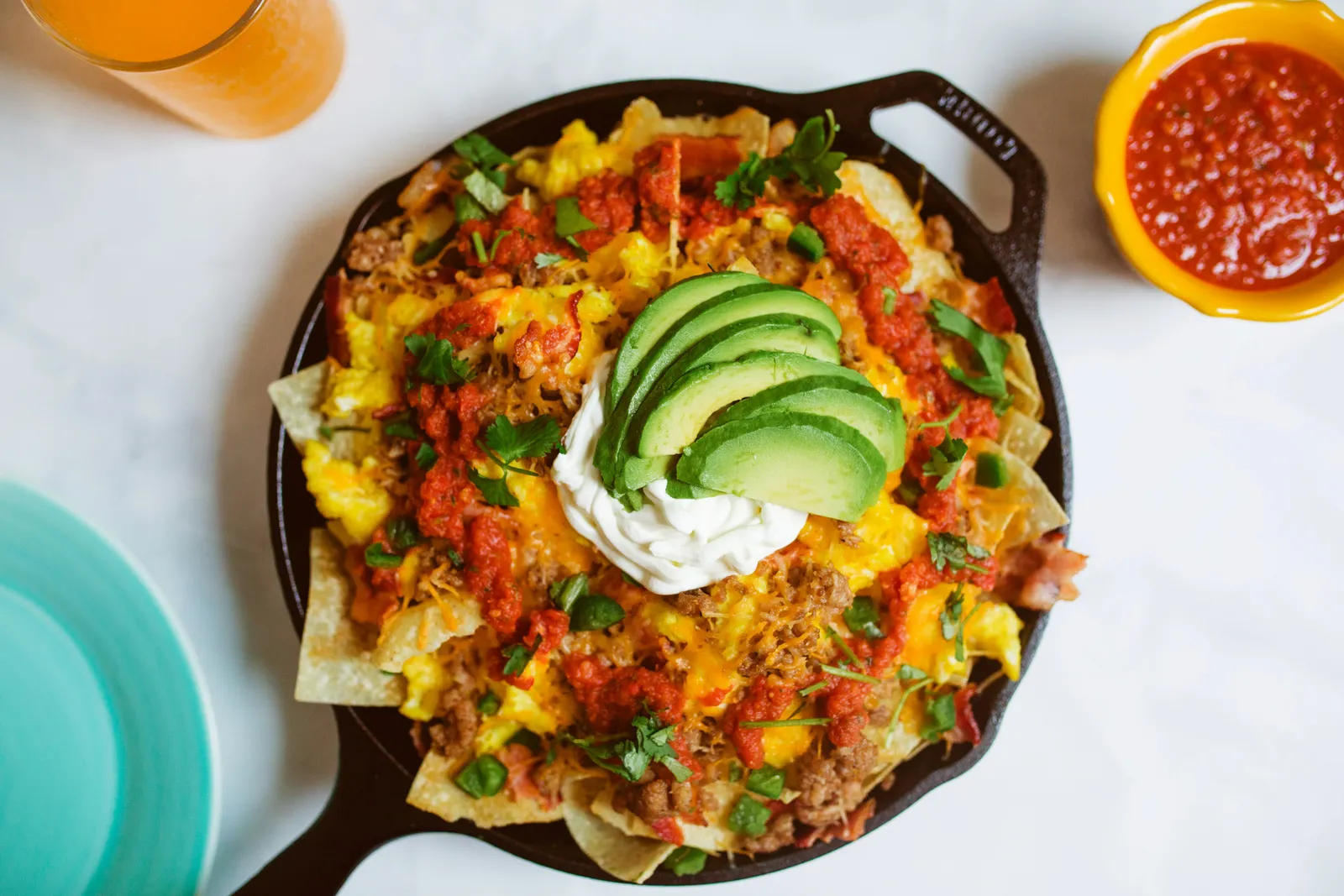
A nacho bar is the best low-effort crowd food there is: one warm pot of queso, a few proteins, a row of toppings, and guests build their own plate while you do almost nothing. It works for game day, a casual dinner party, a game night, a graduation party, or any time you need to feed a crowd without cooking to order.
The catch is that most nacho bar guides stop at a toppings list and skip the two things that actually decide whether it works: how much to buy so you do not run out (or drown in leftovers), and how to set it up so the chips do not turn to mush. This guide gives you the real spread, the exact chip, cheese, and meat math for 10, 20, or 30 guests, how to keep the queso pourable for hours, and the build order that keeps every chip crisp.
Who this is for
You want to feed a crowd something everyone likes, with minimal cooking and no plating to order. Maybe it is game day, a casual party, or a potluck contribution. You want it to look generous and taste good two hours in, not collapse into a soggy pile by the time the second wave of guests arrives.
This is the savory, year-round cousin of our build-your-own mimosa bar and hot chocolate bar: same self-serve logic, same goal of getting you out from behind the food and back into the room.
TL;DR: the nacho bar plan
- A nacho bar is 4 layers: chips, warm cheese, warm protein, cold toppings. Build it in that order and keep the wet stuff away from the chips.
- The one rule that matters: never pre-assemble, and keep chips out of the wet zone. Soggy chips are the only way a nacho bar fails. Let guests build per plate.
- Do the math: about 2 to 3 oz chips, 2 oz cheese, and 3 to 4 oz protein per guest. The table below scales it for 10, 20, and 30.
- Keep queso pourable in a slow cooker on LOW, thinned with a splash of warm milk, stirred every 20 to 30 minutes.
- Keep hot components at 140°F or above, cold toppings chilled and out under 2 hours.
- Five to eight toppings is plenty. More than that and half go untouched.
- Vegetarians eat well with seasoned black beans as a protein, so you do not need a separate menu.
Want a printable countdown for the whole event? Our free Dinner Party Checklist adapts cleanly to a casual party built around a nacho bar.
Why most nacho bars get soggy (and run short)
Two failures sink a nacho bar, and every toppings-list guide ignores both.
The first is sogginess. Tortilla chips are crisp for about 90 seconds once warm cheese and wet toppings hit them, so the worst thing you can do is pre-build a giant tray of loaded nachos and set it out. By the time the third guest arrives, it is mush. A nacho bar solves this by design: guests build their own plate at the moment they eat, and the chips stay in their own dry zone away from the queso and the pico.
The second is running short, usually on chips and cheese, because hosts guess. People eat more chips than you think, chips break, and the queso always goes first. Guessing high on the cheap stuff (chips) and getting the protein math right is the whole game.
Get those two right and a nacho bar is close to foolproof, which is the entire appeal, the same do-the-work-up-front principle behind our guide to hosting a dinner party.
What goes on a nacho bar (the 4 layers)
Strip away the styling and a nacho bar is four layers, built and served in this order:
- The chips. Sturdy, restaurant-style tortilla chips that can hold weight without snapping. This is the foundation; do not cheap out on flimsy ones.
- The warm cheese. Queso (kept pourable in a slow cooker) is the heart of the bar. Shredded cheese is optional backup.
- The warm protein. One or two: seasoned ground beef, shredded chicken, carnitas, or seasoned black beans for the vegetarians.
- The cold toppings. Everything that finishes the plate: pico, sour cream, guacamole, jalapenos, olives, scallions, cilantro, lime.
Set them out left to right in that order so a line of guests builds a good plate without backtracking. The next sections cover how much of each to buy and how to keep the warm layers warm.
How much to buy: nacho bar quantities by guest count
This is the part no competitor publishes as a table, and the part that actually stresses a host. These are practical planning amounts for a nacho bar as the main food, over about 2 hours. If it is one of several dishes, scale down by a third.
| Guests | Tortilla chips | Cheese (queso + shredded) | Cooked protein | Toppings (total) |
|---|---|---|---|---|
| 10 | ~1.5 lb (buy 2 lb) | ~1.25 lb | ~2.5-3 lb | ~2.5 lb |
| 20 | ~3 lb (buy 4 lb) | ~2.5 lb | ~5-6 lb | ~5 lb |
| 30 | ~4.5 lb (buy 6 lb) | ~4 lb | ~7-9 lb | ~7 lb |
A few notes on the math. Budget about 2 to 3 ounces of chips, 2 ounces of cheese, and 3 to 4 ounces of cooked protein per guest. Always buy about 25 percent more chips than the formula says, because they break in the bag and people over-grab. Buy raw meat at roughly 1.3 times the cooked weight you need, since it shrinks as it cooks (3 pounds raw ground beef yields a little over 2 pounds cooked). Offering two proteins does not mean doubling the total: split the same amount across both. For toppings, a little goes far; one 16 oz tub of sour cream and one of pico each cover about 15 to 20 guests.
The cheese: queso vs shredded (and keeping it pourable)
Warm queso is what makes it a nacho bar instead of a bowl of chips, so get this part right.
Queso (a smooth, pourable cheese sauce) is the better choice for a crowd because it coats evenly and holds warm. You can make it from scratch (a roux with milk and melted cheese, or the classic white-American-cheese-and-milk melt), use a good jarred queso doctored with fresh jalapenos and a splash of milk, or melt a block of processed cheese with diced tomatoes and chiles. All three work; the from-scratch version tastes best and a doctored jar is the fastest.
The trick is keeping it pourable for the length of the party. Queso stiffens and skins as it sits. Hold it in a small slow cooker on LOW or WARM, stir every 20 to 30 minutes, and keep a small pitcher of warm milk next to it to thin it back out when it tightens. Do not hold queso over a stove burner: the bottom scorches and the top skins within minutes.
Set out a bowl of shredded cheese (a melty Mexican blend or Monterey Jack) as a backup for people who want more cheese on top. It is optional, but it fills the gap if the queso runs low.
The proteins
One protein is enough; two makes it feel generous. Pick from these, all of which hold warm in a slow cooker or a covered dish:
- Seasoned ground beef. The default for a reason: cheap, fast, universally liked. Season with a taco-spice blend and a splash of water so it stays moist.
- Shredded chicken. Cook it in salsa in the slow cooker and it holds for hours without drying out. The leaner, lighter option.
- Carnitas or pulled pork. The splurge protein, rich and a little special. Make it a day ahead and reheat.
- Seasoned black beans. Not an afterthought: a well-seasoned black bean (cumin, lime, garlic) is a real protein that lets vegetarians build the same plate as everyone else. Always include it.
Keep the proteins in their own warm vessels next to the cheese, and label them so the table moves fast and nobody has to ask.
The toppings (the ones that get used)
A tight row of toppings beats an overloaded table. These are the ones people actually reach for, grouped by what they do:
- For freshness and crunch: pico de gallo, diced white onion, shredded lettuce, chopped cilantro, sliced radish.
- For heat: pickled jalapenos, sliced fresh jalapenos, a hot sauce or two.
- For richness: sour cream (or crema), guacamole, sliced avocado, crumbled cotija.
- The finishers: sliced black olives, scallions, lime wedges, a drizzle of crema.
Put each topping in its own small bowl with a serving spoon, and keep the wet ones (pico, guac, sour cream) at the far end, away from the chips. Five to eight toppings is the sweet spot. Laying out fifteen just means half go home untouched (see the what-to-skip section).
How to set up the station (the build order that prevents sogginess)
The single most important move at a nacho bar is the layout. Arrange the station in the order a guest builds a plate, left to right:
- Plates and chips first. A stack of sturdy plates or boats, then the chips. People grab a base.
- Warm cheese and proteins next. Queso, then the meats and beans, all held warm. This is the hot zone, and it should have its own stretch of table.
- Cold toppings last, and physically separated. Put a gap (or a different section of the table) between the hot zone and the cold toppings so steam and drips do not migrate back to the chips.
- Finishers and napkins at the end. Lime, hot sauce, cilantro, then a big stack of napkins and a spot for trash.
The reason this works: chips stay dry until the last possible second, guests assemble in one smooth pass, and no one is reaching across the queso to get to the lime. For a bigger crowd, run the station along both sides of a table (mirror the setup) so two lines move at once. The same self-serve flow makes our grazing table work for a crowd.
How to keep it warm (and food-safe)
The warm layers need to stay hot and safe for the length of the party. The guidance is clear: keep hot food at 140°F (60°C) or above, out of the temperature danger zone, using a heat source like a slow cooker or warming tray, per FoodSafety.gov.
- Queso: small slow cooker on LOW or WARM, stirred every 20 to 30 minutes, thinned with warm milk as needed.
- Proteins: a slow cooker or a covered dish on a warming tray. Shredded chicken cooked in salsa holds best; ground beef can dry out, so add a splash of water and stir occasionally.
- Cold toppings: sour cream, pico, and guacamole are perishable. Keep them chilled (a bowl nested in a larger bowl of ice helps), and do not leave them out more than 2 hours, per the same FoodSafety.gov guidance. Refill from the fridge in small batches rather than putting everything out at once.
The 2-hour limit is not arbitrary: per the USDA, bacteria in the 40°F to 140°F danger zone double in as little as 20 minutes, which is also why the queso gets a stir on that same cadence.
That split (hot things genuinely hot, cold things genuinely cold) is also what keeps the spread looking fresh deep into the party.
The make-ahead timeline
A nacho bar is one of the most make-ahead-friendly stations there is.
- The day before: cook the proteins and refrigerate them (they reheat better the next day anyway). Make the queso base. Chop the hardy toppings (onions, jalapenos, olives, scallions) and store them covered.
- The morning of: make the pico and guacamole (guac browns, so press plastic wrap on the surface), shred lettuce, cut lime wedges. Set out the empty bowls and label them.
- One hour before: reheat the proteins and queso and move them to the slow cookers on WARM. Fill the topping bowls (keep the cold ones in the fridge until the last minute). Put out chips and plates.
- Just before guests arrive: set the cold toppings out on ice, give the queso a stir and a splash of milk, and point the first guest at the chips.
Do not put the chips out early; they go stale uncovered. And do not dress or assemble anything: the whole point is that guests build at go-time.
What it costs: budget, mid, and splurge
The spread scales cleanly across three tiers. These are typical ranges for feeding 15 to 20 people, not quotes from a specific listing.
- Budget (about $35 to $50). Store-brand chips, a doctored jar of queso or a melted cheese block, seasoned ground beef and black beans, and the core fresh toppings. Served from a slow cooker you already own.
- Mid (about $70 to $95). Restaurant-style chips, scratch queso, two proteins (beef plus salsa chicken), a fuller topping spread including fresh guacamole, and a warming tray for the meats.
- Splurge (about $130 to $180). Premium chips, scratch white-cheese queso, carnitas plus chicken plus beans, a wide topping bar with cotija and crema, individual nacho boats, and reusable chafing or warming gear you keep for next time.
The honest take: the budget version feeds people just as well. The extra money buys a second protein, fresher toppings, and reusable gear, not a fundamentally better nacho.
Good sides and what to serve with a nacho bar
Keep sides light and Tex-Mex adjacent so they do not compete with the main event:
- Mexican street corn (elote) or an off-the-cob corn salad.
- A simple green salad with a lime vinaigrette to cut the richness.
- Cilantro-lime rice or black beans if you want it to be a fuller meal.
- A few Tex-Mex finger foods: taquitos, quesadilla triangles, or jalapeno poppers, kept to one or two so the table stays focused.
- Dessert: churros, cinnamon-sugar chips, or sopapillas.
- Drinks: a batch pitcher (margaritas or agua fresca) and a non-alcoholic option. Our mocktail recipes scale to pitchers for the non-drinkers.
If you are feeding a bigger or grazing-style crowd, a nacho bar also slots neatly next to a finger foods spread or travels well as a potluck contribution (bring the components separately and assemble on site).
What to skip
Half of a good nacho bar is leaving things off. Skip these:
- Pre-assembled loaded nachos. The cardinal sin. A big tray of pre-built nachos is soggy within minutes. Always build-your-own, always per plate.
- Flimsy thin chips. They snap under one scoop of queso. Spend on sturdy restaurant-style chips; it is the cheapest upgrade that matters most.
- Queso on a stove burner. It scorches and skins. Use a slow cooker on WARM.
- The 15-topping table. Beyond about eight, toppings stop getting used and start getting knocked over. Pick the ones above and stop.
- Wet toppings next to the chips. Pico and sour cream drips turn the chip pile to mush. Keep a gap.
- A separate vegetarian menu. Just add a seasoned black bean protein and the vegetarians build the same plate as everyone else.
- Homemade chips for a big crowd. Frying chips for 20 people is a lot of standing over oil for a marginal upgrade. Buy good ones.
FAQ
What should be on a nacho bar? Four layers: chips, warm cheese (queso held in a slow cooker), one or two warm proteins (beef, chicken, or seasoned black beans), and cold toppings (pico, sour cream, guac, jalapenos, olives, scallions, lime). Keep the wet toppings away from the chips and let guests build their own.
How much meat do you need for a nacho bar? About 3 to 4 ounces of cooked protein per guest as a main: roughly 2.5 to 3 pounds for 10 people, 5 to 6 pounds for 20, 7 to 9 pounds for 30. Buy raw meat at about 1.3 times the cooked weight you need.
How many chips and how much cheese? About 2 to 3 ounces of chips and 2 ounces of cheese per guest: roughly 1.5 pounds of chips and 1.25 pounds of cheese for 10, scaling to 4.5 pounds of chips and 4 pounds of cheese for 30. Buy 25 percent extra chips.
How do you keep nacho cheese warm? A small slow cooker on LOW or WARM holds queso pourable for hours. Stir every 20 to 30 minutes and thin with warm milk when it stiffens. Keep all hot components at 140°F or above.
What are good sides for a nacho bar? Mexican street corn, a lime-dressed green salad, cilantro-lime rice, or black beans. Keep them light so they do not compete with the nachos, and add churros or cinnamon chips for dessert.
What this earns you
A nacho bar is the rare crowd food where the easy version and the impressive version are nearly the same: good chips, warm queso, a protein or two, fresh toppings, and a setup that keeps the chips crisp. Do the math once, hold the warm stuff warm, keep the wet stuff away from the chips, and the station feeds everyone while you stay in the room.
If you like the build-your-own format, it is the same engine behind our mimosa bar, hot chocolate bar, and popcorn bar guides. Four stations, one principle: do the prep up front, then let your guests do the assembling.