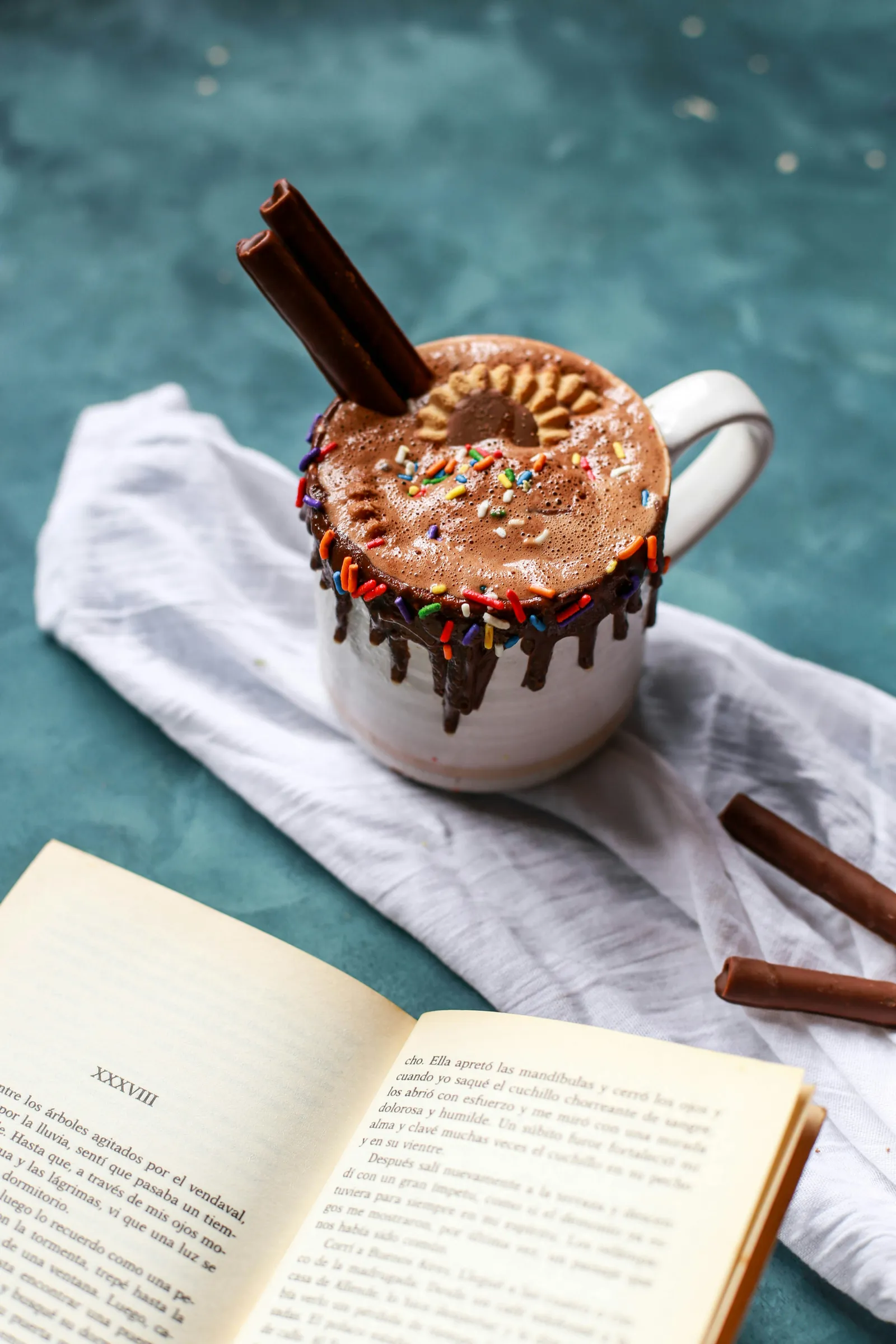
A hot chocolate bar is the easiest crowd-pleaser in winter hosting: one warm pot, a row of toppings, and a stack of cups, and your guests entertain themselves for an hour. It works for a holiday open house, a kids’ party, a post-sledding thaw-out, or the dessert course of a Christmas dinner.
The catch is that almost every hot chocolate bar guide stops at “set out some toppings” and skips the part that actually trips up a host: how much cocoa to make, how to keep it hot for three hours without it scorching, and which half of those toppings nobody touches. This guide gives you the real setup, the exact cup and cocoa math for 10, 20, or 30 guests, the keep-warm method that does not need babysitting, and an honest list of what to skip.
Who this is for
You want a warm, self-serve drink station that runs itself while you host. Maybe it is the dessert moment at a dinner, the centerpiece of a kids’ party, or the thing that makes a cold-weather open house feel like an event. You are not running a coffee shop. You want to set it up, point people to it, and get back to your guests.
If you like the build-your-own format, this is the cold-weather cousin of our mimosa bar guide, same self-serve logic, different season (and a nacho bar is the savory year-round one, a popcorn bar the snack version). For a full dessert spread alongside it, a dessert charcuterie board pairs well on the same table.
TL;DR: the hot chocolate bar plan
- A hot chocolate bar is three things: a warm base, a row of toppings, and cups. Everything else is decoration.
- Make the base from scratch. Warm milk, cocoa, sugar, salt, and a handful of chopped chocolate beats any packet and costs less. Keep it in a slow cooker.
- Do the math: about 2 servings per guest. Roughly 1 gallon of cocoa for 10, 2 gallons for 20, 3 gallons for 30. Buy 50 percent more cups than guests.
- Keep it at 140°F or above in a slow cooker or beverage urn on low, and stir every 20 to 30 minutes so it does not scorch or skin over.
- Five to eight toppings is plenty. Marshmallows, whipped cream, peppermint, chocolate, caramel, cinnamon, cookies, sea salt. More than that just crowds the table.
- Keep the spiked options separate and clearly labeled so the alcohol stays away from kids.
- Budget: about $30 to $45 for 15 to 20 people on the cheap end, $120 to $180 for the splurge setup (most of which is reusable gear).
Want a printable countdown for the whole event? Our free Dinner Party Checklist adapts cleanly to a holiday open house.
Why most hot chocolate bars stall out
Three things separate a hot chocolate bar that runs itself from one that has you hovering all night, and every toppings-list guide skips them.
First, the base goes cold or scorches. A pot of cocoa on the stove needs constant stirring and drops out of temperature the moment you walk away. The fix is a heat source that holds temperature on its own, which changes what you make and how you serve it.
Second, hosts guess on quantity and either run out in the first 30 minutes or make three gallons for twelve people. Cocoa is cheap, so erring high is fine, but cups and toppings add up, and running out of the actual hot chocolate halfway through is the one failure guests notice.
Third, the table gets overloaded. Pinterest-style setups pile on fifteen toppings, three signs, and a tower of props, and the result is a crowded table where most of the toppings go home untouched. A tight, well-chosen station looks more intentional and works better.
Get those three right and the bar genuinely runs itself, which is the entire point of a self-serve station, the same principle behind our guide to hosting a dinner party: do the work up front so you can be in the room.
The 3 parts of a hot chocolate bar
Strip away the styling and a hot chocolate bar is three things, in this order of importance:
- The base. The actual hot chocolate, kept warm in a slow cooker or urn. This is 90 percent of whether the bar is good. Everything else is garnish.
- The toppings. A short row of add-ins guests stir in or pile on: marshmallows, whipped cream, peppermint, chocolate, sauces, cinnamon, cookies, salt.
- The vessels. Cups or mugs, plus spoons or stirrers, a stack of napkins, and a small trash spot.
Nail the base, keep the toppings tight, and have enough cups, and you have a great bar. The rest of this guide is how to do each part at real-party scale.
The hot chocolate base (scratch beats mix)
From-scratch hot chocolate is easy at crowd scale and tastes far better than any packet. The formula per serving is simple: about 1 cup of milk, 1 to 1.5 tablespoons of unsweetened cocoa powder, 1 to 2 teaspoons of sugar, a pinch of salt, and a small handful of chopped chocolate whisked in for body and gloss.
To batch it, warm the milk in a large pot, whisk the cocoa, sugar, and salt into a little hot milk first to make a smooth paste (this prevents lumps), then stir that back into the pot with the chopped chocolate until it melts. Transfer to your slow cooker to hold. A splash of vanilla at the end rounds it out.
If you genuinely do not have the stovetop space, a good packet mix is a fine fallback, but doctor it: stir in real chopped chocolate and a pinch of salt so it does not taste thin and one-note. For the cocoa powder itself, a Dutch-process cocoa or a quality drinking chocolate gives a deeper flavor than the baking-aisle default, though any unsweetened cocoa works.
Make a non-dairy batch in a second vessel if you expect dairy-free guests (see the dietary section below). Do not try to make one pot work for both by adding the milk separately; it never holds temperature right.
How much to make: hot chocolate bar quantities by guest count
This is the part no competitor publishes, and the part that actually stresses a host. Plan on about 2 servings per guest over a 2-hour event: a 6 ounce cup, refilled roughly once. Cocoa is cheap, so round up.
| Guests | Finished hot chocolate | Milk to buy | Cups (buy +50%) | Slow cookers |
|---|---|---|---|---|
| 10 | ~1 gallon | ~1 gallon | 15 | one 6-qt |
| 20 | ~2 gallons | ~2 gallons | 30 | two 6-qt (or refill once) |
| 30 | ~3 gallons | ~3 gallons | 45 | two 6-qt + refill |
A few notes on the math. A standard 6-quart slow cooker holds about 1.5 gallons, so once you pass roughly 15 guests you either run a second cooker or make a second batch on the stove to refill partway through. Buy 50 percent more cups than guests because people set theirs down, lose track of which is theirs, and grab a fresh one. For toppings, budget small: a 1 pound bag of mini marshmallows covers about 20 to 25 guests, and a single can of whipped cream covers roughly 15 to 20.
How to keep it warm (the part that actually matters)
The base needs to stay hot and safe for the length of the party without you babysitting it. The food-safety guidance is clear: keep hot food at 140°F (60°C) or above, the temperature below which bacteria multiply, using a heat source like a warming tray or slow cooker, per FoodSafety.gov. Here is how the real options compare.
- Slow cooker (best for most parties). Set it to LOW or KEEP WARM. It holds hot chocolate for hours, costs nothing extra if you own one, and guests ladle their own. The only downside is the ladle, which can get messy. Best for up to about 15 guests per cooker.
- Hot-beverage urn (best for 20-plus). The big coffee urns have a spigot, so guests fill their own cup with no ladle and no drips, and they hold a lot. The catch: thick cocoa with chopped chocolate can clog a narrow spigot, so keep the base on the smoother side if you use one.
- Insulated carafe or thermal dispenser (best for small or mobile setups). Good for a small gathering or an outdoor station with no outlet. It will not actively heat, so it slowly loses temperature over 2 to 3 hours. Pre-warm it with hot water first.
- A pot on the stove (skip for a party). Fine for a family of four, wrong for a party. It needs constant stirring, drops out of temperature when you walk away, and chains you to the kitchen.
Whatever you use, stir every 20 to 30 minutes so the bottom does not scorch and a skin does not form on top, and keep a small pitcher of warm milk nearby to thin it if it thickens as it sits. (The 20-minute habit does double duty: per the USDA, bacteria in the food-safety danger zone can double in as little as 20 minutes, so a base that ever drifts below 140°F should not sit.)
Hot chocolate bar toppings (the ones that get used)
A tight, well-chosen row of toppings beats an overloaded table. These are the ones guests actually reach for, grouped by what they do:
- For texture on top: mini marshmallows, whipped cream, crushed candy canes or peppermint.
- For more chocolate: chocolate chips, shaved or chopped chocolate, a drizzle of chocolate or caramel sauce.
- For warmth and spice: a shaker of cinnamon, a pinch of cayenne for the adventurous, cinnamon sticks as stirrers.
- For crunch: crushed cookies (graham, shortbread, Oreo), toffee bits.
- The secret weapon: flaky sea salt. A tiny pinch on top of whipped cream is the topping people are surprised by.
Put toppings in small bowls or ramekins with a spoon in each, in a row in roughly the order above, and label anything not obvious. Five to eight toppings is the sweet spot. The mistake is laying out fifteen; see the what-to-skip section.
What it costs: budget, mid, and splurge
The setup scales cleanly across three tiers. These are typical ranges for serving 15 to 20 people, not quotes from a specific listing.
- Budget (about $30 to $45). Homemade cocoa from milk, cocoa powder, and sugar; a slow cooker you already own; toppings from bulk bins; paper cups; a printed sign. Almost all of it goes into the cup, not the gear.
- Mid (about $60 to $90). Better drinking chocolate, a wider topping spread, real or sturdy disposable mugs, a milk frother for whipped milk, a basic chalkboard sign.
- Splurge (about $120 to $180). A hot-beverage urn (the reusable workhorse if you host often), real ceramic mugs, premium drinking chocolate, six-plus toppings including a sauce or two, and styled signage. Most of that cost is reusable gear you keep for next year.
The honest take: the budget version tastes nearly identical to the splurge version, because the base is the same homemade cocoa. The extra money buys reusable gear and presentation, not better hot chocolate.
The make-ahead timeline
A hot chocolate bar is one of the most make-ahead-friendly stations there is.
- A few days before: buy shelf-stable toppings, cups, and cocoa ingredients. Confirm your slow cooker or urn works.
- The day before: make the cocoa base, cool it, and refrigerate it in the pot or a large container. Portion toppings into their serving bowls and cover them. Print or write the sign.
- The morning of: gently reheat the base on the stove until hot, then transfer to the slow cooker on LOW to hold. Set out the toppings, cups, spoons, and napkins. Slice any fresh garnishes.
- Just before guests arrive: top off the slow cooker, put the whipped cream and anything melty out last, and set up the spiked station if you are doing one.
Do not make the whipped cream days ahead if it is fresh; it weeps. Canned whipped cream or stabilized whipped cream holds better for a long event.
The spiked (adult) hot chocolate bar
For a grown-up party, a small spiked station turns the bar into the evening’s main event, but keep the alcohol clearly separate so it stays away from kids. The pours that work in hot chocolate, about 1 ounce per mug:
- Peppermint schnapps: the classic, especially with crushed candy cane.
- Irish cream: rich and crowd-friendly.
- Bourbon: warm and a little grown-up.
- Coffee liqueur: for a mocha lean.
- Amaretto: almond and chocolate is a quiet winner.
Set these at the far end of the table or on a separate side counter, label the station clearly, and put a small “non-alcoholic” note on the main slow cooker so nobody assumes the base is already spiked. If you would rather keep it all zero-proof, a splash of peppermint or vanilla syrup gives the same festive lift; our non-alcoholic spirits guide covers alcohol-free options that actually taste like something.
Dairy-free, vegan, and lower-sugar options
A few easy swaps make the bar work for more guests without running a second event:
- Dairy-free or vegan: make a second small batch with oat or whole-fat coconut milk (both froth and hold body better than almond or rice milk), and use a dairy-free chocolate. Label it clearly and keep it in its own small slow cooker. Set out a coconut whipped topping and dairy-free marshmallows so those guests get the full topping experience too.
- Lower-sugar: offer an unsweetened or lightly sweetened base with sugar and sweetener on the side so guests sweeten to taste. Dark chocolate (70 percent or higher) and a Dutch-process cocoa give a richer flavor with less added sugar, so the base tastes like more than it is.
The point is to make the alternatives feel like part of the bar, not an afterthought parked in the corner.
What to skip
Half of a good hot chocolate bar is leaving things off. Skip these:
- The 15-topping table. Beyond about eight, toppings stop getting used and start getting knocked over. Pick the ones above and stop.
- A pot on the stove with no heat source. It is the single most common reason a bar stalls: cold cocoa and a host stuck stirring. Use a slow cooker or urn.
- Premade single-serve packets as the main base. They taste thin and cost more per serving than scratch. If you must use mix, doctor it.
- Mountains of mini props. The tiny cauldrons, the three chalkboard signs, the garland nobody asked for. One clear sign and good cocoa beat a styled table that tastes mediocre.
- Fresh whipped cream made hours ahead. It weeps and deflates. Use canned, stabilized, or whip it just before guests arrive.
- Glass mugs for a kids’ party. Use sturdy disposables or enamel; hot liquid plus a crowd of kids plus glass is a bad combination.
- Putting the spiked bottles on the main table. Always a separate, labeled station. This is the one rule with no exceptions.
FAQ
What do you put on a hot chocolate bar? The base kept warm in a slow cooker, a row of five to eight toppings (marshmallows, whipped cream, crushed peppermint, chocolate, caramel and chocolate sauce, cinnamon, crushed cookies, flaky sea salt), and plenty of cups. Stir-ins like cinnamon sticks or candy-cane stirrers are a nice touch.
How much hot chocolate do you need for a crowd? About 2 servings per guest over 2 hours: roughly 1 gallon for 10 people, 2 gallons for 20, 3 gallons for 30. Buy 50 percent more cups than guests.
How do you keep hot chocolate warm for a party? A slow cooker or hot-beverage urn on LOW or KEEP WARM holds it for hours at the safe 140°F-or-above mark. Stir every 20 to 30 minutes so it does not scorch or skin over.
Should you make it from scratch or from a mix? Scratch tastes better and costs less, and it is easy at scale: warm milk, whisk in cocoa, sugar, salt, and chopped chocolate. Use mix only in a pinch, and doctor it with real chocolate and a pinch of salt.
How do you do a hot chocolate bar on a budget? Homemade cocoa, a slow cooker you own, bulk-bin toppings, paper cups, and a printed sign run about $30 to $45 for 15 to 20 people. The base is the same as the expensive version, so it tastes nearly identical.
What this earns you
A hot chocolate bar is the rare hosting move where the easy version and the impressive version are the same version: good homemade cocoa, kept warm, with a tight row of toppings and enough cups. Do the math once, pick a heat source that holds temperature, and the station runs itself while you actually enjoy your own party.
If you are building out a winter gathering around it, pair it with Christmas cocktail recipes for the adults and a grazing table for the food, and you have a full open house with almost no day-of cooking.