Potluck assignments have a way of arriving at the worst time. The sign-up sheet says “main dish for 12” and your week says “you have 45 minutes on Wednesday.” Most potluck lists answer this with 50 recipes and no plan, which is how you end up white-knuckling a sliding casserole through a left turn, then hunting for an outlet while your dish goes cold.
These potluck ideas are organized the way the problem actually shows up: by the job you were given and the constraints you have. Main dish or side, office break room or backyard, three days of notice or three hours. Every dish here passes the same three tests (travels, holds, serves itself), and the math for how much to bring is at the top, not buried.
Who this is for
You signed up for a dish, or got assigned one, and you want to bring the thing that disappears first, not the thing that comes home full. Maybe the potluck is at work, where there is no oven and the microwave has a line. Maybe you are the host trying to coordinate twelve people so you do not end up with seven desserts and no mains. All three of you are covered here.
If you are hosting the whole spread yourself instead of splitting it, that is a different problem: start with our housewarming party food guide for a drop-in crowd or grazing table ideas for a self-serve centerpiece table.
TL;DR: the short version
- A good potluck dish passes 3 tests. It survives a 30-minute drive, it holds at room temperature for up to 2 hours (or brings its own heat), and guests can serve themselves with one utensil.
- Bring full servings for about three-quarters of the headcount. Everyone samples several dishes, so nobody takes a full portion of yours. The table below has the math.
- The slow cooker is the best potluck tool you own. It cooks ahead, transports with a locking lid, and solves the keep-it-warm problem with one outlet.
- At work, assume no oven and a contested microwave. Bring things that are good at room temperature.
- Short notice means store-bought, re-plattered. Rotisserie chicken on your own board beats a stressed-out casserole every time.
- Mind the 2-hour clock. Perishable food should not sit out longer than 2 hours (1 hour above 90 degrees), per FoodSafety.gov. Build your choice around that.
Why most potluck dishes fail before anyone tastes them
A potluck dish lives a harder life than a dinner party dish. It gets cooked in one kitchen, driven across town, and eaten an hour or two later in a space with one oven (or none), limited counter space, and twenty other dishes competing for outlets and serving spoons. The word itself goes back to 1592, when potluck meant the luck of the pot: whatever happened to be cooking is what guests got. Modern potlucks added the car ride and the break room, and most recipe lists never caught up.
So judge every candidate dish against the three tests:
- It travels. Nothing sloshes, slides, or needs to be held level. A lidded 9x13, a pot with a locking lid, or a sealed container wins. An open platter of composed anything loses.
- It holds. The dish is genuinely good at room temperature for up to 2 hours, or it brings its own temperature control (slow cooker, insulated carrier, cooler). The 2-hour limit is the FoodSafety.gov rule for perishable food, and it drops to 1 hour above 90 degrees. Bacteria multiply fastest between 40 and 140 degrees, so “it sat out all afternoon” is not a vibe, it is a risk.
- It serves itself. One utensil, no plating, no instructions. If you have to stand next to your dish explaining it, it fails.
There is a fourth, unofficial test: it does not need the host’s kitchen. Oven space at a potluck is the scarcest resource in the building. The guest who shows up needing 20 minutes at 375 is the guest who breaks the whole timeline.
How much to bring: potluck math by headcount
People eat differently at a potluck. Nobody takes a dinner-size portion of any one dish; they build a plate from samples of six. So you do not need full servings for every person, you need potluck-size servings for most of them.
Our working rule, refined over a lot of sign-up sheets: bring full-recipe servings for about 75 percent of the headcount, and cut desserts smaller than you think (people grab squares, not slices). More dishes on the table means smaller portions taken, so round down for a big spread and up for a small one.
| Your assignment | 8 people | 12 people | 20 people |
|---|---|---|---|
| Main dish | 6 servings | 9 servings | 15 servings |
| Side or salad | 6 servings | 9 servings | 14 servings |
| Dip or appetizer | 5 servings | 8 servings | 12 servings |
| Dessert | 8 small pieces | 14 small pieces | 24 small pieces |
| Drinks | 12 cups | 18 cups | 30 cups |
For reference, a standard 9x13 pan is about 8 main-course servings or 12 potluck-size ones, and a 6-quart slow cooker of meatballs covers 12 to 15 people as a main. If the group skews hungry (teenagers, after a game, outdoors), treat the headcount as 25 percent bigger.
Potluck main dish ideas
Main dish is the highest-stakes assignment and the easiest to get right, because the dishes that work are the ones you already know. What makes them potluck mains is the logistics.
- Slow-cooker meatballs. The undefeated champion. Cook ahead, drive with the lid locked, plug in on arrival, and they hold at a safe temperature for the whole party. Marinara or grape-jelly-chili style both vanish.
- Pulled pork or pulled chicken with slider rolls. Made a day ahead, reheated in the slow cooker, served with tongs onto rolls. Self-serve, no knife, feeds a crowd for cheap.
- Baked ziti. The 9x13 workhorse. Assembled the night before, baked before you leave, still good warm-not-hot an hour later. Lid on, towel underneath, done.
- Lasagna. Same logic as ziti with more presence. Cut it into a grid at home so guests are not excavating the first piece.
- White chicken chili. Travels in the slow cooker, ladles into cups, and stands out on a table full of red sauces. Bring a sleeve of small cups if the host might be short on bowls.
- Mac and cheese. The first empty pan at almost every potluck. Bake it in the 9x13, and resist the temptation to get clever with it: smoked gouda experiments come home full, cheddar does not.
- Enchilada casserole. Layered instead of rolled, so it scoops cleanly with one spatula. Sturdy, good warm, and a vegetarian black-bean version covers two assignments at once.
- Sausage and peppers. Sheet-pan roasted at home, transferred to the slow cooker for the trip. Serve with rolls and it becomes sandwiches; serve without and it is low-carb friendly.
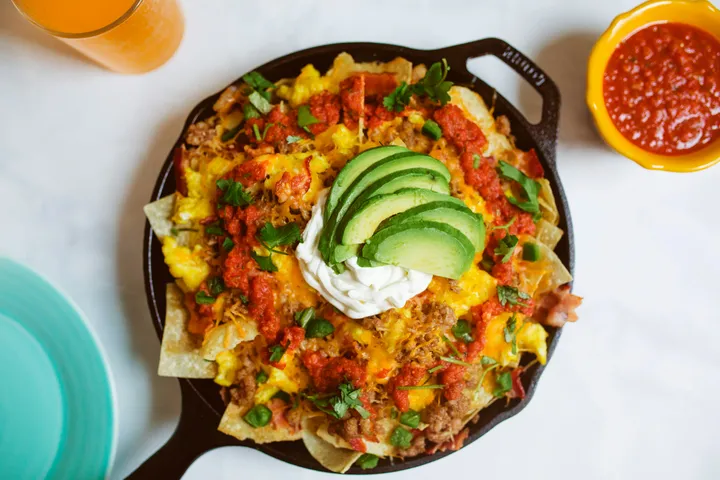
- A taco or nacho bar base. Seasoned ground beef or chicken tinga in the slow cooker, chips and toppings in separate containers. Guests assemble their own, which is self-serve by definition. Only volunteer for this if you are reliable: it flops if you forget the chips.
- Breakfast casserole. For the morning potluck (office breakfasts, post-church, team brunches): egg, sausage, and bread bakes hold their texture at room temperature far better than pancakes or pastries.
Sides and salads that survive the trip
Sides fail at potlucks for one reason: dressing applied too early. Anything that wilts, weeps, or absorbs is a countdown timer. These are not.
- Pasta salad with vinaigrette. Not mayo. A vinaigrette pasta salad genuinely improves as it sits, which makes it the rare dish that is better at hour two than hour zero.
- Orzo or farro grain salad. Sturdy grains, roasted vegetables, feta, lemon dressing. Holds all afternoon, reads as more effort than it is.
- German-style potato salad. Vinegar and mustard instead of mayonnaise, so it is meant to be served at room temperature. The safer and frankly better-tasting choice for a summer table. (If you are hosting the cookout instead of driving to one, our 4th of July menu builds the whole spread on the same make-ahead logic.)
- Broccoli salad. Raw broccoli is structurally indestructible. Dress it at home; it will still be crunchy tomorrow.
- Esquites-style corn salad. Off-the-cob street corn with lime and cotija. Served at room temperature on purpose, scoops with a spoon, no caveats.
- Cucumber salad. Quick-pickled cucumbers and onion. The acidic, cold counterpoint a heavy potluck table desperately needs. Transport in a sealed container, pour off excess liquid on arrival.
- Baked beans. Slow-cooker classic for barbecue-adjacent potlucks. Plug in, stir occasionally, ignore.
- Sesame noodles, served cold. Cold by design, vegan by default, and different from everything else on the table. Toss with the sauce before leaving; add a squeeze of lime on arrival.
- Slaw, dressed on arrival. The one exception to “no last-minute steps”: bring the dressing in a jar and toss it in 30 seconds at the table. Two-minute assembly is fine; what you are avoiding is real cooking on site.
Dips and finger foods
The dip assignment is the easiest win at any potluck. If you want the complete playbook with quantities, our finger foods for a party guide goes deeper; these are the potluck-proof picks.
- Seven-layer dip. Assembled in a clear dish with a lid, zero temperature anxiety, and the chips do the serving.
- Buffalo chicken dip. The slow-cooker dip. Warm, self-regulating, and historically the first empty vessel at any gathering it attends.
- Pinwheels. Tortilla roll-ups sliced cold. Make them the night before; they actually slice better after a night in the fridge.
- Spinach-artichoke dip. Bake at home in the dish you will serve it in. Still good warm rather than hot, which is exactly its potluck temperature.
- Hummus platter. Store-bought hummus, swirled on a plate with olive oil, surrounded by pita and cut vegetables. Assembled, not cooked, and nobody complains.
- Caprese or antipasto skewers. Toothpick food: mozzarella, tomato, basil, or salami, olive, artichoke. No plate needed, which matters at standing-room potlucks.
- Pigs in blankets or sausage rolls. Fine at room temperature, beloved at every income level, gone in 20 minutes.
- Seasoned snack mix. The most underrated potluck contribution. It cannot spoil, spill, or wilt, and the bowl is empty by the end anyway.
Desserts that travel
Dessert is the most oversubscribed potluck category (see the coordination section below for preventing that), so if you take it, bring one that wins on convenience.
- Brownies. Cut into a grid at home, transported in the pan. The standard for a reason.
- Sheet cake, frosted in the pan. No layer cake survives a car. A 9x13 cake with the frosting on, lid over the top, always does.
- Lemon bars. Bright on a heavy table. Keep them cool en route (a cooler bag is enough) and dust the sugar on arrival.
- Cookies. Sturdy, portionless, and nobody has to find a knife. Bake or buy from the bakery; either way put them on your own platter.
- Blondies or rice krispie treats. Hand-held, room-temperature stable, kid-certified.
- Banana pudding. The scoopable crowd-pleaser. It needs a cooler for the drive and a spot out of the sun, but the empty dish justifies the logistics.
- Fruit crumble or cobbler. Travels in its baking dish, tastes intentional at room temperature, and pairs with whatever ice cream someone else inevitably brought.
- A fruit platter. Genuinely welcome. After two tables of cheese and brownies, the person who brought cold watermelon is briefly the most popular person at the party.
Potluck ideas for work
The office potluck has constraints a backyard one does not: no oven, a microwave with a queue, a fridge that is already full of other people’s lunches, and a hard 60-minute window. Optimize for room temperature and zero on-site steps.
- A slow-cooker dish you plug in at 9 a.m. Meatballs, chili, pulled chicken, baked beans. By noon it is hot, safe, and you never touched the microwave. Claim an outlet early.
- Vinaigrette pasta salad or grain salad. Lives happily on your desk until noon. No fridge politics.
- Pinwheel platter. Made the night before, sliced, sealed. Survives the commute on a passenger seat.
- Seasoned snack mix or trail mix. For the colleague who “got busy”: five minutes of mixing, zero cooking, always finished.
- Chips with two salsas and guacamole. Buy the fresh tubs, not shelf-stable jars, and it reads as a real contribution.
- Bakery cookies on your own platter. Honest advice: nobody at an office potluck is auditing provenance. The platter trick works.
One workplace-specific rule: label allergens. Write “contains nuts” or “vegetarian” on a sticky note in front of your dish. At home people ask; at work they silently skip, and your dish loses customers.
Last minute potluck ideas (store-bought that looks intentional)
Three hours of notice does not mean showing up empty-handed or sad. It means assembling instead of cooking. The one move that changes everything: take it out of the store packaging and serve it on your own platter, board, or bowl. That is the entire difference between “grabbed something” and “brought something.”
- Rotisserie chicken, sliced, with slider rolls. $15 and ten minutes turns into a legitimate main dish. Add a squeeze bottle of barbecue sauce and it is a sandwich station.
- Deli antipasto platter. Olives, marinated artichokes, salami, a wedge of cheese, crackers. The grocery deli case is a complete appetizer; arrange it like you mean it.
- A cheese board from the grocery store. Two cheeses, one cured meat, crackers, and grapes is a real board. Our charcuterie board guide has the 30-minute version.
- Frozen meatballs plus jar sauce in the slow cooker. Indistinguishable from effort by hour two of the party. We will not tell.
- Bagged salad kit, upgraded. Two kits in a real bowl, dressed on arrival, topped with the included crunchies. Five dollars a kit, looks composed.
- Chips and fresh salsa and guacamole. The refrigerated tubs, decanted into bowls. Bring double the chips you think.
- Take drinks duty. Lemonade, sparkling water, and ice in a cooler is a real assignment that requires zero cooking and earns full credit. If the crowd skews zero-proof, our mocktail recipes scale to pitchers.
Vegetarian potluck ideas everyone actually eats
The vegetarian dish at a potluck has one job beyond feeding vegetarians: being good enough that everyone else eats it too. These pull it off.
- Black bean enchilada casserole. Hearty enough that nobody asks where the meat went.
- Baked ziti with ricotta. Comfort food first, vegetarian second.
- Sesame noodles. Cold, vegan, and usually the most interesting thing on the table.
- Falafel and hummus platter. Store-bought falafel warms in any toaster oven, or serve at room temperature with pita and pickles.
- Caprese orzo salad. Summer in a bowl, sturdy for hours.
- Spanakopita. Frozen from the grocery store, baked at home, fine at room temperature. Flaky things earn outsized credit.
- Chickpea curry with rice in the slow cooker. Warm, filling, vegan, and it holds at temperature all afternoon.
Label it (“vegetarian” or “vegan”) so it reaches the people it is for. And if you are cooking for a spread that needs more meat-free coverage, our vegetarian charcuterie board converts cleanly to a potluck contribution.
How to coordinate a potluck (for hosts)
Seven desserts and no mains is not bad luck, it is a missing system. If you are the one organizing, claim-a-category fixes it in one message. (It is the same system that runs a good Friendsgiving, which is a potluck with a turkey at the center.)
Set the ratios first. For 12 people: 3 mains, 3 sides or salads, 2 appetizers or dips, 2 desserts, 1 drinks, 1 flex (paper goods, ice, extra seating). For 20, scale to 4-5 mains and add a second drinks slot. Mains and sides always run out before desserts.
Use a shared list with named slots. A group note, a spreadsheet, anything visible where people claim a category, then optionally name the dish. The visibility is the mechanism: nobody signs up for the fourth dessert when three are already on the list.
Assign the scarce resources. Decide in advance who gets the oven (at most one dish), which outlets are for slow cookers, and where coolers go. Say it in the invite: “no oven access, plan for room temp or slow cooker.”
Have serving gear ready. The most common potluck failure is twelve dishes and three serving spoons. As host, stage a jar of extra spoons, tongs, and a stack of sticky notes and a marker for labeling dishes and allergens. If your plate stack cannot cover the headcount, a budget Corelle set solves it once and survives every potluck after.
Run the timeline like any other party. Food out at a set time, perishables back in the fridge or cooler within 2 hours. The hosting instincts from our guide to hosting a dinner party apply here; a potluck is a dinner party where you outsourced the menu and kept the logistics.
What to skip
Half of bringing the right dish is not bringing the wrong one. Leave these at home:
- Anything needing the host’s oven in the last 30 minutes. The oven is booked. If your dish is not done when you walk in, it is the wrong dish.
- Mayo-heavy salads for outdoor summer potlucks. They are the first casualties of the heat clock: 1 hour above 90 degrees, then they are a liability. Vinegar-based versions exist for a reason.
- Soup. It sloshes in the car, needs bowls and spoons the host does not have in bulk, and monopolizes the one ladle. Chili in a slow cooker is the closest acceptable cousin.
- Composed salads dressed at home. Wilted by arrival, soup by serving time. Either bring the dressing separately or pick a sturdier salad.
- An untested recipe. A potluck is a performance with no rehearsal. Bring the thing you have made five times, not the thing you saved on Tuesday.
- The showpiece that needs explaining. If it requires a speech about what it is and how to eat it, it will be politely sampled and quietly avoided.
- A dish with no serving utensil. Tape a spoon to the lid. The dish that cannot be served does not get eaten, no matter how good it is.
The part nobody tells you
The dish that “wins” a potluck is almost never the most ambitious one. It is the one that was hot when things were hot and cold when things were cold, that people could put on a plate without thinking, and that did not ask anything of the host. Cook for the car ride and the folding table, not for the photo. Do that, and you become the person who gets asked “are you bringing the meatballs again?”, which is the entire game.
If this is your first time running the whole show instead of bringing one dish, start with our dinner party menu ideas and work up from there. The skills stack.