A dessert charcuterie board is one of the easiest ways to end a party: no plating individual desserts, no timing a cake to the table, just an abundant sweet spread people graze from with coffee or a last drink. Build it once, set it out, done.
The catch with most dessert boards is that they are a pile of candy and cookies with nothing to cut the sweetness, so guests take one of everything, hit a sugar wall, and stop. This guide builds a dessert charcuterie board the way our savory boards work, organized by the role each item plays, and balanced with fresh fruit and a little salt so it actually keeps people coming back. You also get the make-ahead, the food-safety notes most guides skip, and what to leave off.
Who this is for
You are hosting and you want dessert handled as one generous, build-it-ahead spread instead of a fussy plated course. You want it to look abundant without being a sugar coma, and you would rather assemble it than bake six separate things. The framework below is the part to bookmark, because it is what keeps a dessert board from being a candy dump.
A dessert board runs on the same method as our charcuterie board guide; this is the sweet version of it, with the balance and the build worked out.
TL;DR: the dessert board plan
- Build by role, like a savory board: a chocolate anchor, cookies and baked bites, fresh fruit, a salty crunch, a dip for dunking, and dried fruit.
- Balance the sweetness. Fresh fruit, salted nuts, and a pinch of flaky salt are what keep it from being a sugar bomb.
- Assemble close to serving. Prep the parts ahead, but add fresh fruit and cream dips at the last minute.
- Mind two make-ahead traps: chocolate bloom (from temperature swings) and fruit browning.
- Most of it is shelf-stable; only the cream dips and cut fruit need the 2-hour watch.
- Scale it: a small board for a few, a long spread or a grazing table for a crowd.
Our free Dinner Party Checklist timeline folds dessert into the rest of your hosting.
What is a dessert charcuterie board (and how it differs from a savory one)
A dessert charcuterie board is a sweet spread arranged like a charcuterie board: cookies, chocolate, fruit, candy, and dips, set out for guests to graze instead of being served a plated dessert. The word charcuterie actually means cured meats, so “dessert charcuterie” is a playful borrowing of the term rather than a literal one. Nobody is curing anything; you are just borrowing the format.
The difference from a savory board is what fills each role. Where a savory board has cured meat as its salty anchor and cheese as its substance, a dessert board has chocolate as the rich anchor and cookies as the substance. The logic is identical, which is the useful part: if you can build one of our charcuterie boards, you already know how to build this.
What goes on it: by the role each sweet plays
Arrange by the job each item does, not by color or by piling on whatever is sweet. That is what keeps the board balanced instead of one-note.
The chocolate anchor (the rich center)
Chocolate is the dessert board’s anchor, the way cured meat anchors a savory one. A few forms give variety: a dark chocolate bar broken into shards, chocolate-covered pretzels, chocolate-covered strawberries, truffles, and a few squares of milk and dark. If you want one showpiece, a chocolate “salami” (a no-bake chocolate-and-cookie log sliced into rounds) is a fun nod to the savory original.
The cookies and baked bites (the substance)
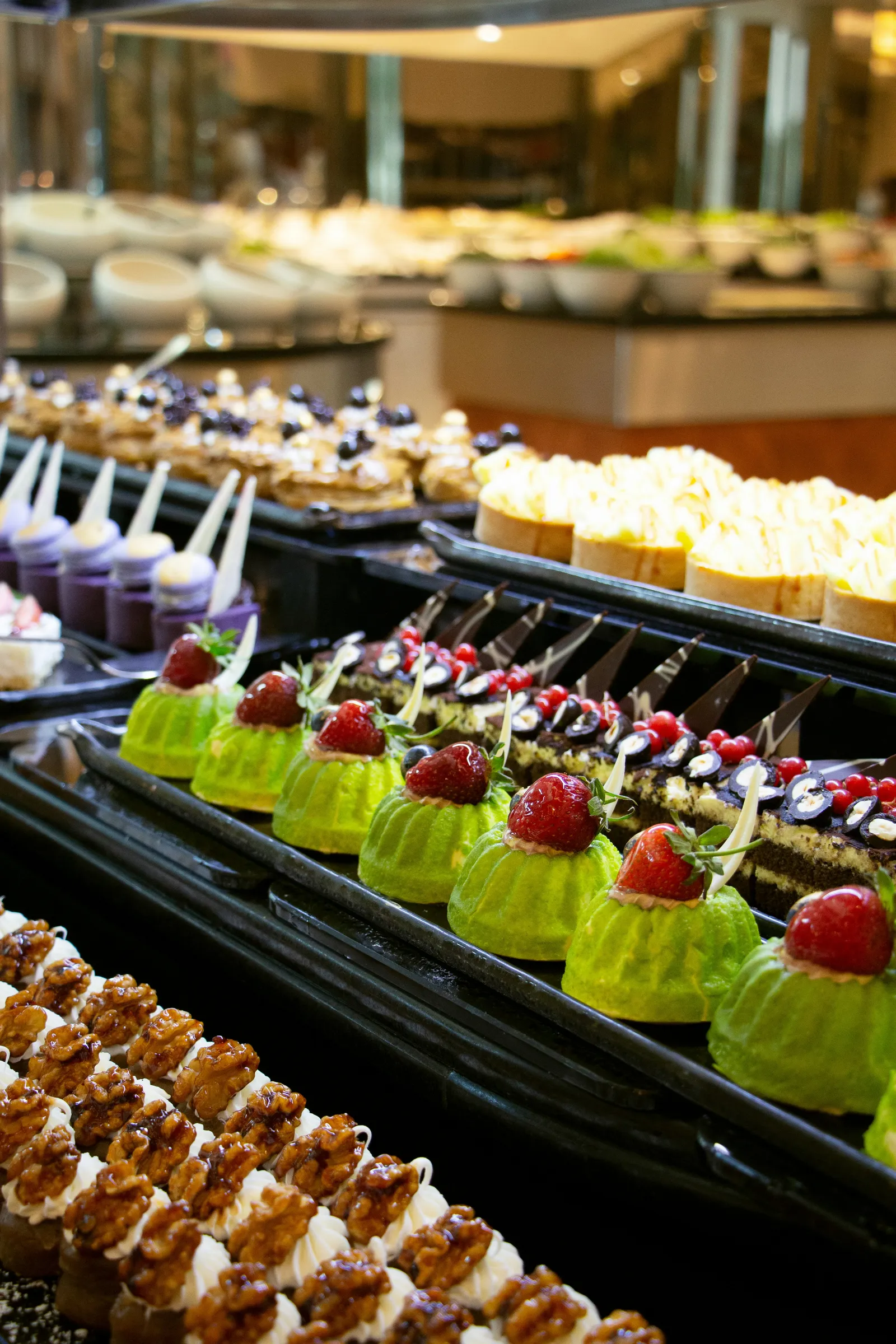
These are the substantial, hand-to-mouth part, the cheese equivalent. Aim for variety in texture: something crisp (shortbread, biscotti, wafer cookies), something soft (brownie bites, mini cupcakes), and something light (macarons or meringues). Two or three kinds is plenty; you do not need a bakery case.
The fresh fruit (color and balance)
Fresh fruit is where the board gets its color and, more importantly, its balance. Strawberries, raspberries, grapes, clementine segments, cherries, and thin apple or pear slices break up the richness and give people something that does not feel like a third dessert. This is the cheapest part of the board and the part that makes it look generous.
The crunch and salt (the anti-sugar-bomb lever)
This is the role most dessert boards skip, and it is the one that makes the board work. A little salt and crunch resets the palate so the sweetness does not flatten out: pretzels, salted or candied nuts, toffee, a handful of popcorn, sea-salt caramels. Without it, a dessert board reads as relentlessly sweet and people stop after a couple of bites.
The dip for dunking (the interactive part)
One or two dips make the board interactive and give the fruit and cookies somewhere to go: warm chocolate ganache or a small fondue, caramel sauce, a marshmallow dip, or a sweetened cream cheese or yogurt dip. These are also the one perishable element to watch (more on that below).
The dried fruit and extras
Dried apricots, dates, figs, candied citrus, and a drizzle of honey or a piece of honeycomb fill the gaps and add chew without more sugar-shock. They are shelf-stable, so they are happy out the whole time.
The balance: how to keep it from being a sugar bomb
Here is the single thing that separates a dessert board people graze all night from one they abandon after two bites: balance the sweet with fresh and salty. Sweetness flattens the palate fast, so a board that is all candy, cookies, and chocolate stops being appealing within a few bites.
The fix is built into the roles above. Make sure a real share of the board, roughly a third, is fresh fruit and a salty crunch, not more sugar. The fresh fruit cuts the richness; the salted nuts, pretzels, and a literal pinch of flaky sea salt over the chocolate or caramel reset the palate between bites. It is the same reason salted caramel works. Do this and a dessert board feels like dessert; skip it and it feels like a candy dish nobody finishes.
How to build it
A dessert board comes together in minutes once the parts are ready.
- Start with the base. A wooden board, a marble slab, or a sheet of parchment on a tray. Parchment makes cleanup trivial and lets you write little labels.
- Place the anchors and bowls first. Set the dip bowls down, then a couple of larger items (the chocolate shards, a stack of cookies) to give the board structure.
- Group, do not scatter. Build in small clusters of each item rather than spreading single pieces around. Clusters look generous; scattering looks sparse.
- Keep wet away from crisp. Put cut fruit and dips at one end and crisp cookies and pretzels at the other, so nothing goes soggy before guests reach it.
- Fill the gaps. Tuck dried fruit, nuts, and candy into the open spots so there are no bare patches.
- Add the fragile things last. Fresh fruit, chocolate-dipped fruit, and anything that browns or melts goes on right before serving.
If the board is part of a larger dessert table, our how to set a table guide covers the rest of the setup.
Make-ahead, and two traps to avoid
The board saves you time only if most of it is done before guests arrive, but dessert has two make-ahead traps the savory version does not.
- The day before: Bake or buy the cookies and store them airtight. Make any dips and refrigerate them. Portion the dried fruit, nuts, and candy.
- A few hours ahead: Lay out the shelf-stable items: chocolate, cookies, pretzels, dried fruit, candy. These are happy to sit.
- Right before serving: Add the fresh fruit (toss apple and pear slices with a little lemon so they do not brown), the chocolate-dipped fruit, and the cream-based dips.
The two traps: chocolate bloom and fruit browning. Chocolate bloom is the dull white film chocolate develops when it goes through temperature swings, like being refrigerated and then warmed. It is cosmetic, not spoilage, but it looks off, so keep chocolate at cool room temperature rather than moving it in and out of the fridge. Browning is just oxidation: cut apples and pears late, and toss them with lemon juice.
A mini board, or a board for a crowd
The same build scales in both directions.
For a mini board (a date-night dessert, a small gathering), a single plate or small slab does it: a few squares of good chocolate, two kinds of cookie, a handful of berries, some nuts, and one little dip. Do not over-buy; a small board can feel just as generous.
For a crowd, do not pile everything onto one board that looks wrecked within the hour. Build two or three medium boards and place them around the room, or spread the dessert across a long table as a grazing table, which uses the same by-role logic at full party scale. Keep a backup plate of cookies and chocolate in the kitchen to refresh the spread partway through.
Themed versions
Because the board is just a format, it takes a theme easily. For the holidays, a Christmas dessert board leans into red and green from real food (strawberries, green grapes, peppermint bark); our Christmas charcuterie board uses the same get-the-color-from-real-food approach. For October, a Halloween candy-and-dessert board is a natural, and our Halloween charcuterie board covers the spooky-from-real-food tricks. Birthdays, baby showers, and brunch all work too; a dessert board pairs nicely with a mimosa bar at a morning party.
Dietary swaps
A dessert board is easy to make inclusive without building a separate one. For gluten-free guests, swap in gluten-free cookies, meringues (naturally gluten-free), fruit, chocolate, and nuts, and keep them grouped in their own corner. For vegan guests, use dark chocolate (many bars are dairy-free, check the label), fruit, nuts, and a vegan cookie or two, and offer a fruit-based dip rather than a cream one. The same group-it-in-a-zone idea we use for the meat-free section of a vegetarian charcuterie board works here.
A quick word on food safety
Most of a dessert board is shelf-stable and perfectly happy out for the length of a party: chocolate, cookies, dried fruit, candy, nuts, and pretzels do not need a clock on them. The exceptions are the cream-based dips (whipped cream, cream cheese, mascarpone, yogurt) and cut or chocolate-dipped fresh fruit. For those, the usual rule applies: per FoodSafety.gov, do not leave perishable foods out of refrigeration for more than two hours. Put the cream dips out in a small bowl you can refresh, and keep a backup in the fridge rather than setting out a giant bowl that sits all night.
The “3-3-3 rule,” honestly
If you have read about charcuterie boards, you have seen the “3-3-3 rule,” and it does not really apply here. The 3-3-3 rule is a starting ratio for a savory board (three cheeses, three meats, three accompaniments), and it is a popular guideline, not an official standard. For a dessert board you are working with chocolate, cookies, fruit, and dips instead, so the number does not map. Use it loosely if it helps you remember to bring variety in a few categories, then build out to fill the board.
What to skip
The dessert board mistakes worth avoiding:
- The all-candy, no-balance board. Without fresh fruit and a salty crunch, it gets sickly fast and people stop eating. Make about a third of the board fruit and salt.
- Fruit that browns. Cut apples and pears at the last minute and toss with lemon. Better yet, lean on berries and grapes that hold.
- Bloomed chocolate. Do not refrigerate chocolate and then warm it. Keep it at cool room temperature.
- Cream dips left out all night. Tie this to the food-safety note: small bowl, refresh, backup in the fridge.
- Crisp cookies against wet fruit. They go soft. Keep wet and crisp at opposite ends of the board.
- Building it hours early. The fragile parts wilt and melt. Prep ahead, assemble close to serving.
A short FAQ
What do you put on a dessert charcuterie board? Build by role: a chocolate anchor, cookies and baked bites, fresh fruit, a salty crunch (pretzels, nuts), a dip for dunking, and dried fruit. Let fruit and salt balance the sweetness.
What is a dessert charcuterie board? A sweet version of a charcuterie board: cookies, chocolate, fruit, and dips arranged for grazing. The charcuterie name is borrowed (it really means cured meats); the format is the same.
How do you build one? Set the dip bowls and a couple of anchor items first, build the rest in clusters, keep wet items away from crisp ones, and add fresh and chocolate-dipped fruit last.
How far ahead can you make it? Prep the parts the day before (cookies, dips, dried items), lay out the shelf-stable pieces a few hours ahead, and add fresh fruit and cream dips right before serving.
What should you avoid? An all-candy board with no balance, fruit that browns, bloomed chocolate, cream dips left out for hours, and crisp cookies going soggy against wet fruit.
What’s next
A dessert charcuterie board is one of the most forgiving ways to end a party, as long as you build it for balance and not just for sugar. Organize by role, make about a third of it fresh fruit and a salty crunch, prep the parts ahead, and assemble close to serving.
When you are planning the rest, the charcuterie board guide has the full method behind any board, a grazing table scales dessert to a crowd, the seasonal boards (Christmas and Halloween) run on the same logic, and a breakfast charcuterie board brings it to the morning. For now: bake the cookies tonight, and build the board just before dessert.