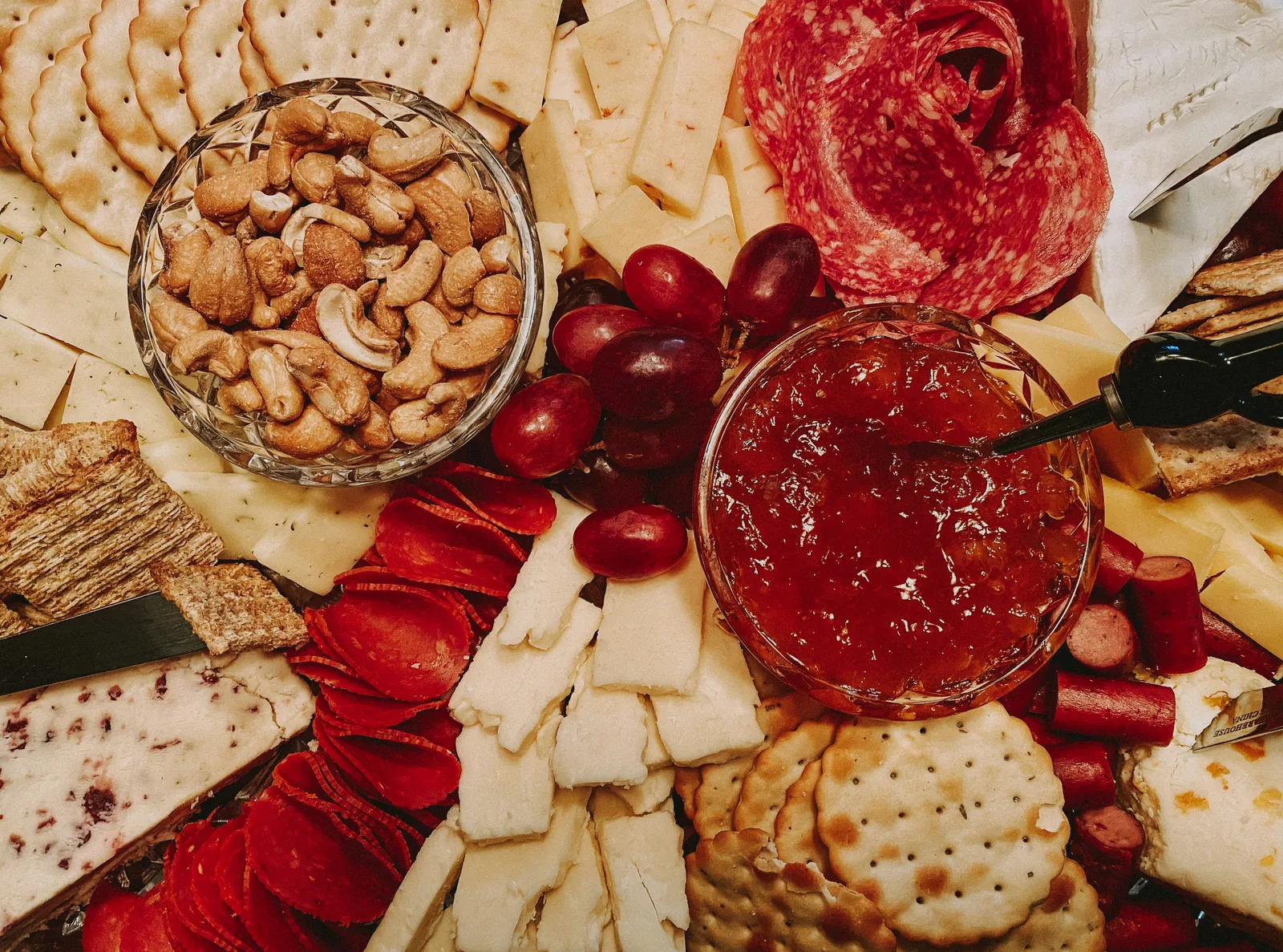
A Christmas charcuterie board is supposed to be the easy part of the holidays: set it out, let people graze, go enjoy your own party. But most of the advice out there is a pretty red-and-green photo and a grocery list, with nothing about how to make it ahead, how to keep it safe sitting out all evening, or how to make it actually good to eat instead of just nice to look at.
This guide builds a Christmas charcuterie board that does both. Festive, yes, with the red and green coming from real food rather than dye, but organized by what each item does so the board eats as well as it photographs, made ahead so you are not assembling it while guests arrive, and safe to leave out across a long holiday party.
Who this is for
You are hosting or contributing to a Christmas gathering and you want the board handled: built ahead, set out, done. You would rather it be the thing that frees you up than one more December task that eats your afternoon. You also want it to taste like something, not just look like a holiday card.
If you want the full method behind any grazing board, our charcuterie board guide is the foundation. This is the Christmas version, with the festive color, the shape question, and the make-ahead plan worked out.
TL;DR: the Christmas board plan
- Get the color from real food, not dye. Red comes from cranberries, pomegranate, salami, and red grapes; green from rosemary, pistachios, green apple, and grapes.
- Build by role: a savory anchor (cured meat), cheeses, festive sweets, a holiday crunch, and fresh fruit for color.
- Make it ahead. Assemble a few hours early, refrigerate, set out 30 to 45 minutes before guests arrive.
- Mind the clock. A party board sits out for hours, so watch the cured meat and soft cheese (the 2-hour rule).
- A shape is optional. A tree or wreath arrangement is fun, but only if it stays easy to eat from. No special product required.
- Budget about $4 to $8 per person, depending on the cheeses and meats.
Our free Dinner Party Checklist timeline folds neatly into the rest of your December hosting.
Festive without the gimmicks: color from real food
The festive look of a Christmas board should come from the food itself, not from food coloring or novelty. The good news is that the holiday palette is already sitting in the produce aisle.
For red, reach for pomegranate arils, fresh and dried cranberries, red grapes, cherry tomatoes, roasted red peppers, and the natural red of salami and cured meats. For green, use rosemary sprigs, green grapes, pistachios, green apple and pear slices, cucumber, and fresh herbs. Arrange the reds and greens in their own areas and the board reads Christmas without a drop of dye or a single plastic decoration.
This matters beyond looks. Dyed or novelty items tend to taste like the gimmick they are, and they crowd out the food people actually want to eat. Real ingredients give you the color and the flavor in the same bite, which is the whole point of a board.
One practical note on the color: you do not need the whole board to be red and green. A few clear hits of each, a cluster of pomegranate here, a fan of green grapes there, a couple of rosemary sprigs, read as festive against the natural creams and golds of the cheeses and crackers. Trying to make every square inch holiday-colored is how a board tips into looking staged rather than appetizing.
The items, by the role they play
Forget arranging by color alone. Arrange by the job each food does, the same way our charcuterie board method works, with the festive ingredients slotted into each role.
The savory anchor (cured meat does the work)
The anchor is the salty, savory, substantial role that keeps a board from feeling like a fruit-and-cracker plate. On a Christmas board that is usually cured meat, and two or three kinds give you variety without crowding. A mix of textures works best: something draped, something sliced, and something firm.
- Prosciutto, draped in loose folds, the classic salty-savory anchor.
- Salami or soppressata, sliced or folded, and a natural source of holiday red.
- Summer sausage, sliced, sturdy, and a reliable crowd favorite.
- For vegetarian guests, add a meat-free anchor like marinated olives or marcona almonds (see the cross-link below).
The cheeses
Aim for two or three cheeses in different styles (one soft, one firm, one with a little character) so there is contrast in texture and flavor. If a guest is vegetarian, it is worth checking the label: several traditional cheeses, including authentic Parmesan, are made with animal rennet and are not actually vegetarian. Our vegetarian charcuterie board guide explains which to look for and how to build the meat-free version.
- A soft cheese: brie, which you can cut into a star or tree shape for a low-effort festive touch.
- A firm, aged cheese: sharp cheddar or a nutty gouda.
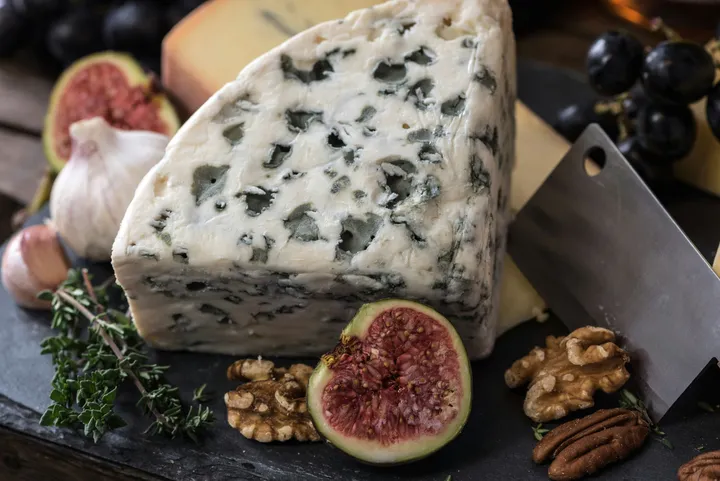
- A festive option: a cranberry- or herb-studded cheese, or a wedge of blue for contrast.
The festive sweet
- Fresh or dried cranberries, the signature holiday red.
- Fig jam or preserves, the natural partner for the cheeses.
- Dark chocolate or chocolate-covered almonds, a clean sweet bite.
- Honey or quince paste. (Honey is vegetarian but not vegan, worth knowing if a vegan guest is coming.)
The holiday crunch
- Candied or spiced pecans and walnuts, the cozy December nut.
- Pistachios, a natural source of green.
- Rosemary sprigs, which double as an aromatic garnish and a green accent.
- Seeded crackers, breadsticks, and gingersnaps, the sturdy vehicles.
The fresh (where most of the color comes from)
- Pomegranate arils, the festive red with almost no prep beyond seeding.
- Red and green grapes, for the easy holiday two-tone.
- Green apple and pear slices, tossed with a little lemon so they do not brown.
- Cucumber or endive, green vehicles for a dip or a soft cheese.
- Clementine or citrus segments, bright and seasonal.
The vehicle and the centerpiece
- Crostini, sliced baguette, and water crackers, to carry everything.
- A baked brie with cranberry, warm in the center, if you want one showpiece.
Making a tree or wreath shape (without the fuss)
Shaped boards are one of the most-searched Christmas board ideas, and you do not need a special tray to make one. A shape is just an arrangement.
For a tree, work in a triangle: a star-cut piece of cheese or a rosemary sprig at the top, then rows of salami, crackers, and cheese widening toward the base like branches, with pomegranate or cranberries tucked in as ornaments. For a wreath, arrange everything in a ring on a round board, with a rosemary or grape border standing in for greenery and a small bowl of dip or jam in the center.
One honest caveat: a shape is a fun touch, not a requirement, and it should never make the board worse to eat from. If keeping the tree intact means nobody wants to be the first to wreck it, or the items are packed too tight to grab, you have prioritized the photo over the party. Build it loose enough that people actually dig in.
A real board for 8 to 12
For a holiday gathering of 8 to 12, build with two or three cured meats, three cheeses, two or three festive sweets (cranberry, a jam, the candied nuts), the holiday crunch, the fresh and colorful section, and plenty of crackers and crostini.
Plan roughly 2 to 3 ounces of cheese plus about 2 ounces of meat per person. A Christmas party board can run a little more generous than a pre-dinner holdover, since it is often the main thing people are snacking on through the evening. For 8 to 12 that is about 1.5 to 2 pounds of cheese and a pound or so of meat, plus the extras. Expect to spend roughly $4 to $8 per person depending on the cheeses and meats. Lay the bowls and soft items first, set the cheeses, then fill the gaps with meat, fruit, and crunch so there are no bare patches. If the board precedes a seated meal, our how to set a table guide covers the table itself, and a board pairs naturally with something from our Christmas cocktail recipes.
Scaling it: a board for two or a big holiday crowd
The 8-to-12 build is the standard, but Christmas hosting comes in every size.
For a board for two, a cozy Christmas Eve night in, a small slab or even a dinner plate does it: one cured meat, two cheeses, a little cranberry or fig jam, a handful of candied nuts, some crackers, and a few grapes and pomegranate arils for color. Do not over-buy, because cut cheese and sliced meat do not keep well, and a small board can feel just as festive as a big one.
For a big party of 20 or more, do not build one enormous board that looks wrecked within the hour. Build two or three medium boards and place them in different rooms (one by the drinks, one near the tree), or set out a single large grazing board and keep a backup tray in the fridge to refresh it partway through. Spreading the food out spreads the crowd out too, which keeps any one corner from jamming up.
A festive board for kids, and the giftable mini board
Two quick variations worth knowing for December.
A kid-friendly section keeps younger guests happy without a separate plate. Group a few no-explanation crowd-pleasers in one corner: cubed mild cheese, plain crackers, pretzels, grapes, clementine segments, and a couple of holiday cookies or chocolate coins. Keep anything spicy, very sharp, or olive-and-marinade-heavy at the other end so kids have an obvious safe zone to graze.
A mini board makes a genuine gift. A small wooden board or even a sturdy disposable tray, wrapped with a few cheeses, some crackers, dried fruit, nuts, and a jar of jam, is a warmer present than a bottle of wine and costs about the same. Assemble it the day you are giving it (perishables do not travel for days), and if it has to sit in a cold car for a stretch, keep the cured meat and soft cheese in a separate chilled bag and add them at the last minute.
Make-ahead for a busy December
The board only saves you time if it is done before guests arrive, and December gives you plenty else to do. Here is the plan.
- The day before: Make the candied nuts and any cranberry compote, slice the hard cheeses, portion the jams into small bowls, and confirm any vegetarian guests’ cheese is suitable.
- A few hours ahead: Assemble the full board on a large platter, bowls and soft items first, then cheeses, then meat, fruit, and crunch. Cover it and refrigerate.
- 30 to 45 minutes before guests arrive: Pull the board from the fridge so the cheese loses its chill (cold cheese is half its flavor), slice the apples and pears, and set the board out, ideally away from the kitchen so the crowd gathers there.
Assembled and chilled, the board waits for you, which is exactly what you want on a night you are also pouring drinks and finding everyone’s coats a home.
Food safety for a board that sits out at the party
A Christmas party runs long, and a board can sit out for hours, which is where holiday spreads get risky. Per FoodSafety.gov, you should “never leave perishable foods out of refrigeration for more than 2 hours,” and the goal is to keep food out of the danger zone between 40°F and 140°F where bacteria multiply fastest.
On a Christmas board, the watch items are the cured meat and the soft cheese. The simple fix is to put out about half of those perishable items and keep backups in the fridge, then swap or refresh at the two-hour mark instead of letting one platter sit all evening. The shelf-stable parts of the board (nuts, crackers, dried fruit, chocolate, and jam) are happy out the whole time and can carry the spread once you pull the meat and soft cheese. We cover the same rule in a longer-grazing context in our housewarming party food guide.
What to skip
The Christmas board mistakes worth avoiding:
- The all-color, no-flavor board. Red and green is the look, not the goal. If it is pretty and tastes like nothing, you have missed the point.
- Food coloring and dyed novelties. Real cranberries, pomegranate, and rosemary give you the color and the flavor. Dyed items give you only the color.
- A shape that is too fussy to eat. A tree or wreath is fine until it makes people afraid to touch the board. Keep it loose and reachable.
- Duplicating the Christmas dinner. If the same items are about to appear at the table, leave them off the board. It is a grazing spread, not a preview of the meal.
- Leaving the meat and soft cheese out all night. Tie this to the food-safety section: swap and refresh.
- Forgetting the vegetarian guests. Some of your Christmas crowd may not eat meat, so point them to our vegetarian charcuterie board, which also explains why some cheeses (including authentic Parmesan) are not actually vegetarian.
A short FAQ
What do you put on a Christmas charcuterie board? Build by role: a savory anchor (cured meats), two or three cheeses, festive sweets (cranberry, fig jam, dark chocolate), a holiday crunch (candied pecans, pistachios, rosemary), and fresh fruit for natural color (pomegranate, grapes, green apple). Let the red and green come from real food.
What is the 3-3-3 rule for charcuterie? A popular guideline, not an official rule: commonly three cheeses, three meats, and three accompaniments. A handy starting ratio; scale it up for a holiday crowd.
What are five things to avoid on a Christmas charcuterie board? An all-color-no-flavor board, food coloring instead of real ingredients, a shape too fussy to eat, duplicating the Christmas dinner, and leaving perishables out all evening.
Are charcuterie boards okay for diabetics? Many hosts include lower-sugar options so everyone can graze: nuts, cheese, olives, vegetables with a dip, and a little dark chocolate, with the sweetest items kept in their own spot. Protein-forward and vegetable-based picks are the easiest lower-sugar choices. This is general hosting guidance, not medical advice, so ask guests about their own needs.
What is replacing charcuterie boards? Nothing, really. The classic board is still the standard. You may have seen variations like grazing tables (a bigger format) or the occasional viral trend like butter boards, but a well-built cheese-and-charcuterie board has not gone out of style.
What’s next
A Christmas charcuterie board is one of the most forgiving things you can put in front of holiday guests, as long as you build it for flavor and not just for the photo. Get the color from real food, organize by role, make it ahead, and keep an eye on the clock once it is out, and you have a board that earns its place on the busiest hosting nights of the year.
When you are ready for the rest of the season, our Christmas dinner ideas cover the main event, the finger foods for a party guide has more grazing options, and for the rest of the year the Halloween and Thanksgiving charcuterie boards run on the same build-by-role logic. For now: prep the nuts, assemble it this afternoon, and go enjoy the party.