The French 75 has one of the great cocktail names. Named for the French 75mm field gun that the artillery teams used in World War I, the drink was supposed to feel like that, fast-firing, lethal, with enough kick to make you forget the trenches. It’s named for a weapon, served at celebrations, and Taylor Swift’s reported favorite, all at once. The drink has range.
It’s also a cocktail with an identity problem. The classic Savoy recipe from 1930 calls for 1 ounce of gin, half an ounce of lemon, half an ounce of simple syrup, and 3 ounces of Champagne, served up in a flute. The bartender Jeffrey Morgenthaler argues that the original recipe (per Harry MacElhone’s 1919 book) was a Tom Collins with Champagne substituted for soda, meaning it should be served over ice in a tall glass. And a third faction, citing pre-Prohibition French bartenders, insists the original used cognac, not gin.
Three valid French 75s. None of them is wrong. The host’s job is knowing which one to make for which occasion. That’s what this guide is about.
TL;DR
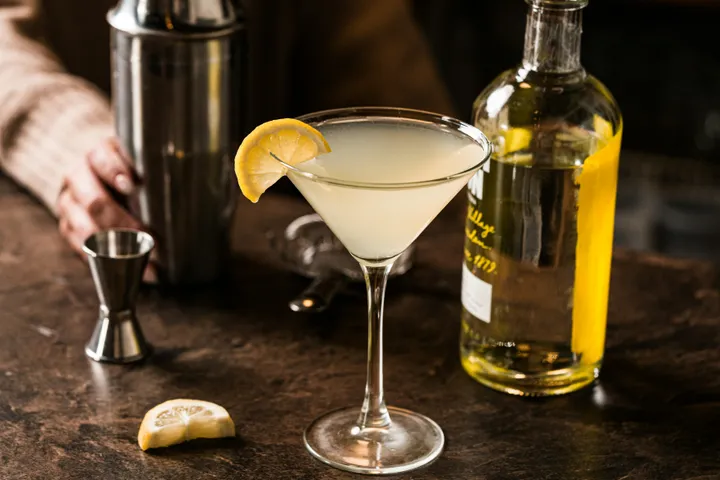
- The classic Savoy version: 1 oz London dry gin, 0.5 oz fresh lemon juice, 0.5 oz simple syrup (1:1), 3 oz Champagne. Shake the first three with ice, strain into a chilled coupe or flute, top with Champagne. Lemon twist garnish.
- The Morgenthaler version (on the rocks): 1 oz gin, 1 oz lemon juice, 0.5 oz 2:1 simple syrup, 2 oz Champagne. Built and poured over ice in a Collins glass. Higher acid, lower bubble, more sippable.
- The cognac version: Same Savoy ratios with VS or VSOP cognac instead of gin. Softer and oakier; closer to a French 125.
- What to buy: Tanqueray, Beefeater, or Bombay Sapphire for the gin (botanical-forward London Dry that stands up to bubbly). A non-vintage Brut Cava, Prosecco, or grower Champagne in the $15-30 range. Skip the $9 bottle and skip the $80 bottle; both are wrong for cocktails.
- For a party: the pitcher version below scales the gin/lemon/syrup base to 12 drinks per 750ml bottle of bubbly. Pre-mix the base; add Champagne at service.
- Glassware: a coupe for stability and volume, a champagne flute for tradition, a Collins glass for the Morgenthaler version.
What is a French 75
A French 75 is a cocktail in the sour family with sparkling wine added. The skeleton is: spirit + lemon + sweetener + bubbles. Take a Tom Collins, swap the soda water for Champagne, and you have something close to the original drink.
The name comes from the French 75mm field gun (officially the Canon de 75 modèle 1897), which the French army deployed in massive numbers during WWI. The gun was famous for its rapid fire (15-30 rounds per minute) and was credited with giving the French and Allied armies a decisive artillery advantage. American soldiers stationed in Paris during and after the war drank a lot of Champagne and a lot of gin, and at some point a bartender named the bracing combination of both after the gun. The exact bartender is contested. The most credible candidate is Harry MacElhone, who tended bar at Buck’s Club in London during the war and later opened Harry’s New York Bar in Paris, where the drink became a fixture.
The cocktail first appears in print in MacElhone’s 1919 ABC of Mixing Drinks and again in Harry Craddock’s 1930 Savoy Cocktail Book. Both early recipes use gin. The popular claim that the original used cognac, often cited as fact, is largely traced to David Embury’s 1948 The Fine Art of Mixing Drinks, in which he argued that cognac was the natural spirit of choice in pre-Prohibition France. The published written record starts with gin. Both versions are valid, but the cognac-was-first narrative is more legend than documented history.
The drink became a fixture of American cocktail culture during Prohibition, when speakeasies served it at celebrations, and surged again in the 2000s when bartenders revived classic cocktails. Taylor Swift naming it her favorite in interviews (around 2014 onward) gave it a final cultural boost that explains its annual December and February search spikes.
The three French 75s
The most-asked question on the Internet, never fully answered, is which French 75 ratio is correct. The honest answer: it depends on what you want the drink to do. Here’s the comparison.
| Version | Gin / Spirit | Lemon | Syrup | Champagne | Glass | Profile |
|---|---|---|---|---|---|---|
| Classic Savoy | 1 oz gin | 0.5 oz | 0.5 oz (1:1) | 3 oz | Flute or coupe (up) | Bubbly, light, celebratory |
| Morgenthaler (rocks) | 1 oz gin | 1 oz | 0.5 oz (2:1) | 2 oz | Collins glass over ice | Sippable, sour-forward, less bubbly |
| Cognac / French 125 | 1 oz cognac | 0.5 oz | 0.5 oz (1:1) | 3 oz | Flute or coupe (up) | Soft, oaky, richer |
The Savoy is what you want at a dinner party or celebration: high carbonation, low alcohol per ounce of finished drink, easy to drink in 10 minutes. The Morgenthaler is what you want at a slower-paced cocktail hour: more concentrated, the carbonation lasts longer over ice, and the cocktail rewards 30 minutes of sipping. The cognac version is what you want at a holiday dinner: the oak in the cognac complements rich food in a way gin doesn’t.
If you’re making one French 75 for yourself or one for a guest, do the Savoy. If you’re making your own at home for a quiet evening, try Morgenthaler’s. If it’s Christmas or a winter dinner party, consider cognac.
The classic French 75 (Savoy style)
The standard recipe. What 95% of cocktail bars pour when you order a French 75.
Ingredients (one drink):
- 1 oz London dry gin (Tanqueray, Beefeater, or Bombay Sapphire)
- 0.5 oz fresh lemon juice (always fresh)
- 0.5 oz simple syrup (1:1 sugar to water by volume)
- 3 oz Champagne, Cava, or dry Prosecco
- Lemon twist for garnish
Method:
- Chill a coupe glass or Champagne flute in the freezer for 10 minutes. (Skip this if you’re in a rush, but the cocktail is noticeably better in a cold glass.)
- Combine the gin, lemon juice, and simple syrup in a cocktail shaker with ice. Do NOT add the Champagne yet.
- Shake hard for 10-12 seconds, until the shaker is frosty.
- Strain into the chilled glass.
- Top with chilled Champagne. Pour slowly to preserve carbonation.
- Express a strip of lemon peel over the surface (squeeze the peel skin-side-down so the citrus oils spritz across the drink), and drop the twist in.
Glass: Coupe (more stable, wider rim, easier to drink fast) or champagne flute (taller, traditional, preserves carbonation slightly longer). Both are correct.
Why the ratios work: The 1 oz gin + 0.5 oz lemon + 0.5 oz syrup is the classic sour ratio scaled small, designed to leave room for the 3 oz Champagne pour. The shaker integrates the spirit, citrus, and sugar; the Champagne brings everything together. Don’t shake the Champagne; you’ll flatten it.
Critical: chill the Champagne hard. Lukewarm Champagne foams violently when added to a cold cocktail. Bottle should be at refrigerator temperature minimum (35-40°F) before pouring. Better: ice bucket for 20 minutes before service.
The Morgenthaler French 75 (rocks version)
Bartender Jeffrey Morgenthaler’s contrarian position: the original 1919 recipe was effectively a Tom Collins with Champagne substituted for soda, so the drink should be served on the rocks in a Collins glass, not up in a flute. He has a point. The version below is excellent and tastes different from the Savoy.
Ingredients (one drink):
- 1 oz London dry gin
- 1 oz fresh lemon juice (double the Savoy)
- 0.5 oz 2:1 simple syrup (2 parts sugar to 1 part water by volume; more concentrated than 1:1)
- 2 oz Champagne or sparkling wine (less than the Savoy)
- Lemon peel for garnish
Method:
- Combine gin, lemon juice, simple syrup, AND Champagne in a cocktail shaker with ice. (Yes, Champagne goes in the shaker. This is the controversial part.)
- Shake briefly, just to combine. Don’t shake hard or long; you’re not trying to chill more, you’re trying to integrate.
- Pour everything into a Collins glass (highball-style) filled with fresh ice.
- Express a lemon peel over the surface and drop in.
Glass: A tall Collins glass or a highball glass. Filled with ice.
Why the ratios are different: More lemon and a more concentrated 2:1 syrup means the cocktail has more flavor density per ounce. Less Champagne means less dilution from ice melt. The drink is sour-forward and slightly less bubbly than the Savoy, but it stays interesting for a longer pour. Excellent for slow sipping or a longer cocktail hour.
On putting Champagne in the shaker: The argument is that brief shaking with Champagne distributes the carbonation evenly through the drink rather than concentrating it on top. The drink loses some fizz; what’s left is integrated. Most modern bartenders find this acceptable for the Tom Collins-style format because the drink isn’t meant to be sparkling-forward.
The cognac French 75
The contested “original” version. Whether or not it predates the gin version (the published record suggests not), it’s a different and excellent cocktail.
Ingredients (one drink):
- 1 oz VS or VSOP cognac (Hennessy VS or Pierre Ferrand 1840 if you want something more interesting)
- 0.5 oz fresh lemon juice
- 0.5 oz simple syrup (1:1)
- 3 oz Champagne or sparkling wine
- Orange peel for garnish (the orange complements the cognac better than lemon)
Method: Same as the classic Savoy. Shake the first three with ice, strain into a chilled coupe or flute, top with Champagne.
Why cognac works differently: Cognac brings vanilla, oak, and caramel notes that gin’s juniper doesn’t have. The drink is softer, rounder, and reads as more “elegant” in the holiday-dinner sense. The orange peel garnish (instead of lemon) pulls the cognac character forward; lemon peel works too if you only have lemons.
When to use this version: Winter dinner parties, holidays, with rich food. The gin version pairs with light food (salads, seafood, brunch); the cognac version stands up to roast lamb, prime rib, or holiday goose. Some bartenders call this the French 125 specifically to distinguish it from the gin version, though both names get used interchangeably.
What gin to buy
The most-confused part of French 75 recipes online. Two of the top-ranking guides recommend different gins, and one explicitly says the other’s pick is wrong. Here’s what’s going on.
A French 75 has a lot of acidic lemon, sweet syrup, and effervescent Champagne. All three of those compete with the gin’s botanical character. You need a gin that asserts itself through the citrus and bubble. Delicate floral gins (Hendrick’s, Aviation, Empress) get lost.
Best gins for a French 75 (London Dry style, $25-30):
- Tanqueray ($25). The bartender default. Classic juniper-forward London Dry. Cuts through citrus and bubbles cleanly.
- Beefeater ($25). Slightly more peppery than Tanqueray. Excellent value.
- Bombay Sapphire ($28). Smoother, more botanical complexity. Slightly more expensive than Tanqueray but worth it in cleaner cocktails.
Splurge-worthy alternatives ($35-50):
- Sipsmith London Dry ($40). British, slightly fuller-bodied, the rare premium gin that doesn’t disappear in a cocktail.
- The Botanist ($40). Scottish, 22 botanicals, more complex than Tanqueray. Stands up to citrus.
- Plymouth Gin ($30). Slightly sweeter and softer than London Dry. Bridges to the cognac version’s profile.
What to skip:
- Hendrick’s ($35). Beautiful in a martini, lost in a French 75. The cucumber-and-rose profile gets buried by the lemon. Save it for the gin and tonic.
- Aviation, Empress 1908, Roku. All delicate, floral, designed to be the lead instrument in a cocktail. The French 75 has too many competing flavors for them to show.
- Flavored gins (cucumber gin, strawberry gin, citrus gin). The lemon and Champagne already contribute flavor; flavored gin makes the drink muddled.
What champagne (or sparkling wine) to buy
The single biggest cost lever in this cocktail. People reach for Champagne (capital C, from the Champagne region of France) because the cocktail’s name suggests it. You don’t need it.
The Champagne / sparkling wine in a French 75 is a structural ingredient. Its job is to add carbonation, acidity, and a small amount of alcohol. The gin and lemon do almost all the flavor work. Buying a $90 bottle of Veuve Clicquot for cocktails is like buying a $90 bottle of olive oil to dress a salad: the quality doesn’t translate proportionally.
For everyday French 75s ($12-20):
- Freixenet Cordon Negro Brut Cava ($12-14). Spanish, made by the traditional Champagne method, dry. The bartender’s pour for any sparkling cocktail.
- La Marca Prosecco ($16). Italian, slightly fruitier than Cava, widely available. Slightly sweeter (which can work in a French 75).
- Bisol Crede Prosecco DOCG ($22). Quality step up from La Marca; tighter bubble, drier finish.
For dinner-party French 75s ($20-35):
- Roederer Estate Brut ($25). California sparkling, made in the Champagne method by the same family that makes Cristal. Excellent quality-to-price.
- Schramsberg Mirabelle Brut ($28). California, traditional method, complex enough to actually drink straight too.
- Gruet Brut ($18). New Mexico, surprisingly good for the price.
Champagne-specifically ($40+):
- Pol Roger Brut Reserve NV ($55). The bartender’s choice when “real” Champagne is required.
- Billecart-Salmon Brut Réserve NV ($55). Lighter, more delicate. Works in a French 75 because it doesn’t fight the gin.
- Grower Champagne (small producer Champagnes; varies by importer). Often $35-50 and dramatically more interesting than the big houses. Ask your wine shop.
What to skip:
- Anything under $10. The cheap sparkling wine headache is real. The sulfite levels and sugar content of sub-$10 bottles will catch up to you.
- Sweet sparkling wines (sweet Prosecco, Asti Spumante, demi-sec Champagne). Already-sweetened bubbly turns the cocktail cloying when you add simple syrup.
- Cristal, Dom Pérignon, Krug, vintage Champagnes. Save the $200+ bottle for sipping. Genuinely wasted in a mixed drink.
Flute vs coupe vs rocks
The glassware question that almost every top-ranking recipe dodges. Three legitimate choices, each with reasons.
Flute (champagne flute). The traditional choice. The tall narrow shape preserves carbonation longer (less surface area for bubbles to escape). Looks formal and reads as celebratory. The downside: flutes hold only about 6 oz comfortably, which is exactly the volume of a French 75, so there’s no headroom for stirring or for the foam that forms when you pour. Tip when poured incorrectly. Best for: formal dinners, weddings, NYE, when “celebratory” is the point.
Coupe (coupe glass). The modern preferred choice. The wide bowl is more stable on a tray or counter, holds 7-9 oz comfortably (room for ice melt and pour), and has the elegant vintage profile bartenders prefer. The trade-off: bigger surface area means carbonation dissipates slightly faster. For a French 75 drunk in 15 minutes, this doesn’t matter. Best for: dinner parties, cocktail hour, any time you want to actually see and drink the cocktail rather than perform it.
Rocks / Collins glass. Only for the Morgenthaler version. The whole point is the cocktail is served over ice, which means a flute or coupe makes no sense. Use a Collins glass (8-12 oz, tall and narrow) or a highball glass for the same effect. Best for: slow sipping, cocktail hours that run long, summer service when “elegant” matters less than refreshing.
Recommendation for hosting: Coupes. They’re more stable, more forgiving, and look more intentional on a table. Flutes are visually iconic but functionally fussy. For more on glassware as a category, see champagne flutes and coupe glasses.
The pitcher version (serves 12)
The biggest gap in every other French 75 recipe online: nobody gives you the scaled measurements for a party. Here they are.
For 12 servings (one 750ml bottle of sparkling wine + scaled base):
- 12 oz London dry gin (just under half a 750ml bottle)
- 6 oz fresh lemon juice (about 6 lemons)
- 6 oz simple syrup (1:1)
- 1 750ml bottle of Champagne / Cava / Prosecco (about 25 oz, divided across 12 drinks)
- 12 lemon twists for garnish
Method:
- Up to 6 hours ahead: Combine the gin, lemon juice, and simple syrup in a large pitcher. Stir to integrate. Refrigerate.
- 30 minutes before service: Take the pitcher out. Place 12 coupe glasses in the freezer if you have space, otherwise just on the counter. Slice 12 lemon twists.
- At service: Working one drink at a time, pour about 2 oz of the gin-lemon-syrup base into each glass. Top each with about 2 oz of chilled Champagne (the bottle yields 12 pours of 2 oz each). Lemon twist garnish. Serve immediately.
Critical: Do NOT add the Champagne to the pitcher. Once Champagne is in a pitcher, it goes flat in 15-20 minutes. The gin-lemon-syrup base can sit refrigerated for up to a day. The Champagne gets added per-glass at the last possible moment.
For larger parties: scale the gin-lemon-syrup base proportionally. A second 750ml bottle of bubbly adds 12 more drinks. So a 24-guest party needs 2 bottles of sparkling + double the base. Round up; running out of cocktails is worse than having leftover Champagne.
Pre-party timeline
For a dinner of 8 with French 75s as the welcome drink:
- Morning of the party: Shop. Juice the lemons (one large or two small lemons per 4 oz of juice). Make simple syrup if you don’t have any (1 cup sugar + 1 cup water, simmered 2 minutes; lasts a month refrigerated). Chill the Champagne.
- 3 hours before: Combine gin, lemon juice, and simple syrup in a pitcher. Refrigerate.
- 1 hour before: Place coupes in the freezer if space allows. Slice lemon twists. Verify Champagne is cold enough.
- 15 minutes before guests: Set up the bar station. Pitcher of base on counter. Champagne in ice bucket. Coupes on a tray. Cutting board with extra lemons in case anyone wants additional garnish.
- At service: Pour base + top with Champagne + garnish, one drink at a time. The whole process for 8 drinks takes 4-5 minutes.
Variations
French 76 (vodka)
Same recipe as the classic Savoy French 75, but with vodka instead of gin. The result is cleaner, more spirit-neutral, and slightly less interesting (the gin’s botanical complexity is what gives the French 75 its character; vodka has none). Useful for guests who don’t like gin.
Ratios: 1 oz vodka, 0.5 oz lemon juice, 0.5 oz simple syrup, 3 oz Champagne. Lemon twist garnish.
French 77 (elderflower)
The most popular variation. Adding elderflower liqueur (St-Germain) to the classic French 75 creates a more floral, slightly sweeter drink.
Ratios: 1 oz gin, 0.5 oz fresh lemon juice, 0.5 oz St-Germain elderflower liqueur, 0.5 oz simple syrup (some bartenders skip the syrup since the elderflower brings sweetness), 3 oz Champagne. Lemon twist garnish.
When to use: Spring and early summer events, brunches, Mother’s Day, when “elegant” is the goal.
Lavender French 75
A modern variation using lavender simple syrup instead of plain. Floral, slightly perfumed, photographs beautifully.
Lavender syrup: Simmer 1 cup sugar + 1 cup water + 2 tablespoons dried culinary lavender for 5 minutes. Strain through a fine mesh sieve. Cool. Use in place of regular simple syrup at the same ratio.
Caution: Lavender can taste like soap if you use too much. Start with 2 tablespoons dried lavender; you can always make a stronger batch next time.
Non-alcoholic French 75
The Champagne carries half the flavor of a French 75, and non-alcoholic sparkling wines (Lyre’s Classico, Pierre Zéro, French Bloom) have improved dramatically in the last three years. For the gin, use a non-alc gin (Lyre’s Dry London Spirit or Ritual Gin Alternative).
Ratios: 1 oz non-alc gin, 0.5 oz fresh lemon juice, 0.5 oz simple syrup, 3 oz non-alc sparkling wine. Built the same way.
For more on the non-alc category: non-alcoholic spirits: what to buy and what’s overhyped.
Food pairings
The French 75 pairs more flexibly than most cocktails because its three flavor anchors (gin, lemon, bubble) work with both savory and sweet.
Best food pairings:
- Brunch: smoked salmon and capers, eggs benedict, quiche, crab cakes, fresh fruit and yogurt
- Light dinners: Caesar salad with anchovies, grilled fish (branzino, snapper, halibut), shellfish (oysters, shrimp, scallops)
- Charcuterie: cured ham, aged manchego, briny olives, fig jam. Avoid heavy washed-rind cheeses; the lemon and bubble will fight the funkier flavors. For more on board planning, see charcuterie board.
- Holiday hors d’oeuvres: smoked salmon canapés, deviled eggs, blinis, gougères
- Dessert: lemon tart, almond cake, fresh berries with mascarpone. Avoid chocolate; the citrus fights cocoa.
Cognac version specifically: richer food works. Roast lamb, prime rib, holiday goose, mushroom dishes. The oak in the cognac complements roasted protein.
What to skip:
- Heavy creamy pastas. The lemon and bubble cut against the cream.
- Spicy food. The carbonation amplifies capsaicin; spicy food + French 75 is rough.
- Chocolate desserts. Citrus and chocolate are an old combination but they don’t actually work well together; the cocktail loses.
What to skip
Bottled lemon juice. Universal cocktail rule, but worth repeating. Bottled lemon juice tastes like preservative and dilution. Fresh-squeezed lemon juice is non-negotiable for any cocktail in the sour family.
Sweet sparkling wines. Sweet Prosecco, Asti Spumante, demi-sec Champagne, and “Moscato d’Asti” all carry too much residual sugar to balance against the simple syrup. The drink reads as cloying. Always use brut or extra-brut.
Delicate floral gins. Hendrick’s, Aviation, Empress, Roku, and similar gins are designed to be the lead flavor in a cocktail. In a French 75, they get buried by lemon and bubbles. Save them for martinis and gin and tonics.
Flavored simple syrups (vanilla, honey, etc.). Plain simple syrup is correct. The exception is the lavender variation; otherwise, complex syrups muddle the drink.
Cristal, Dom Pérignon, or vintage Champagne in cocktails. Save the $200 bottle for sipping. A non-vintage Brut at $25 produces a better cocktail because the carbonation is what matters, and you can’t taste the vintage Champagne’s nuance once it hits lemon and syrup.
Pre-mixing with Champagne in the pitcher. The single most-made mistake. Champagne goes flat in 15-20 minutes once exposed to air. Always add Champagne per-glass, never to the pitcher.
Shaking the Champagne. It explodes the carbonation. Always combine the gin/lemon/syrup in the shaker first, then strain and top.
A shake that’s too long. 10-12 seconds maximum. Over-shaking dilutes the cocktail and leaves you with a watery drink.
A short FAQ
Why is my French 75 flat? Three usual reasons: (1) the Champagne was too warm when poured (room temp bubbles foam violently then collapse); (2) you shook the Champagne by accident; (3) you poured the Champagne first and then dropped the cocktail base on top, which kills carbonation faster than the reverse. Always cold Champagne, always added second, always poured slowly.
Can I use Diet 7-Up or sparkling water in a pinch? You can, but you’re no longer making a French 75; you’re making a gin sour with seltzer. The structural function of Champagne is provided by carbonation + dryness + a small alcohol contribution. Sparkling water gives you the carbonation only. The drink will taste thin and unfinished.
How many French 75s can I make from one 750ml bottle of Champagne? About 12, using a 2 oz Champagne pour per drink. That’s the Savoy ratio. If you go heavier on the bubbly (3 oz, which some sources do), you’ll get about 8 per bottle.
What’s the ABV of a French 75? Around 14-16% finished drink. The cocktail isn’t strong per ounce (about 5 oz of finished drink), but the combination of gin and Champagne means each one has more alcohol than a glass of wine. Pace accordingly.
Should I shake or stir? Shake. The sour family (drinks with citrus and sweetener) always gets shaken to aerate the citrus and integrate the sweetener. Stirring would leave the drink unintegrated. The exception is the cognac variant, where some bartenders prefer to stir; both work.
Is the Champagne brand important? Less than you think. Once Champagne is in a cocktail with lemon, gin, and sugar, you can’t taste the nuances of the wine. A $15 Brut Cava and a $90 Veuve Clicquot will produce nearly identical French 75s. Save the expensive Champagne for sipping or for ceremonial pours (a toast, a wedding); use a quality Cava or Prosecco for cocktails.
Is the gin brand important? Yes, more than the Champagne. The gin is the only flavor anchor in the cocktail that you can actually taste through the bubble and lemon. Tanqueray or Beefeater at $25 makes a noticeably better French 75 than Gordon’s at $15.
The French 75 is one of the cocktails that gets better the more you know about it. The first time you make one, follow the classic Savoy recipe. After that, try Morgenthaler’s version on a slow night. For the holidays, swap in cognac. For brunch, add elderflower. The drink rewards experimentation more than most because the four-ingredient skeleton accepts variation gracefully.
For the broader home-bar build, see bar cart: how to set up a real home bar and cocktail shakers: the type bartenders actually use. For the right glass, see champagne flutes and coupe glasses. For sister recipes, see gin cocktail recipes, paloma cocktail recipe, and lemon drop cocktail recipe. For holiday cocktail menus, see christmas cocktail recipes.