The gimlet has the highest ratio of opinions to ingredients of any three-ingredient cocktail. Gin or vodka. Rose’s or fresh lime. Cordial or simple syrup. 1:1 or 2:0.75:0.75 or 2.5:0.5:0.5. Coupe or rocks. Shaken or stirred. For a drink that requires three things and 30 seconds, the gimlet generates a remarkable amount of argument.
The good news: there’s no single correct gimlet. There’s the Chandler classic (1:1 gin to Rose’s lime cordial, the version Raymond Chandler’s character in The Long Goodbye declares is the only real gimlet). There’s the modern spirit-forward version (2.5 oz gin, 0.5 oz each fresh lime and simple syrup, which is what most American cocktail bars pour today). There’s the balanced sour version (2:0.75:0.75, which follows the “golden ratio” of classic sours). And there’s the French Gimlet (with St-Germain elderflower liqueur, a modern twist).
This guide gives you all four, with the right gin for each, real pitcher math for parties, the fresh-lime-vs-Rose’s debate settled with verified history, and the lime-juice freshness window every recipe online ignores.
TL;DR
- Chandler classic: 1.5 oz gin + 1.5 oz Rose’s Lime Cordial (or homemade lime cordial). Stir or shake. Chilled coupe. The 1953 Long Goodbye recipe.
- Modern spirit-forward: 2.5 oz gin + 0.5 oz fresh lime juice + 0.5 oz simple syrup. Shake. Chilled coupe. What most American bars pour.
- Balanced sour: 2 oz gin + 0.75 oz fresh lime juice + 0.75 oz simple syrup. Shake. Chilled coupe. The tart, balanced classic-sour build.
- French Gimlet: 1.5 oz gin + 0.75 oz fresh lime juice + 0.75 oz St-Germain elderflower liqueur. Shake. Chilled coupe. Floral and slightly sweeter.
- What to buy: Tanqueray ($25), Beefeater ($25), or Plymouth Gin ($30) for the gin. Either Rose’s ($6) for the classic or quality cordials (Liber & Co., Strongwater) for the upgraded version. One lime per drink.
- Glass: chilled coupe glass is standard. A Nick-and-Nora works. Rocks glass with fresh ice for sipping.
- For a party: pre-mix the gin + simple syrup base in a bottle (refrigerated up to a week). Add fresh-squeezed lime juice within 4 hours of service. Shake to order.
What is a gimlet
The gimlet is a three-ingredient gin-and-lime cocktail in the sour family. The two main historical builds are the cordial version (gin plus a sweetened lime cordial, of which Rose’s Lime Cordial is the standard) and the fresh-juice version (gin plus fresh lime juice plus simple syrup or sugar). Both are correct; both have been published recipes for nearly a century.
Wikipedia traces the cocktail’s first printed appearance to 1928, a description of “gin, and a spot of lime” in D. B. Wesson’s I’ll Never Be Cured III. The 1930 Savoy Cocktail Book specifies “one half gin and one half lime juice”, meaning lime cordial, in 1930 context. The most famous literary reference is in Raymond Chandler’s 1953 novel The Long Goodbye, where Philip Marlowe declares: “A real gimlet is half gin and half Rose’s lime juice and nothing else.”
The drink’s origins are contested. Two stories circulate:
The tool theory. A gimlet is a small hand-drilling tool that bores narrow holes. The cocktail name may reference its “penetrating” effect on the drinker. The Online Etymology Dictionary gives this as the most likely derivation.
The Royal Navy surgeon theory. That the cocktail was named for Rear Admiral Sir Thomas Gimlette (1857-1943), a Royal Navy surgeon who allegedly mixed gin with lime juice to encourage his crews to take anti-scurvy citrus rations. This story is the more romantic one and gets repeated widely online. Wikipedia explicitly flags it as apocryphal: the story is not mentioned in Gimlette’s obituary in the BMJ or The Times, nor in his Who Was Who 1941-1950 entry. It’s a great pub-quiz story but probably not how the drink got its name.
What we do know with confidence: the Royal Navy’s lime-juice ration came from the work of Scottish naval surgeon James Lind, who demonstrated in 1753 that citrus fruits cured scurvy. Lauchlan Rose (note the spelling, many recipe sites get this wrong) patented “Rose’s Lime Juice” in 1867. It was the world’s first commercially produced fruit concentrate, preserved with sugar rather than alcohol, which dramatically expanded its market beyond ships. Rose’s became the gimlet’s defining lime ingredient.
The four gimlets
The most common confusion in gimlet recipes is that the ratio changes meaningfully based on whether you’re using Rose’s (concentrated cordial), fresh lime + syrup (two ingredients), or a hybrid. Here’s all four side by side.
| Version | Gin | Sour | Sweet | Garnish | Profile |
|---|---|---|---|---|---|
| Chandler classic | 1.5 oz | 1.5 oz Rose’s cordial (sour + sweet combined) | , | Lime wheel | Sweet, lime-forward, vintage |
| Modern spirit-forward | 2.5 oz | 0.5 oz fresh lime | 0.5 oz simple syrup | Lime wheel | Gin-forward, dry, modern |
| Balanced sour | 2 oz | 0.75 oz fresh lime | 0.75 oz simple syrup | Lime wheel | Tart, balanced, classic-sour |
| French Gimlet | 1.5 oz | 0.75 oz fresh lime | 0.75 oz St-Germain | Lime wheel or twist | Floral, slightly sweeter |
Which to make:
- New to gimlets? Start with the balanced sour (2:0.75:0.75). It’s the gentlest learning curve.
- Want to taste the cocktail the way it appears in The Long Goodbye? Make the Chandler classic with Rose’s.
- Like gin and want it forward? Make the modern spirit-forward version.
- Hosting a brunch or want something floral? Make the French Gimlet with St-Germain.
The Chandler classic (with Rose’s or homemade cordial)
The 1953 version. What every American drinker imagined when they read The Long Goodbye.
Ingredients (one drink):
- 1.5 oz London Dry gin (Tanqueray, Beefeater, or Plymouth)
- 1.5 oz Rose’s Lime Cordial (or homemade lime cordial, see below)
- Lime wheel for garnish
Method:
- Place a coupe glass in the freezer for 5-10 minutes to chill.
- Combine gin and Rose’s in a cocktail shaker with ice.
- Shake hard for 10 seconds. (Chandler’s character implies stirring, and a stirred version works; shaking gives slightly more dilution and a colder drink.)
- Strain into the chilled coupe.
- Garnish with a lime wheel on the rim.
Glass: Chilled coupe glass, the traditional vessel. A Nick-and-Nora works equally well.
Why this ratio: Rose’s is a concentrated cordial that combines lime juice with sugar in a single ingredient. At 1:1 with gin, the drink is sweet and lime-forward, closer to a punch than to a modern sour. This is the historical canon and what Chandler’s Philip Marlowe orders.
The homemade cordial upgrade. Rose’s is a fine ingredient but uses high-fructose corn syrup and artificial color. If you make gimlets often, a homemade cordial is dramatically better. The simplest version: combine 1 cup sugar, 1 cup water, the zest of 4 limes, and 4 oz fresh lime juice in a saucepan. Simmer until sugar dissolves (about 3 minutes). Cool, strain, refrigerate in a clean bottle. Lasts 2 weeks. Use at the same 1:1 ratio with gin.
The modern spirit-forward gimlet
The version most American cocktail bars pour today. Gin-forward, less sweet, more like a stiff Martini cousin than a sour.
Ingredients (one drink):
- 2.5 oz London Dry gin
- 0.5 oz fresh lime juice
- 0.5 oz simple syrup (1:1 sugar:water by volume)
- Lime wheel for garnish
Method:
- Chill a coupe glass.
- Combine gin, lime juice, and simple syrup in a shaker with ice.
- Shake hard for 10-12 seconds.
- Strain into the chilled coupe.
- Garnish with a lime wheel.
Why this ratio: the 5:1:1 ratio (gin to lime to syrup) lets the gin lead. The lime brightens the cocktail; the syrup softens the lime’s tartness. You taste the gin’s botanicals (juniper, coriander, citrus peel) clearly, which is the point of using a London Dry. The drink reads as bracing and adult, more like a wet martini with a lime cheek than a tropical sour.
When to use: when you want the cocktail to feel spirit-forward, when you have a particularly good gin worth showcasing, or when serving alongside savory food where you don’t want the cocktail to read as dessert.
The balanced-sour gimlet
The “golden ratio” sour build. Tart, balanced, the friendliest for new drinkers.
Ingredients (one drink):
- 2 oz London Dry gin
- 0.75 oz fresh lime juice
- 0.75 oz simple syrup
- Lime wheel for garnish
Method: identical to the modern spirit-forward version. Shake, strain, garnish.
Why this ratio: the 2:0.75:0.75 ratio (8:3:3) is the canonical sour template, the same proportions used in a Whiskey Sour, Daiquiri, or Margarita scaled to a single drink. The gin, lime, and sweetness all read in roughly equal measure. The cocktail tastes “balanced” in the technical sense: no single ingredient dominates.
When to use: when serving to drinkers who don’t usually drink gin (more lime cushions the juniper); when you want a more refreshing summer-leaning version; when you’re making a batch for guests and want a build that pleases the median palate.
The French Gimlet (with St-Germain)
A modern twist. Replaces the simple syrup with St-Germain elderflower liqueur, which brings floral character and slightly more sweetness.
Ingredients (one drink):
- 1.5 oz London Dry gin
- 0.75 oz fresh lime juice
- 0.75 oz St-Germain elderflower liqueur
- Lime wheel or thin lime twist for garnish
Method: shake all three with ice, strain into a chilled coupe, garnish.
Why this version: elderflower’s floral, slightly muscat-like character pairs beautifully with juniper-forward gin. The result is a cocktail that reads as elegant and slightly sweet, works well at brunches, garden parties, and as a welcome drink for guests who don’t usually drink cocktails. For more on brunch hosting, see mother’s day brunch ideas.
Buying St-Germain: the standard bottle is around $35 for 750ml. It lasts months once opened (refrigerate after opening to preserve aromatics). The same bottle works in French 75 variations and Hugo Spritzes.
What gin to buy
For all four gimlet versions, you want London Dry style, juniper-forward, with citrus and coriander notes that play against the lime. Floral or savory gins (Hendrick’s, The Botanist) work but produce a different drink; the cocktail loses some of its sharp definition.
Budget ($20-30), the workhorse:
- Tanqueray London Dry ($25). The bartender’s default. Juniper-forward, crisp, slightly peppery.
- Beefeater London Dry ($25). Slightly softer than Tanqueray, more citrus-forward. Excellent value.
- Bombay Sapphire ($28). Smoother and more botanical, mid-range richness. Good in any of the four gimlet versions.
Mid-tier ($30-45), for sipping or special-occasion gimlets:
- Plymouth Gin ($30). Slightly sweeter and softer than London Dry, slightly earthier. Excellent in the Chandler classic.
- Sipsmith London Dry ($40). British, full-bodied, holds its character against fresh lime.
- Tanqueray No. Ten ($40). Higher-end Tanqueray with brighter citrus. Worth it in the spirit-forward version.
What to skip:
- Navy-strength gins (57%+ ABV), they overwhelm the lime and produce a harsh drink. Save for Negronis.
- Heavily floral gins (Hendrick’s, Aviation, The Botanist), they work but produce a different cocktail; the gimlet’s structural clarity gets blurred.
- Flavored “gin liqueurs” (sloe gin, fruit-infused gins), too sweet for the gimlet’s already-sweetened profile.
Rose’s vs fresh lime vs homemade cordial
The single most-debated question in gimlet making. There’s no wrong answer, but the three options taste meaningfully different.
Rose’s Lime Cordial:
- The historical canon (1867 onward)
- Sweetened, slightly artificial color, uses high-fructose corn syrup
- $6-8 per bottle, lasts months refrigerated
- Use at 1:1 with gin (the Chandler classic ratio)
- Tastes like: lime candy, vintage, slightly old-fashioned
- Best for: when you want the cocktail to taste like its 1953 self
Fresh lime juice + simple syrup (two separate ingredients):
- The modern craft-cocktail revival approach (1990s onward)
- Brighter, sharper, more lime-tart
- Requires squeezing limes (one lime yields about 1 oz of juice)
- Use at 0.5 oz lime + 0.5 oz syrup for spirit-forward, or 0.75 oz each for balanced sour
- Tastes like: a proper sour, bright and modern
- Best for: when you want the cocktail to feel current and tart
Homemade lime cordial:
- The upgrade option, takes 15 minutes to make
- Combine 1 cup sugar + 1 cup water + zest of 4 limes + 4 oz fresh lime juice, simmer 3 minutes, cool, strain. Lasts 2 weeks refrigerated.
- Use at 1:1 with gin (same as Rose’s)
- Tastes like: Rose’s, but with real lime instead of artificial flavoring
- Best for: when you make gimlets weekly and want the best version
Specialty cordials worth buying instead of homemade:
- Liber & Co. Real Lime Cordial ($16), small-batch, real ingredients, available online
- Strongwater Lime Cordial ($20), botanical-leaning, premium
- Tippleman’s Lime Cordial ($18), bartender-favored
Glassware
The gimlet is traditionally served “up” (chilled, no ice) in a stemmed glass. The four options:
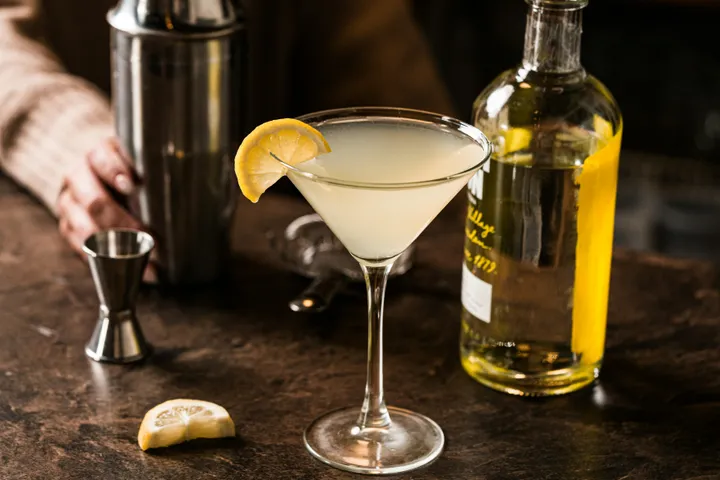
Coupe (the standard). A 6-8 oz coupe glass, chilled. The traditional gimlet glass, used in vintage and modern bars alike. The wide bowl shows off the cocktail’s clarity, and the stem keeps your hand from warming it.
Nick-and-Nora. A 5-6 oz stemmed glass with a tulip shape. Slightly more elegant than a coupe; preserves aromatics slightly better. Named for the Nick and Nora Charles characters in The Thin Man films (1934-1947). If you have these, use them.
Cocktail glass (martini-style). A V-shaped martini glass. Larger than a coupe, holds more easily, more dramatic visually. Slightly fussier to drink from. Acceptable but not preferred.
Rocks glass with fresh ice. Some drinkers prefer the gimlet on the rocks, colder, longer-lasting, less spirit-forward feel. Use a chilled rocks glass, fresh ice, garnish with a lime wedge. This is the casual-summer version.
Mason jar fallback. No proper glasses? A pint mason jar works. Chill in the freezer first; serve the cocktail in the jar without ice. The cocktail won’t look as elegant but tastes the same.
Batching a gimlet for a party
The gimlet is one of the easiest cocktails to batch because the ratios scale cleanly. The trick is timing: fresh lime juice oxidizes within hours, so you can’t pre-mix the whole drink the day before. Here’s how to scale it properly.
For 8 servings (balanced sour ratio, the most party-friendly):
- 16 oz gin
- 6 oz fresh lime juice (about 6-8 limes)
- 6 oz simple syrup
- 8 lime wheels for garnish
- Plenty of ice
Method:
- Up to 1 week ahead: combine the gin and simple syrup in a clean bottle. Refrigerate. (Without lime juice, this base stays good indefinitely.)
- Within 4 hours of service: juice the limes. Strain the juice. Add to the gin-syrup base. Stir to combine. Refrigerate.
- 30 minutes before guests arrive: place 8 coupe glasses in the freezer. Slice 8 lime wheels.
- At service, per round of drinks: pour 2.5-3 oz of the pre-mixed gimlet base into a shaker with ice. Shake 10 seconds. Strain into a chilled coupe. Garnish with a lime wheel. Repeat for each glass.
Per-drink service time after the first round: about 60 seconds.
Critical: the 4-hour lime juice window. Fresh-squeezed lime juice loses its bright, sharp character within 4-6 hours. It starts to taste flat, oxidized, and slightly bitter. For a party, juice your limes no more than 4 hours before service. If you squeeze them at noon for a 7pm dinner, the cocktails will taste worse than store-bought lime cordial.
Why batching works for the gimlet specifically: the cocktail has no shaken egg white, no carbonation, no muddled herbs. It’s three ingredients that mix together cleanly. The only volatile component is the lime juice, which is why we add it within 4 hours.
Pre-party timeline
For a dinner of 6-8 with gimlets as the welcome drink:
- Day before: make simple syrup (1 cup sugar + 1 cup water, simmered 2 minutes; refrigerated, lasts a month). Combine gin and simple syrup in a bottle if pre-batching.
- Day of, morning: buy fresh limes (one per drink, plus 2-3 extra). Wash and dry them.
- 4 hours before service: juice the limes. Strain. Add to the gin-syrup base (if pre-batching) or store in a covered jar in the refrigerator (if batching just before service).
- 1 hour before guests: chill the coupe glasses in the freezer. Slice lime wheels (one per glass plus 2 extras).
- 15 minutes before service: set up the bar station: pre-batched base, cocktail shaker, jigger, lime wheels, ice.
- As guests arrive: shake and pour gimlets one at a time. Each takes 60 seconds.
Common gimlet mistakes
These are the six errors that turn a gimlet from great to mediocre, in order of frequency.
1. Using bottled lime juice. Bottled lime juice (the green plastic squeeze bottles, or even glass bottled juice) tastes metallic and flat. Always fresh-squeezed. A single lime makes 1 oz of juice, enough for one cocktail.
2. Over-shaking. 10-12 seconds is the right shake time for a gimlet. Past 15 seconds, the ice over-dilutes the drink and you lose the gin’s character. Past 20 seconds, the cocktail is watery. Time it.
3. Using navy-strength gin (57%+ ABV). Gins like Plymouth Navy Strength, Sipsmith VJOP, or Hayman’s Royal Dock work in Negronis and Aviations where the higher proof carries vermouth and bitters. In a delicate three-ingredient gimlet, they overwhelm the lime and produce a harsh drink. Stick to 40-47% ABV.
4. Skipping the chilled glass. A room-temperature coupe warms a freshly-shaken cocktail by 4-6°F in 90 seconds. The cocktail loses its crispness. Chill the glass 5-10 minutes in the freezer (or fill with ice and water for 2 minutes, then empty) before pouring.
5. Using Rose’s at the modern fresh-lime ratio. Rose’s is concentrated. Using 0.5 oz Rose’s where the recipe calls for 0.5 oz fresh lime + 0.5 oz simple syrup produces a thin, weakly-flavored drink. Use Rose’s at 1:1 with gin, not as a 1:1 substitute for fresh lime in modern recipes.
6. Cutting the garnish after juicing. Reserve a lime slice before juicing the rest of the lime. A juiced lime half makes a sad pulpy garnish. This is a small thing that makes the drink look much more intentional.
Variations
Vodka Gimlet
Replace the gin with vodka at the same volume. Everything else stays the same. The vodka gimlet is cleaner and lime-forward (vodka contributes no flavor of its own), more accessible to non-gin drinkers. Use the modern spirit-forward ratio (2.5 oz vodka + 0.5 oz lime + 0.5 oz simple syrup) for the best result.
Vodka picks: Tito’s ($25), Stoli ($22), or Reyka ($28). For more vodka cocktails see vodka cocktail recipes.
Cucumber Gimlet
Add 3 thin cucumber slices to the shaker before adding the other ingredients. Muddle gently with the gin (don’t pulverize). Add lime juice, simple syrup, and ice. Shake harder than usual (12-15 seconds). Double-strain through a fine mesh sieve to catch the cucumber pulp. Garnish with a cucumber ribbon.
The cucumber adds a vegetal freshness that pairs especially well with Hendrick’s (which is cucumber-led) or The Botanist (Scottish, herbal). Excellent in summer.
Basil Gimlet
Same idea as the cucumber gimlet but with 4-6 fresh basil leaves. Slap the basil between your hands before adding to the shaker (to release the aromatic oils) but don’t muddle hard. Shake briefly, double-strain. Garnish with a fresh basil leaf.
The basil adds herbal sweetness without bitterness. Use the balanced sour ratio (2:0.75:0.75). Italian-leaning dinners benefit.
Non-alcoholic gimlet
The gimlet is one of the easier classics to translate to non-alc because the lime and sweetener carry most of the flavor. Use 2.5 oz Lyre’s Dry London Spirit ($36) or Seedlip Garden 108 ($32) at the same modern spirit-forward ratio. The Seedlip version is slightly more vegetal; Lyre’s is closer to a London Dry profile.
For more on the non-alc category, see non-alcoholic spirits: what to buy and what’s overhyped.
Food pairings
The gimlet’s bright acidity and gin’s botanical profile pair specifically well with:
Best pairings:
- Oysters and briny seafood. The classic gin-and-lime combination has been served alongside raw bar items for over a century. Both lean acidic; both pair clean.
- Citrus-dressed salads (Caesar with anchovies, watercress with citrus vinaigrette).
- Sushi. Especially nigiri and sashimi. Gin’s juniper plays surprisingly well with rice vinegar.
- Soft cheeses with herbs, fresh goat cheese with herbs, mascarpone, fresh ricotta. For broader board planning see charcuterie board.
- Pre-dinner aperitif. The gimlet’s relatively low ABV (compared to a Martini) makes it a session-friendly opener.
French Gimlet specifically:
- Brunch foods (eggs benedict, smoked salmon, fresh fruit)
- Light spring vegetables (asparagus, peas, fennel)
- Mother’s Day, Easter brunch, garden parties
What to skip:
- Heavy red meat or smoked proteins, too rich for the gimlet’s bright weight; use a Manhattan or Negroni
- Spicy food, the lime amplifies chili heat in a way that gets unpleasant fast
- Cream-based pastas or risottos, the lime fights cream
What to skip
Bottled lime juice. The single biggest mistake. Fresh-squeezed lime juice is non-negotiable. A 30-cent lime makes a $14 cocktail; bottled lime juice ruins the drink and the cost savings are trivial.
Sweet flavored vodkas (citron, vanilla, etc.). The cocktail already has lime and sweetener built in; flavored vodka muddles the profile.
Heavily floral or savory gins. Hendrick’s, Aviation, Empress 1908, and The Botanist all produce a different cocktail, not necessarily a bad one, but not the classic gimlet. Save them for gin and tonics.
Pre-mixed gimlet shots from a bottle. The mass-market bottled “gimlet” cocktails contain artificial flavors and corn syrup. A homemade gimlet takes 60 seconds; there’s no reason to compromise.
Garnishing with a lemon wheel. The gimlet is lime, not lemon. Lemon garnish on a gimlet is a Manhattan-shaped misunderstanding.
Adding ice to the served drink (when serving “up”). The gimlet is shaken with ice and then strained into a chilled glass. Ice in the served glass continues diluting and changes the cocktail as you sip. (The rocks variation is fine; that’s a different drink.)
Skipping the chilled glass. A warm coupe ruins a properly-shaken gimlet in 90 seconds. Always chill.
A short FAQ
How many gimlets can I make from a bottle of gin? A 750ml bottle yields about 10-12 gimlets at the spirit-forward 2.5 oz ratio, or 12-14 at the 2 oz balanced ratio. Plan one per guest plus a refill or two for a 2-hour party.
Can I use lime cordial in the modern fresh-lime recipes? You can, but you need to adjust. Lime cordial is sweeter and more concentrated than fresh lime + simple syrup combined. If substituting Rose’s for a modern recipe that calls for 0.5 oz fresh lime + 0.5 oz syrup, use about 0.75 oz Rose’s and skip both other ingredients.
Why does my gimlet taste flat? Two usual causes: (1) you used bottled lime juice (replace with fresh); (2) you under-shook it (10-12 seconds is the minimum). Less common: your gin is past its prime (an open bottle should last 1+ years, but if it’s been on a sunny shelf, the botanicals fade).
What’s the ABV of a gimlet? About 22-26% in the finished drink. The 2.5 oz of 40% gin + 1 oz of sweetened lime + dilution from shaking lands around 24%. Lower than a Manhattan (30%); higher than a French 75 (15%). Sippable but not a session drink, pace accordingly.
Is it shaken or stirred? Either works, but shaken is the modern default for the fresh-lime versions (the sour template wants aeration). The Chandler classic with Rose’s can be either, Chandler’s character orders his “stirred,” but most bars shake. Choose what you like; shaken is slightly more vigorous and colder.
What’s the smallest amount of fresh lime juice I can buy? One large lime makes 1 oz of juice. For one gimlet at the spirit-forward ratio, half a lime is enough. For the balanced-sour ratio, three-quarters of a lime. Buy 2 limes per drink to be safe; the extras keep refrigerated for 2 weeks.
The gimlet rewards drinkers who understand which version they want. The Chandler classic for vintage character. The modern spirit-forward for gin-forward elegance. The balanced sour for the easiest crowd-pleaser. The French Gimlet for brunch and floral occasions. Knowing which to make for which guest is the host-level skill the recipe alone doesn’t teach.
For the broader home bar build, see bar cart: how to set up a real home bar and cocktail shakers: the type bartenders actually use. For the right glass, see coupe glasses and martini glasses. For sibling spirit pillars: gin cocktail recipes, vodka cocktail recipes, and bourbon cocktail recipes. For sister single-cocktail recipes: sazerac cocktail recipe, french 75 cocktail recipe, paloma cocktail recipe, and lemon drop cocktail recipe. For brunch-context hosting, mother’s day brunch ideas.